Amaluna – Review

CIRQUE DU SOLEIL’S AMALUNA under the Big Top in Calgary until May 19th
Listen to my review of Amaluna on CBC Eyeopener on April 11, 2013
http://www.cbc.ca/eyeopener/columnists/theatre/2013/04/11/jessica-goldman-reviews-amaluna-1/
CIRQUE DU SOLEIL’S AMALUNA under the Big Top in Calgary until May 19th
Listen to my review of Amaluna on CBC Eyeopener on April 11, 2013
http://www.cbc.ca/eyeopener/columnists/theatre/2013/04/11/jessica-goldman-reviews-amaluna-1/
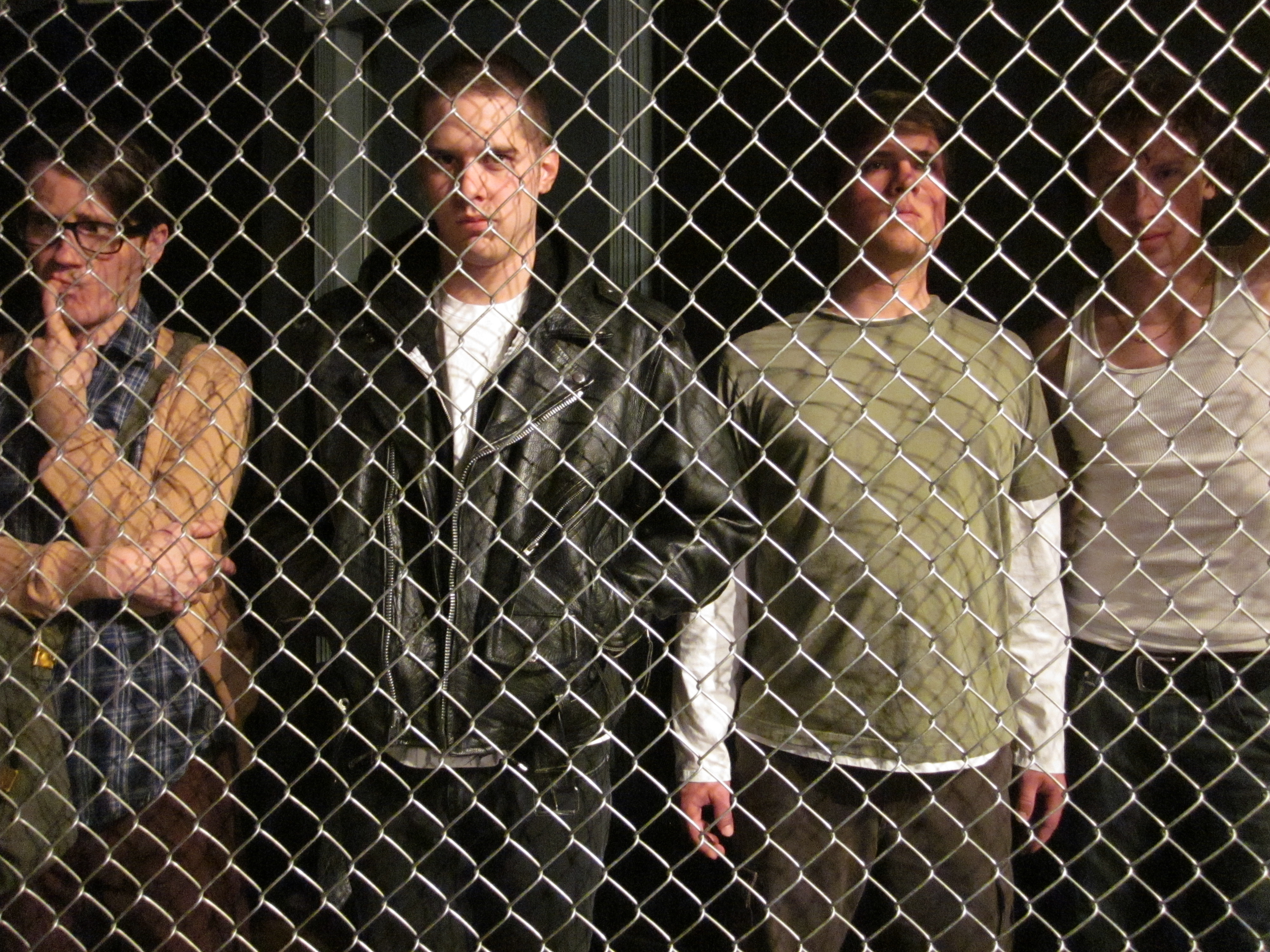
From l to r: Beau Barker, Josh Symonds, Brendan Andrews and Andrew McKenzie. Photo by Amy Dettling.
War
March 27 to April 6, 2013
EPCOR Motel
The issue at play in Theatre BSMT’s production of Dennis Foon’s clunky and ridiculously contrived War is the genesis and outcome of violence in male teenagers. Told through the intersecting stories of four boys, the play attempts to take the shine off the fierce aggression sold to young men as glamorous, successful modes of being. Hockey obsessed Brad (Andrew McKenzie) has been groomed to be a goon on the ice since he was young and that mindset has more than spilled over into his attitude off the ice. His best friend Tommy (Brendan Andrews) dreams of flying a fighter jet and his time as a cadet has added on a lust for killing thanks to the rhetoric about “the enemy” he has been fed over the years. Shane (Josh Symonds) is a feared gang member with a newly acquired heart of gold who is tired of being the thug for rent. Finally Andy (Beau Barker) is the nerdy actor who desperately wants to learn the ways of the tough guys both for a part he’s after and to better protect himself from other boys. While Foon’s motivation for writing the play is interesting and the characters he chooses to tell his tale fine enough, the death and destruction War reaps on what passes for dialogue in this play is an unforgivable casualty.
Told with sparse language eliminating anything resembling an adverb or adjective in a combative Haiku kind of flow, the boys spend most of the play spitting declaratives at each other. In a scene where Andy, attempting to exact revenge from Brad for making him strip, demands the same from Brad, the dialogue becomes monosyllabic. “Problem?….Trust…..Test….Now?…Now…The Belt…Some Space…..Additional….Right here?….Affirmed”. Is this manner of speaking supposed to be a metaphor for the fact that these boys are operating in a type of war zone without time for drawn out exchange? Possibly. Does the resulting dialogue sound false, laughable and forced? Absolutely. Even when the script allows things to become more conversational in tone, the flow is littered with made up “gang” terms like Skrunk for slutty girls and Scube for loser boys. Rather than sound modern and menacing, the whole effect is risible, utterly undermining the lessons we are supposed to be learning as each boy’s violence turns on them in various destructive ways.
Not helping matters is a cast that seems as uncomfortable with the language as we are. McKenzie delivers his lines with cottonmouth-like diction, making it almost impossible to understand what he is shouting about and Andrews’ unmodulated aggression takes the impact out of his one truly violent scene. Symonds ’dialogue is spared much of the irritating cadence and as a result his character is somewhat compelling to watch even if he can’t provide the fearsome gangster charisma that is called for in this role. But Symonds does give us one of the only emotionally grabbing scenes in the play with a monologue about his brother’s violent death. The fact that Symonds could carry off the scene despite the distracting bleed-through sound of the show going on next door speaks to his professionalism if nothing else.
The one bright spot in this production is Barker, who is the only actor to rise above the monumental limits of the script to deliver a thoughtful and at times subtle performance. Whether speaking of his father’s death to the other boys or in his fourth-wall breaking monologue, Barker’s take on nerdy intelligence seems plausible and decidedly non-cliché.
But neither Barker’s decent performance nor Amy Dettling’s fairly smooth direction which has the boys moving around the chain-link fence set can save this play from itself. I would love to be able to write off War as a failed experiment and be fine with its dismissal. But what makes this failure so hard to forget is that Foon actually had the seeds of a good play here. The issues are fresh and in need of examination. Unfortunately with this treatment, the battle to win over the audience is lost before the play can even get going.
RATING
For everyone – SKIP IT
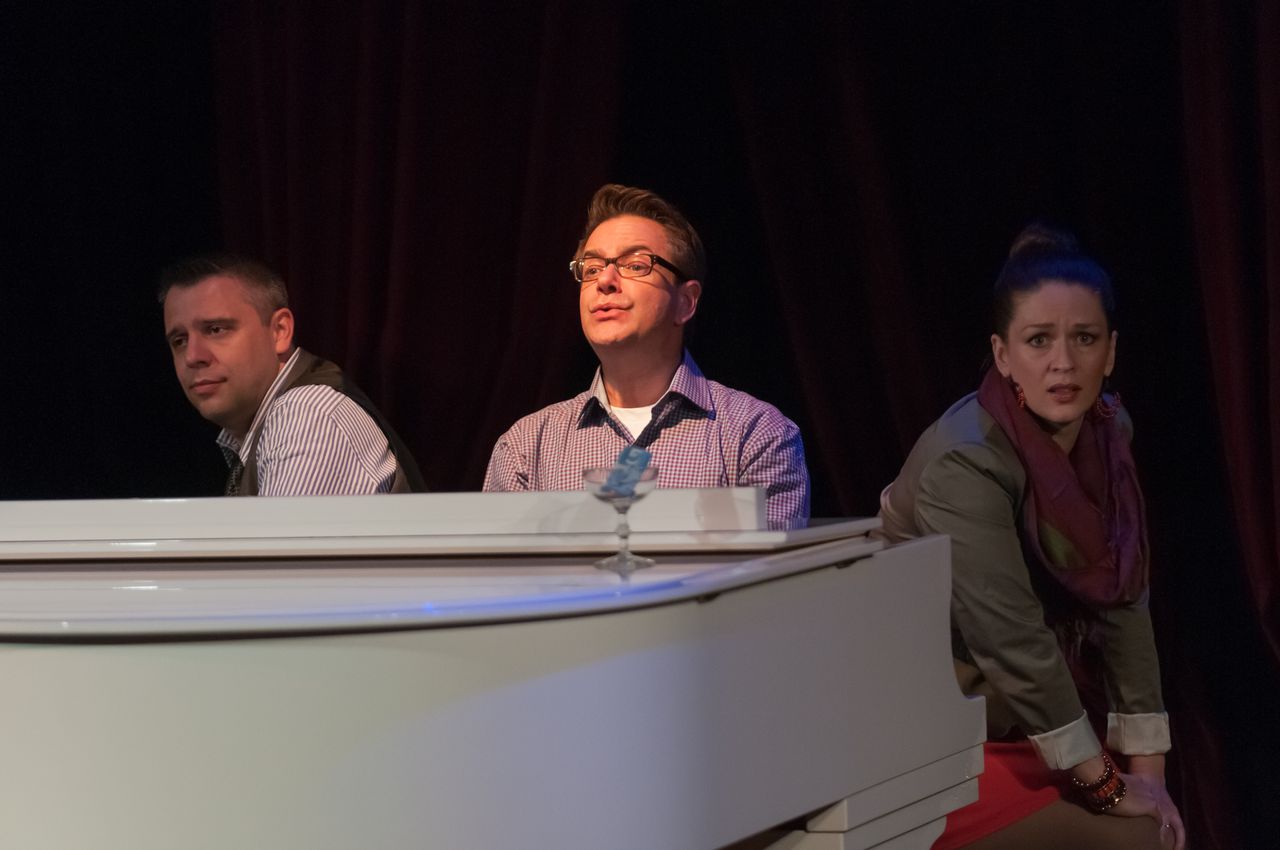
Katherine Fadum as Pam, Joe Slabe as Steve and JP Thibodeau as Allan in If I Weren’t With You by Joe Slabe, photo by Benjamin Laird.
If I Weren’t With You
April 1 – 20, 2013
Lunchbox Theatre
http://www.lunchboxtheatre.com/if-i-werent-with-you.html
Listen to my review from CBC Eyeopener at http://www.cbc.ca/eyeopener/columnists/theatre/2013/04/02/jessica-goldman—if-i-werent-with-you/
Below you’ll find the song list for the Joe Slabe’s world premiere musical, If I Weren’t With You, about what happens when a once happy marriage starts falling apart:
I Do
Everything is Fine
In the Beginning
Someone’s Always There
In Your Shoes
Tell Yourself You’re Happy
The Man in the Middle/If I Weren’t With You
If I Weren’t With You (Reprise)
Someone’s Always There (Reprise)
I give you this list not simply because it wasn’t printed in the program. (Which is wasn’t, and anyway what’s up with that? Please, please, please theatre companies…put the songs on the program!!) I’m giving you the songs because I’m betting you’ll want to go back and read the titles to remember just how much you enjoyed listening to them in this predominantly lighthearted yet grounded in reality musical look at relationship issues.
Directed with finesse by David Leyshon, If I Weren’t With You adds up to a show with 80% comedy, 10% tragedy and another 10% reality in the narrative/lyrical mix. The musical starts with the marriage of Pam (fantastically played by Katherine Fadum) and Allan (JP Thibodeau sweetly playing a man who’s lost himself) who are young and in love with their whole lives ahead of them. The show then quickly fast forwards to several years later when the couple are not so young, not so happy and possibly turning away from the love part. Pam is working all the time not really communicating and Allan is trying to communicate but he’s not really listening. They’re at that awful stage when a marriage is in trouble where they say everything is ‘fine’ to each other, but we all know better. Behind their spouse’s back the couple is secretly dreaming of what life would have been like without each other and all the things they’ve given up to be together. As their frustration grows they begin to fight, say some pretty hurtful things and end up not talking at all. Or at least not to each other. But they do end up talking, separately to Steven (a somewhat stiff yet charming Joe Slabe); a single gay friend of Pam’s who plays the middle-man trying to get the couple to work things out. There is a bit of an emotional twist that gets revealed later in the play that I won’t give away, but it helps explain the genesis of the couple’s problems and it’s the roadblock they need to get past.
But back to the music. All the songs in the show are written and composed by Slabe who provides a live accompaniment courtesy of a baby grand piano on the stage. It’s an interesting double duty Slabe is taking on here with both playing all the music and also acting a supporting role in the show and Leyshon handles this tricky directional challenge well. At times Slabe works in the background, dimly lit; simply providing the music. When called upon, Slabe easily transitions into actor/singer and piano player role without any pesky directorial contrivance.
Of the ten songs in this one-act, fifty-minute show, I’m happy to say that I liked every single one. Thematically they all had a kind of jazzy, somewhat funky show tune standard kind of feel to them. So yes, nothing terribly risky or original, but does that matter when each song is eminently hummable and enjoyable on its own merits? With Slabe’s great piano playing and arrangements that guaranteed to tickle your earworms, I don’t think so. But really, it was the lyrics that won me over. If I Weren’t With You is a fairly generic storyline, but what saves this light musical from being nothing but a cliché, are Slabe’s quite funny, smart, insightful, and occasionally melancholy songs that don’t rely too heavily on hackneyed phrasing to make a point. The ideas they convey maybe old and at times even overly retread, but the words sound fresh and entertaining and even poignant in places. Everything is Fine is a wonderful duet by the couple which has them claiming status quo to each other while wondering why they are secretly upset yet afraid to stir the pot. Someone’s Always There allows Fadum’s voice to shine as she laments that she is never lonely, but painfully aware that she never gets a minute to herself. In one of the best numbers of the show, Allan and Steve drunkenly sing In Your Shoes, a duet about how they wish they could trade relationship statuses with each other. And of course, If I Weren’t With You has the couple hilariously listing off all the things they wouldn’t have (acne, a fat ass, a boring home in the suburbs) and would have (better sex, regular sex, a career they loved) if only they were single and or married to someone else.
Sure the audience pretty much knows how it’s going to all work out, this is a light musical after all. But thanks to peppy direction, fun songs/lyrics and engaging performances, If I Weren’t With You is a delightfully lovely romp through someone else’s marriage struggles.
RATING
For the guys – Tired of the guy always being played as a buffoon in comedies about marriage issues? Not the case here. Allan is a relatable character and there is thankfully no attempt to make you take sides. SEE IT
For the girls – This is not adults behaving badly or genders tossed around as stereotypes. While the show is a funny light musical, it does touch on real issues that everyone can appreciate. SEE IT
For the occasional theater goer – A perfect one-act light musical. You’ll like the story, the music, the lyrics and the performers. SEE IT
For the theatre junkie – Sometimes even serious theatre goers just want to be entertained by a fun light, short show. This would be a good one for that. SEE IT

Kyall Rakoz, Conrad Belau, Alyssa Bradac. Photo credit Bree Gardner.
This is How I Left
March 28 – 31st, 2013
Living Spirit United Church
http://thirdstreet.ca/12-13-season/creation-ensemble/
How do we go on when the person we love dies? Who are we without them? How do we face the fear and possible rejection of being our authentic self? To what lengths will we go to find connection? These are some of the important questions asked in Third Street Theatre’s inaugural and original production This is How I Left. Questions so universal, they could have been the fodder for any play on any stage in Calgary. But what’s makes this show different is that these themes of love, loss and fitting in are all told from an LGBT perspective. A perspective not simply or lightly trotted out for this show. Third Street Theatre’s mandate is, “ the positive promotion of queer culture, stories, and voices …. in order to engage and educate”. To this I’d add, entertain intelligently, as was shown by this uniquely compelling first production.
Grieving the loss of her wife Sarah to a freak accident while deployed in Iraq, Sam (Alyssa Bradac) is undergoing grief counselling at a military hospital. It’s just a few years since Sam has been able to be openly gay with Sarah’s military colleagues as the infamous “don’t ask, don’t tell” policy was finally done away with. But even with this access to the military’s therapy services, Sam isn’t doing well. Counselling isn’t working, she is unable to continue her career as a writer and she is spiralling dangerously downward in her grief unable to let go of Sarah and truly say goodbye. In a distinctly non-ghost like fashion, Sam is visited by the spirit 17-year old transgender woman named Alex (Conrad Belau) who is having her own hard time dealing with the reality of her violent death. Thinking at first that she is going insane, Sam rejects the ghost with comedic aplomb. But soon the two realize that only by trusting each other and revealing parts of their stories will Alex be able to remember and come to terms with her death and will Sam finally be able to move past grief into living once again.
The stories they reveal, told through flashback for Alex in a Dickens-esque Ghost of Christmas past fashion and through monologue, video and letter reading for Sam, show the very human and painful side of each of these characters. Rejected and made fun of for most of her young life, Alex finally finds love with her “Peter Pan”(Kyall Rakoz) and while she is afraid of revealing her sexual identity, she is in love and loved and happy for the first time. But secrets have a way of becoming known when you aren’t looking and even her friend and new confidant Elle (Lindie Last) can keep her safe. Sam has had strong and good love for thirteen years with Sarah, but even strong relationships get strained and Sam feels the mourner’s guilt of her barely-there indiscretion. These are both characters unsure of themselves as individuals and trapped in a kind of no woman’s land of self-doubt.
It all sounds horribly dark and depressing, and by no means is this play an uplifting or feel good kind of show. But what the creation ensemble writers of this piece have thankfully realized is that you can’t bombard the audience with preachy downer heavy-handedness for 80 minutes and expect to make your point. This is How I Left is smartly peppered with some wonderfully witty, sweet and lighthearted moments to help us connect with these characters in order to care about their struggle. We are shown a beautifully romantic anniversary video Sam made for Sarah using the now ubiquitous flashcard method, setting up how the two women met and fell in love. This private moment rendered public for us in a huge wall-sized projection instantly seals our affection for the grieving widow. Sam’s sharp but funny quips as she processes Alex’s existence and time travel abilities provides some much-needed laughter and a break from the unhappiness of the story. The bus-stop meeting of Alex and her soon to be boyfriend, ‘Peter’ is a geeky, sweet moment that charms us with its awkwardness.
But as creative as the storytelling is and how nicely balanced between light and dark emotions, This is How I Left at times feels somewhat forced, clichéd and overstuffed. Hackneyed lines like, “We are all connected like the walls of a labyrinth,” cheapen the mostly authentic voice of the script. More problematic is that this play suffers from multiple ending syndrome. Not content to end on a somewhat blurry but artistically fascinating note where the plot twist we didn’t even know was coming is revealed, the play goes on and on giving us one final moment after another diluting impact and adding unnecessary and manipulative heart-wringing plot elements. Narratively, this is a show that feels so close to wonderful and yet quite off the mark in a few spots.
What was not off the mark in the slightest and what truly makes this play a triumph is the hard-working and tremendous cast. Rakoz plays ‘Peter’ with a sweet and nerdy charm and gives one of the best drunk performances I’ve seen in a long time. Last’s Elle is tough and no-nonsense yet she infuses her with a kind of loyal likeability that makes the character feel real. Belau’s turn as a transgender woman is remarkable. From his subtle mannerisms, to his cadence to his ability to conjure the innocence of a 17-year-old without one ounce of camp or regression was a joy to watch. But really, this show belongs to Bradac who owns the stage 110% with her grief and her anger and her sass and her journey from stuckness to afterlife. It’s a tour de force performance from an actress previously unknown to me, but one that I hope to see more of in future.
Rarely does a company produce a first original play without some blemishes, and while This is How I Left has its smatterings, overall this is an impressive and daring effort by a group of tremendously talented artists. If this show is any indication, we can expect great things from Third Street Theatre as they tell us the stories of the queer community and at the same time, tell us stories that we can all find truth in.
RATING
For the guys – There is nothing to be put off by here. This show is not preachy, aggressive or inaccessible in the slightest. It tells stories of queer characters that you will relate to on many levels and asks questions that are important for all of us to think about. SEE IT
For the girls – Finally a show that doesn’t put queer characters up as stereotypical, over the top characters to be laughed at. These stories resonate with empathy and sympathy and are well worth spending time with. SEE IT
For the occasional theatre goer – The at times cloudy story line that flashes back and forth with a somewhat complicated twist at the end may just be too much work for you. SKIP IT
For the theatre junkie – Some slight plot issues aside, there are many reasons to see this play. The best reason I can give you is Alyssa Bradac. SEE IT

Photo by: Benjamin Laird Arts & Photo | Haysam Kadri as William Shakespeare in The Shakespeare Company, Ground Zero Theatre and Hit & Myth production of William Shakespeare’s LAND OF THE DEAD by John Heimbuch
Land of the Dead
March 22 – April 6, 2012
Studio at the Vertigo Theatre Centre
http://www.vertigotheatre.com/main/index.php?site=mystery&id=production&production=216
According to the online bible of all things film/TV related IMBd (The Internet Movie Database), there were no fewer that sixty-nine zombie movies made last year. While some might say that number is astonishing, others will point to the fact that zombie movies are relatively cheap to produce and come with a built-in audience of rabid horror flick fans. These fans not only see the movies in theatres, but will also stream or purchase the after-market versions, generating even more profit for the film-makers.
Upon closer look however, it isn’t just the expected slasher movie crowd that’s into zombies these days, nor is it just the usual suspects taking on the telling of these undead stories. Mega Hollywood stars Bill Murray and Woody Harrelson had their go starring in the intelligently spoofy yet creepy 2009 Zombieland. AMC’s runaway hit The Walking Dead has almost consistently been the highest-rated show among viewers 18 to 49 and boasts some decidedly non-traditional horror genre fans. Perhaps the weirdest mainstream zombie success of late has been Seth Grahame-Smith’s 2009 bestselling novel Pride and Prejudice and Zombies, which integrated the classic Jane Austen tale with modern zombie lore. It seems like you can’t turn around these days without bumping into an undead character infiltrating our cultural output. So what gives?
According to Clemson University professor Sarah Lauro, this latest fad is a direct result of the disempowered, tough economic times we live in. “Zombie-themed things rise in popularity when societies feel dead inside — figuratively speaking — because of cultural dissatisfaction and economic upheaval”, says Lauro. In other words, we feel dead, so we watch dead. I have no idea if playwright John Heimbuch was experiencing this malaise when he penned the 2008 mashup play Land of the Dead, combining none other than William Shakespeare with zombie fiction. But having seen the recent production by The Shakespeare Company, Ground Zero Theatre and Hit & Myth, frankly I don’t care what state of mind Heimbuch was in. I’m just glad he was in it.
Ninety percent Shakespeare, seven percent zombie and three percent modern horror mayhem, this cleverly written, in-jokey, self-reverential comedy uses the parlance, play references and real life drama of William Shakespeare as a backdrop for a zombie attack. The date is 1599 and Shakespeare’s Henry V opens the newly built Globe Playhouse in London. Will Kemp, a former actor with the company, crashes the play hoping to bring his famous role of Falstaff back to life much to Shakespeare’s artistic disgust. Adding to Will’s stress is a visit by Francis Bacon, attorney general of London and sideline author, who has written a play to court the Queen’s favour. Knowing that a new production will receive greater acceptance if passed off as a Shakespeare original, Bacon bribes Will into claiming it as his own despite Shakespeare’s strong issue with the script and subject. While the arguments rage inside the backstage spaces of The Globe, a far greater menace is brewing outside the walls of the theatre. It seems an ‘affliction’ has taken hold of England in the form of a zombie plague. After several of Will’s players are bitten and turned into zombies, the Globe is quarantined, but not before the Queen herself and a smattering of her guards also take shelter in the fledgling theatre. Are they safe locked up in the Globe? Is there a cure? Who is willing to risk and fight? And will this be the end of them all?
It all sounds terribly silly on paper, and in lesser hands I suppose it would be. But this production is so superbly realized on almost every level that you can’t help but sit back and let the quick-witted Shakespearean nods delight your intellectual funny bone while at the same time being amused at the somehow fitting absurdity of the zombie intrusion on this famous theatrical bunch. Marvellously directed by Kevin McKendrick, never once does the play fall into groan-worthy camp. Instead McKendrick manages to balance with astonishing cohesion the more formal action of his Shakespearean actors with the horror effects of his zombie players. Never could I imagine it would feel so natural to watch a zombie bite a chunk off a palace guard while the rest of the cast clamoured about in full Shakespearean language.
This is not to say that language is taken all that seriously in this play. One of the delights of Land of the Dead is how much the play takes the piss out of the dialogue and the characters. At one point when Shakespeare asks Will, “From whence he came”, the response from Will is, “Can’t you just speak normal for once?!” These beautifully delivered lines were the extraordinary handiwork of two of the cast’s strongest performances. Richard Kenyon plays a delightfully opportunistic and resentful Will Kemp with agile inflection and energetic phrasing. Haysam Kadri as Shakespeare once again shows why he is one of the most versatile and talented actors in Calgary with his perfectly executed sulky and temperamental take on the famously revered playwright. Also of note were Joel Cochrane’s bombastic Bacon played with gleeful arrogance, Karl Sine’s controlled and loyal Richard Burbage (Shakespeare’s friend and star player), Julie Guy’s plucky costume sewer Kate and Kelsey Flower’s hysterical turn as John Rice, the boy who plays the lady in the company. In fact the only weak note in this remarkably strong cast was Lenette Randall who’s Queen Elizabeth just couldn’t rise to the level of talent displayed by the other actors.
But even with all this remarkable dialogue, direction and acting, Land of the Dead suffers from one fatal problem. It’s billed as a play that both Shakespeare and horror film fans can enjoy and that’s a claim way beyond the boundaries of what this show can offer. So much of the delight of this play relies on riffs from Shakespeare’s works and nods to real events in his life, that unless you are in on the joke, you’re left wondering what all the theatre students in the audience are laughing about. Occasionally the general audience will get it – it’s hard to miss the ‘To be, or not to be’ moment. But what of the rumour that Bacon wrote all of Shakespeare’s plays? Or that the Globe was actually built by Burbage and his brother out of pilfered material? Or the muddling up of Romeo and Juliet’s lines with other famous quotes in one of the final scenes? What about the resurrection of Falstaff as a metaphor for the zombie apocalypse to some? These will be lost on the average horror aficionado who no doubt will be tapping their fingers in boredom wondering when the zombie stuff is finally going to happen.
Zombie entertainment may be big business these days and I appreciate that Land of the Dead wants to cash in on the trend. But rather than trying to lure an audience that may not walk away smiling with their intellect and lust for blood sated, my hope is that this show owns up to what it really is. An extremely funny play for Shakespeare lovers with a bit of a dark and twisted side. Now that’s a description you can sign me up for anytime.
RATING
For zombie fans – You have to sit through to the end of an overly long first act before even one zombie shows up and then they appear only sparingly in Act 2. Even with some good biting, tearing of flesh and blood-soaked scenes, there just isn’t enough zombie in this zombie play to make it work for you. SKIP IT
For Shakespeare fans – Unless you are a purist that can’t stand anything but the most classic reverential production of Will’s work, you’ll love this smartly spoofy treatment of Shakespeare and his colleagues. The zombie stuff is pure icing that will make you laugh without dumbing the play down one iota. SEE IT
For the theater junkie – Even if you aren’t as up on your Shakespeare as you might have once been (and really, who is?) there is lots to enjoy in this production. For the acting and direction alone this is worth getting a ticket. SEE IT

Noah Parets (Billy) and Rich Hebert (Dad) in “Billy Elliot the Musical.” Photo by Amy Boyle
Billy Elliot
March 26 – 31, 2013
Jubilee Auditorium
http://www.ticketmaster.ca/Billy-Elliot-the-Musical-tickets/artist/1106208
There’s an audition scene halfway through the second act of Billy Elliot the Musical where young Billy, vying for a spot at the Royal Ballet School, is asked what he loves about dancing. After several meatless, non-answer answers, Billy finally admits (in song and dance) that dancing makes him feel electric and free. It should be a soaring moment where the audience swells with pride knowing that with this display of heart, soul and talent, Billy is assured of a spot at the prestigious school. The problem is that while technically there is a lot to be impressed by with Billy’s dancing here and in the show’s other dance numbers, Noah Parets, who plays Billy* does so without one ounce of soul. In fact, this mechanical, matter or fact approach in both acting and direction infects most of production, making Billy Elliot a hollow visual treat with predictable characters and stock storytelling.
Based on the 2000 film, Billy Elliot, the musical with forgettable music by Elton John and book and lyrics by Lee Hall, was the toast of the stage in its day winning four Olivier Awards and ten Tony Awards including best musical. The plot revolves around the motherless Billy who discovers he likes ballet way more than the boxing lessons his father forces him to take. Billy’s struggle to have his love of dance and dreams of an artistic future accepted by his working class, male-dominated family is juxtaposed by the family’s own struggle with the historical 1984 UK miner’s strike that threatens to put them out of work for good.
Not surprising, this follow your dreams, hard-times musical is riddled with every cliché conceivable. An absent-minded, foul-mouthed, but loveable grandmother? Check. A blue-collar father who thinks dancing is for “puffs” but comes around to support his boy? Check. An inspiring teacher who turns Billy onto ballet and then pushes him to spread his wings and never look back? Check. A possibly gay, drag-dressing friend Billy can confide his love of dance to? Check. The requisite anti-Thatcher number accompanied by Maggie in contemptible effigy? Check. The imagined ghost of his mother who appears to send love and support? Check, yet again. The only thing saving this show from being one large groan plot-wise is a fleeting swath of intensely exciting and creative direction and one musical number that manages to lift its head above the muck. Both these moments come at you in the first act and follow one on top of another.
Following a slow and uninspired start where we meet the strikers and look in on a boxing and ballet class, Billy finds himself alone with his senile grandmother. In response to her grandson’s question about missing her dead husband, she breaks into song explaining that while he was a drunken bastard they found happiness when they went dancing. “We’d Go Dancing”, is not only a lovely bit of foreshadowing to Billy’s own escapist feelings about dance, but it’s touchingly smart lyrics and well-staged flashback treatment finally gives audience something real to connect with.
“Solidarity”, a number which moves the audience back into the real action of the play intersects three elements of the storyline in what might one of the most ingenious and successful choreographed pieces of storytelling I’ve ever seen. The miners are striking, the police are sent to quell the crowd and Billy is finally finding his feet in ballet class. The number weaves not only the lyrics of these plot points together, but has actors crashing the spaces of each other with miners acting as ballet bars and ballerina’s causing confusion for policemen. Each group of characters has a notion of solidarity that applies to their own cause, and the refrain, which is sung by each of these groups, ties the scene together in a theatrical gem. Yes, there are sniffles in Act 2 in all the expected heart-string tugging places, but unfortunately never again does Billy Elliot rise to this level of sophistication in story, lyric or staging.
But this show really isn’t about sophistication or clever lyrics. It’s a musical that hinges on our connection with Billy as we root for him with anticipation in spite of the happy ending we all know is coming. In the hands of a better actor, perhaps even this fairly automated and impersonal production that had scenes chugging along in conveyor belt fashion , could have managed to dig its way into our hearts. Parets unfortunately just doesn’t bring anything beyond being a kid that can dance and sing on key. In the end , Billy Elliot feels like a very expensive recital of a talented kid that you know just doesn’t “have it”.
RATING
For the guys and the girls – There are some cute laughs along the way in this otherwise obvious musical. And the dancing is quite good. But much of the story drags and the inability of the actors to connect with the audience will make this fine but not necessarily fun. MAYBE SEE IT
For the occasional theatre goer – It’s a feel-good musical with some real life struggle thrown in. You’ll feel the show is a little long, but you’ll be entertained well enough. SEE IT
For the theatre junkie – Accompanying me to the show was someone who saw the original production on Broadway and she was horrified at the blandness this version offered. The two grand moments in the first act are compelling, but not worth sitting through such an obviously called-in effort. SKIP IT
*NOTE – there are three actors playing the role of Billy in this run. My review is based on the production starring Noah Parets.
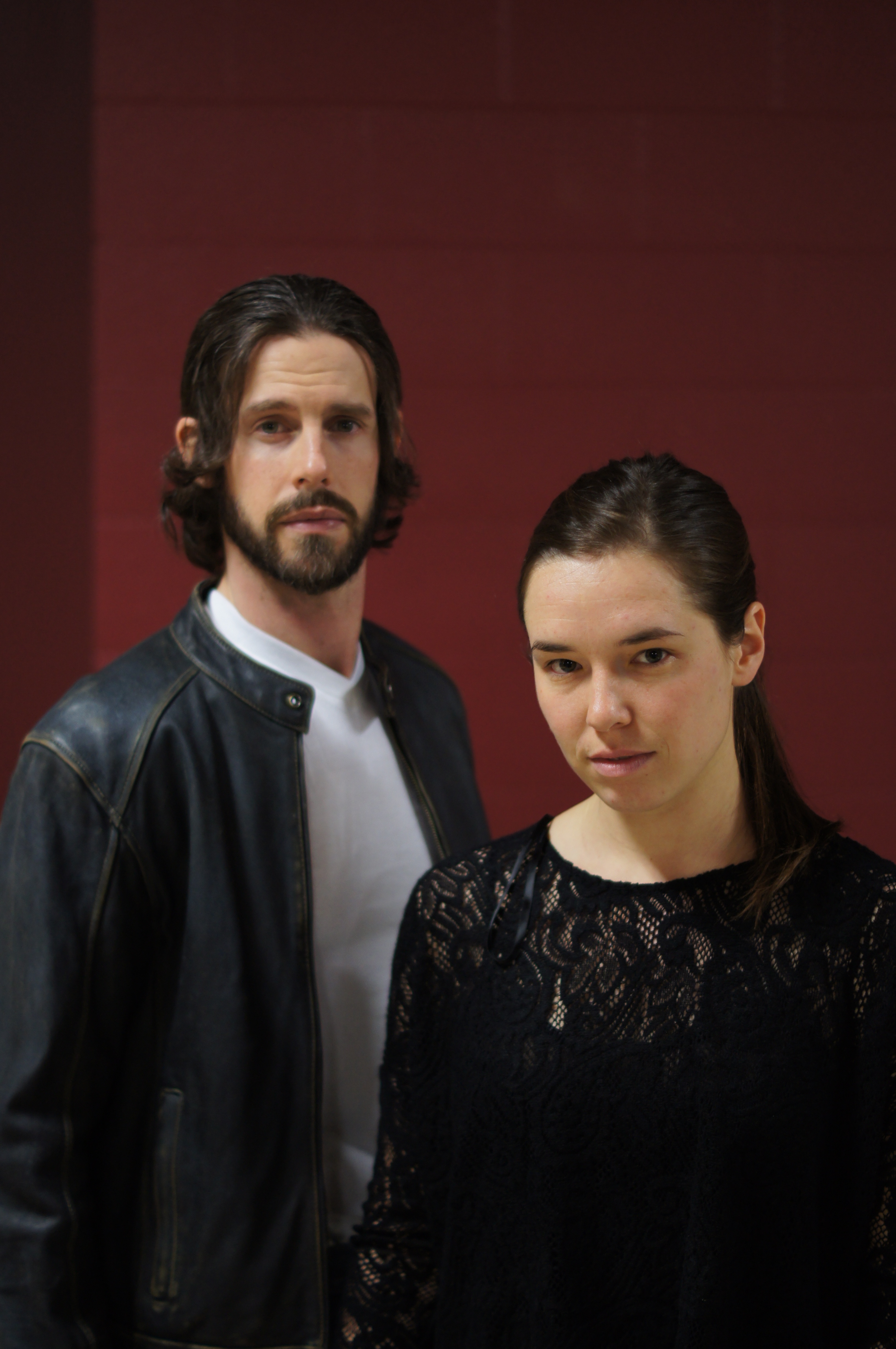
Justin Michael Carriere and Geneviève Paré. Photo Credit: Sara Traschel.
Polygraph
March 20 – 30, 2013
Pumphouse Theatre
http://www.sagetheatre.com/production2.html
By definition a Robert Lapage play is a multisensory experience. Known as the modern master of multi-media theatre, Lapage’s productions challenge and amaze the audience with visual splendor that takes projection to an orgiastic level of meaning and amazement. His grand images transfigure, add depth of scope and most importantly work in partnership with his scripts, blending language and representation that results in a whole that is the outgrowth of the intertwined parts. So crucial is Lepage’s brand of magic in the success of his productions that it’s always risky to try and stage one of his plays in his absence. More problematic still is trying to house his grand design in a small theatre not suited for Lepage’s scope of imagery. No doubt both of these hurdles were top of mind for Sage Theatre’s production of Polygraph, Lepage’s 1987 semi-autobiographical thriller-esque story. Their production had risk written all over it. But thanks to a wall, a woman and wonderful direction, this Polygraph is a triumph on its own terms.
Based on true events which saw a young Lepage briefly accused murdering of a friend and forced to take a lie detector test, Polygraph addresses feelings of misplaced guilt, blurred lines between truth and perception and the tearing down of barriers. A mash-up of mystery, thriller and film-noir, the play, told in French and English, tells the story of the aftermath of a young woman’s horrific murder which finds her best friend Francois (Justin Michael Carriere) accused and forced to submit to a polygraph test to prove his innocence. Passing the test, but never told of the results, François spirals into a kind of depressive madness where self-punishment and self-doubt are his poison. Intersecting with this story is François’s neighbour and friend Lucie (Geneviève Paré), a young actress who lands a part in a thriller movie unknowingly playing François’s murdered friend. The repercussions of the murder (real and on set) for both Lucie and François are brought out by a third character, David (Brain Jensen), a criminologist who touches both their lives as the keeper of the polygraph results.
Artfully directed by Kelly Reay, the action takes place in a modified theater in the round configuration (the audience is seated on only two sides on the stage) with a brilliantly designed set by Terry Gunvordahl resembling a wall-like structure stripped of its middle and made hollow. This wall imagery plays heavy in Lepage’s script – literally as the structure between François and Lucie’s apartment and the Berlin Wall through which David escapes abandoning and betraying someone from his past, and metaphorically as the wall keeping the truth from being known. Reay embraces all meanings in his direction forcing his actors into a physical relationship with the set that runs the gamut from sexual to practical as they crawl on, scamper across, take apart, put back together and against the set in pleasure and horror.
Equally as intriguing as the tactile interaction with the design is Reay’s use of film, light and sound to bring the right amount of Lepage-ness to the production while at the same time respecting the space limitations of a small theatre. Projections onto the upper part of the set show images of scene titles in a chapter-like fashion, French to English sur titles, historical footage of the Berlin Wall, live images of the actors and the movie outtakes from Lucie’s film set. Lights at the bookends of the stage beautifully depict a movie camera and its playback mode, an oncoming train and provides much of the shadowy lighting that sets the mood for the play. But it’s was Peter Moller’s sound design that really elevated this production and brought largeness to the space and action. Moody, atonal and eerie Moller’s original composition was our sensory clue into the meanings behind Polygraph’s mystery and our entry point into the delight of a scene. Nowhere is this better illustrated than a during romantic dinner between David and Lucie that has the pair seated at a restaurant table waited on by François. David and Lucie speed up and slow down as though being controlled by the skip button on a remote control while François continues to whirl around them in efficient waiterly fashion. The direction is smart, the acting superb, but it’s the time-morphing sound accompanying the scene that makes the whole thing tick brilliantly.
With so much visual stimulation in a play, the actors can often come off as B-players but Reay makes sure his cast is front and centre and never upstaged by the technical accoutrements. Jensen’s David speaks in stilted yet strangely calming German-ish cadence and through a thoughtful performance emerges as a loveable presence despite his cruel withholding of the truth. Carriere as François gives a decent depiction of a tortured soul, but has a hard time overcoming some of the script’s action without substance. We are told that François has gone mad from the polygraph rather than shown it dramatically, making the character’s believability and motivation for self-doubt frustratingly thin. Carriere does his best to bring depth to his depressive and violent scenes, but with little to play off of, these moments often feel hollow. But in an almost nothing else matter’s kind of performance Paré as Lucie steals the show. Her confidence during several highly vulnerable full nude scenes, the ability to wholly embrace and embody the dialogue and an infections energy whether channeled positively, in discomfort or in fear makes her the ‘can’t take your eyes off of’ centerpiece in this ensemble.
Polygraph is by no means a faultless script and the holes of character motivation and at times over clever plot intersections I felt were evident in my previous viewings are just as constant in this production. But the story is intriguing and in Sage Theatre’s expert hands, this production is an excellent and exciting adaptation of the unique experience that comes with seeing a Lapage piece.
RATING
For the guys and the girls – An experience on many levels with a cool/creepy vibe and solid to tremendous acting. Like a legal high without the munchies. SEE IT
For the occasional theatre goer – Plots and idea are gleefully blurred in this show, making it not an easy to enjoy or fully understandable night in the theatre. SKIP IT
For the theatre junkie – This is not Lepage light – it’s Lepage intimate and it’s beautiful in its own way. Yes the plot is thin in places, but let it go and watch Paré do her stuff and let her talent make you tingle. SEE IT

Hawksley Workman in The God That Comes. Photo Credit: Trudie Lee
The God That Comes
March 19 – April 7, 2013
Big Secret Theatre
http://www.atplive.com/2012-2013-Season/GodThatComes/index.html
If a show is cool, does that automatically mean it’s good? It’s an important question to ponder when seeing Juno Award winner Hawksley Workman and Christian Barry’s new show, The God That Comes, a song cycle performance based on the mythology of Bacchus, the Greek God of Wine. From the minute the audience enters the theatre, coolness abounds. With most of the seating set up cabaret-style, cocktail tables are draped in sexy red linens adorned with lush bunches of red grapes, the smell of incense hangs heavy in the air, the dim lighting suggests an after-hours underground club and audience members are happily sipping on plentiful glasses of wine. We are in the mood.
Workman takes the stage to tell us that this first bit isn’t the show. What it is, he explains, is the story that the show will address. Smartly here Barry (the playwright and director) realizes that not everyone in the audience will be fluent in Greek mythology, so Hawksley spells it all out for us. Once upon a time there was an oppressive and cold-hearted king who was obsessed with rules and order. Then there appeared a God in the mountains who embraced all things hedonistic; sex, wine, dancing – the fun things in life. The kingdom’s women and slaves think this sounds pretty darn good, so off they run to the mountain to take part in the God’s fun, upsetting the King greatly. Especially when he learns that his own mother is taking part in these pleasure orgies. To find out just what the devil is going on; the King disguises himself in women’s clothing at night and climbs the mountain to observe. Things don’t go very well for him from there. The crowd mistakes him for a wild animal and in their passion-filled frenzy they turn on him and tear him to pieces with his own mother cutting off his head to present to the God.
The next seventy minutes or so are the show and here we get even more cool. Workman accompanies his singing on the drums, guitar, keyboard and ukulele in what can best be described as a concept album concert/solo musical play that has him telling the Bacchus story by taking on the personas of the God, the King and his mother. What pushes the show beyond simply a thematic concert is Barry’s dark and moody direction which utilizes on stage costumed mannequins representing the three characters, lighting to indicate who the songs are about, flashing neon words beside the stage emphasizing the scene’s dramatic message and recorded sound transitions that allow Workman to move between instruments and characters.
Workman for his part not only belts out the 12 songs that comprise this album/show, he becomes the characters through first person lyrics. He sings belligerently and with military force as the King, with more dreamy luxury as the God and with a slightly soft falsetto as the mother. There’s no question that Workman is a talented performer as a musician/singer and as a storyteller. But talent here doesn’t necessarily mean all the songs work musically or as a narrative element. Of the dozen songs that comprise the show, about half of them held the audience rapt. The percussion-pounding beat of the drum-fronted song Invocation (You Know What It Is, Come to the Mountain), started things off on a remarkably high note. The Dress Makes the Man, with its wry humour depicting the King’s possible delight at his drag transformation kept the audience laughing at its silly cleverness. Poignantly delivered and on par with Workman’s more accessible music were the beautifully cerebral If Your Prayer, depicting the meeting of the King and the God and the haunting Can You Believe?, describing the shock at the King’s death.
But along with the magical theatrical musical moments came some grating, tiresome and even clichéd attempts. The most egregious of these included Remember Our Wars, which is nothing more than a screeching effort by the King to establish his dominant personality and the overwrought and empathy-sucking He’s Mine, in which the Mother laments her son’s death with shallow motivation that is given no dramatic explanation.
You would think that because these songs are the only hook the audience has into this concert as a theatrical performance, the failing of half of them should mean the failing of half the play. Not exactly a good ratio when reviewing a performance. But here’s the thing…. It’s that pesky coolness again. The show is so unique, creative and visually stimulating and Workman is such a charismatic, compelling performer that even if the bad closely equals the good in a narrative sense, we don’t care. The experience is the message when it comes to this show and on that front Workman and Barry deliver big time. We are transported and we are seduced and we do buy into the risks these artists took in staging this performance. So while I’ll put my criticisms out there for the record, I’ll happily now sit back and say I was very glad to have been able to take part in it all.
RATING
For the guys and the girls – You don’t need to be a Workman fan to appreciate this show, but you do need to be open to an alt rock kind of metaphorical and theatrical type of storytelling. I will bet it’s unlike anything you’ve seen before and for some of you that alone will be enough to love this show, even with its flaws. MAYBE SEE IT
For the occasional theater goer – Non theater-going music fans might like that this show is more a concert than a dialogue driven play. But those looking for a traditionally fun musical will be confused and disappointed. SKIP IT
For the theatre junkie – Yes not all of it works, but the risks taken and successes achieved in this show on many levels are well worth your time. SEE IT
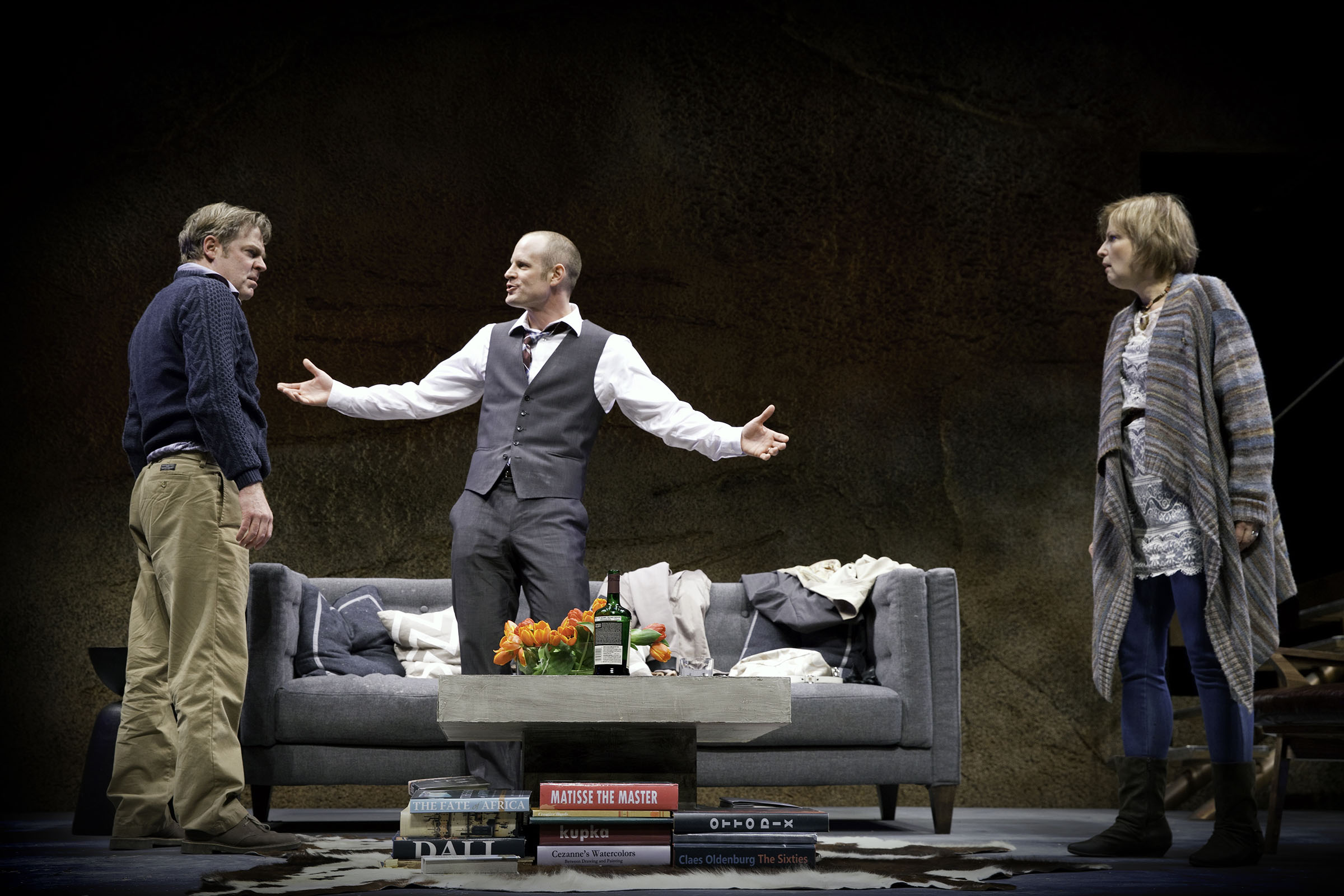
(l to r) Doug McKeag, Ryan Lyhning, Helen Taylor. Photo by Trudie Lee
God of Carnage
March 12 – April 7, 2012
Max Bell Theatre
http://www.theatrecalgary.com/plays/god_of_carnage/more_info/
“How many parents stand up for their child and end up behaving infantile themselves in the process?” It’s a congratulatory question asked by one of the parents in a couple’s get-together discussing a schoolyard fight between their children in Yasmina Reza’s Tony Award winning one-act comedy, God of Carnage. The laudatory remark seems fitting as these couples have come together specifically not to point fingers at one another’s child or to blame each other’s parenting skills. Instead they are meeting to calmly discuss the incident that saw Annette and Alan’s boy, Benjamin swing a baton at Veronica and Michael’s boy Henry, knocking two of his teeth out. Amicable moods prevail as the couples agree to get the boys together to apologize and work things out.
But right from the start, the audience knows that this civil discussion is teetering on the brink of disaster in large part due to the discordant nature of all the personalities in the room. There’s Veronica (Helen Taylor) a social justice saviour of the earth do-gooder, her husband Michael (Doug McKeag) a seemingly easy-going guy that’s just too amenable to be true, Annette (Daniela Vlaskalic) the uptight but politically correct wealth manager and her stereotypically boorish, workaholic lawyer husband Alan (Ryan Luhning). With a mix like this (and the need for an actual story arc in the play) there’s just no way that tempers are going to remain uncorked.
And there you have the glut of the play. Tempers are lost; fighting ensues – between couples, between individuals and between genders. It’s reasonable adult sparing at first, but the action quickly devolves (with the help of alcohol) into the puerile and preposterous where not only do words get tossed, but ridiculous beatings with couch pillows, a contrived tulip massacre, dubious purse dumpings and accusations of hamster murder are all fair game. Not to mention a projectile vomiting scene and clean up scenario so milked for humour that it’s painful in its artifice. Which is not to say that the audience doesn’t suck it all up with glee. These overwrought plot twists are fashioned not so much for the creativity they bring to the play or the wit they add to the comedy. Instead the gags cheaply target for the easy laugh in the most efficient way possible. And apparently nothing is funnier than watching a wealth manager not excuse herself to go the bathroom when she needs to throw up, not once…but three times on a strange couple’s coffee table.
I remember feeling this same sort of disappointment with the script when I saw the play four years ago on Broadway. And while the stellar New York cast of Jeff Daniels, Hope Davis, James Gandolfini and Marcia Gay Harden did their best to bring a modicum of reality to their characters, I couldn’t help but think that God of Carnage failed because it was neither a true farce nor an adroit, ingenious comedy.
The actors in this production certainly don’t match the talent of the original Broadway cast, but for the most part they held their own well enough. Luhning is obviously enjoying himself playing the ill-mannered pot-stirrer and his energy is appreciated even if his timing is a bit slow in places. Vlaskalic starts off somewhat unsure of her voice but warms up to the role once her character moves beyond the requisite vomiting. McKeag is the strongest performer in the cast, going from affable to cantankerous in a way that makes the entire audience exhale along with him. Perhaps the only real weak link in the ensemble is Taylor whose upstanding, holier than thou performance had its moments, but was hampered by her self-conscious delivery that more often than not lead to a wooden delivery.
Director Jan Alexandra Smith does her best to keep the one room/one gag type action moving along. Annette and Alan walk halfway out the door more times in this production that would seem humanly possible and never before have you seen people stomp around one room so feverishly as this. Costume-wise they all looked the part save for wealth manager Annette. Clad in shades of soft neutrals, she hardly gave the air of a high-power financial player. But more egregious was the choice to put her in Capri pants with nude nylons and a run of the mill mall purse. These may be small issues, but all together they contrived to lessen the impact of this character’s position and by extension the humour of watching her fall.
Patrick Du Wors’ set design adequately represents an upper/middle class living room fitted with all the right art and culture books that Veronica has amassed over the years. But no matter how hard I squinted at what dangled above the stage, all I could make out was dozens of strings with various sized and coloured rocks tied to the bottom. Was this a metaphor for the damage these couple were doing? Was it some kind of chandelier? Or was it a cast member’s kid’s art project gone awry. Regardless, it was a superfluous addition to what needed only to be a simple prop-bound set.
But then, to my mind, all of God of Carnage is inconsequential and superfluous. With so many modern ways to watch adults behaving badly for 90 minutes (reality TV anyone?) I wish this play gave us something to truly think about and made us laugh in ways less obvious. But maybe that’s the point. Adults behaving this badly aren’t worth thinking about deeply nor are they really that funny. In that case, mission accomplished.
RATING
For the guys and the girls – If your funny bone is tickled watching ideologies low-blow each other and genders take swipes, then this is the play for you. If you want a little smarts with your comedy – move along. MAYBE SEE IT
For the occasional theatre goer – It’s a fast-moving, comically shocking, easy to follow quick show. You may be miffed at the non-ending, but you’ll have fun along the way. SEE IT
For the theater junkie – It’s always nice to make a Tony winner part of your cannon, but remember, just because it wins a Tony, doesn’t make it a great play. Maybe it was just the best of a not so great bunch that year. MAYBE SEE IT
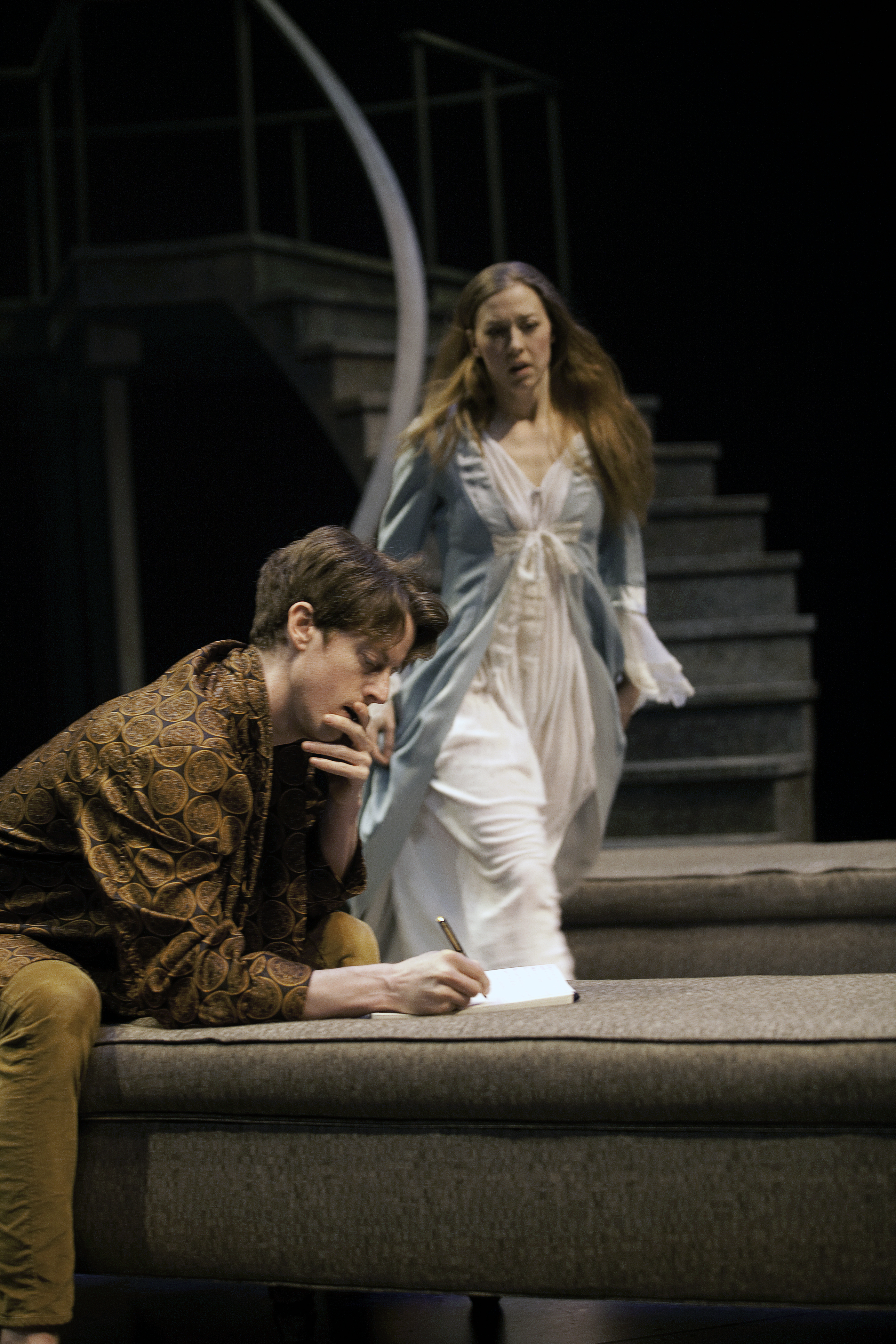
Jamie Konchak and David Patrick Flemming. Photo Credit: Trudie Lee Photography
The Apology
March 8 – April 6, 2013
Martha Cohen Theatre
http://www.atplive.com/2012-2013-Season/TheApology/index.html
Listen to my live review of The Valley on CBE Eyeopener on Thursday, March 22 on
Have you ever had a friend who’s made bad romantic/lifestyle choices? Not once, but again and again and again. More often than not with the same partner. At first you get caught up in the drama of the situation. Almost like a car crash you can’t help but look and breathlessly wait to hear what new crises has befallen them due to their own naïve and somewhat masochistic choices. But eventually the titillation wears off, the constant emotional calamity becomes tiresome and your threshold for empathy then sympathy then even the slightest caring whatsoever evaporates into thin air.
Put this friend on stage in the form of four 19th century historical figures and make your waning friendship the challenge the audience must face as they struggle through the characters’ endless romantically caused disasters and you have Dara Teitel’s new play, the Apology.
This coming of age historical fiction play with overly busy direction by Kate Newby tells the tale of the 18-year-old Frankenstein author Mary Shelley (Jamie Konchak), her poet boyfriend poet Percy Bysshe Shelley (David Patrick Flemming), Mary Shelley’s stepsister, Claire Clairmont (Ava Jane Markus) and the aristocratic poet Lord Byron (David Beazley) as they come together in a decidedly unorthodox polyamorous philosophical pact while living together for a time at Byron’s home in Switzerland.
In what feels like an interminably long first act, we watch these four fall in and out of bed with each other, become jealous, fight, make up, take drugs, bed different partners , get territorial over mates, battle, reconcile and do it all over again. Wash, rinse, repeat. And while watching young, attractive rebellious (famous) characters behaving salaciously is certainly initially entertaining, the baring of flesh and the writhing of bodies becomes quickly pedestrian and dull, especially when peppered with the unrelenting green-eyed monster yelling that accompanies it. It is interesting to note however, that in the performance I saw, which was opening night, Newby decided to greatly tone down the gay love scenes. I’d heard from people who attended preview evenings that the male actors performed together with full frontal nudity, yet the version I saw had them in underwear. Either staging would have been fine in my opinion, yet I couldn’t help but wonder if the many corporate sponsors and VIP’s in the audience had anything to do with the less racy direction. Apparently these are the things one thinks about when being bored by lasciviousness.
The play’s tedium begins to lift near the end of the second act when Mary becomes pregnant and out of competitive spite, Claire makes sure she too is with child via the very disinterested Lord Byron. Suddenly the stakes are higher. No longer is their existence just about the rollercoaster of sex, drugs and emotional upheaval. There are lives on the line as well as careers – Mary has finished Frankenstein and is being lauded in literary circles for her accomplishment. But instead of moving beyond their destructive lifestyles, the patterns continue disastrously into the second act with the group broken up but still playing out similar games with each other from arm’s length. Frankly I had broken off the friendship with the play long before the second act and was therefore unmoved by the slight maturation of the characters (save Byron) and their situations as the play progressed.
I was also unmoved by Teitel’s decision to set the second half of the play in modern times. Mary and the gang go from period dress to present day skinny jeans and cell phones in Act 2, and while I understand this was a metaphor examining the relentlessness of sexual politics regardless of era, I found the design decision twee. More problematic was that Teitel was apparently attempting to explore the feminist side of Shelley’s character and the politics feminists face when pregnancy comes into their lives. While Teitel provides some very nicely written bits of dialogue on this issue, any real intelligent discussion is stomped on by the endless sexcapades that completely drown out these important notions. I just can’t imagine anyone is going to walk away from The Apology thinking it was an interesting examination of feminist struggle.
Yet even with all my disaffection for the plotline and much of the staging, I couldn’t bring myself to truly dislike the play. Credit for this goes partially to Teitel, who manages to give her characters some deliciously smart and funny dialogue amid the tedious scenarios she makes them live out. Mary’s discussion of a woman’s self-coconsciousness during sex, Byron’s bemoaning a man’s right to a little rape fantasy, and Mary’s lawyer Tom (Graham Percy) explaining that a beard is just a series of missed deadlines are some magnificent pieces of writing that kept my ears intrigued even when the rest of me was less enthused.
The acting was the other, much larger reason I found affection for The Apology. While this show was in many ways an ensemble piece, it’s Mary’s role that leads the cast and Jamie Konchak does a superb job vacillating between feminist confidence, youthful insecurity, jealous indignation and vulnerable love. Any fondness I had for Mary was a complete outgrowth of Konchak’s ability to break through the limits of the writing and bring a tender humanness to the role. Flemming’s Percy was also pitch perfect in his range of emotion, resulting in a performance that superseded the dislikeable foppish nature of his character. Markus as Claire took a jealous, whiny, spiteful role and with excellent timing and completely present and exposed emotion turned her into a compelling addition to the action. Lord Byron is described as ‘despicable’ and he certainly is in this play, but it is Beazely’s oily performance and acerbic delivery that makes his character is so cringe-worthy. Finally, Tom may be the only sane, likeable character in the play, but rather than rest on the affable nature of his role, Percy projects an honest decency that is attractive beyond the lines he is given. To say that this was a uniformly strong cast would be understating the incredible work these actors did keeping me engaged in what I felt was a bromidic and repetitive telling of a mildly salacious story.
Teitel apparently named her play The Apology because later in life Mary “apologized” for her young lifestyle believing it had been a failed experiment. Had Teitel actually dramatized this conclusion in her play, perhaps the ride might have taken on more meaning. Instead we leave the foursome still very much snarled in their toxic behaviour making the two hours spent in the theatre the only failure I could wrap my head around.
RATING
For the guys and the girls – This play could have been retitled Young People Behaving Badly. Yes, it’s fun to see the wild private lives of such well-known authors and poets at first. But a lack of connection to the characters and tedium with their situation may leave you wishing you could enjoy their art and know less about the artist. MAYBE SEE IT
For the occasional theatre goer – Teitel herself notes that she doesn’t come up with any answers in this play which will probably translate into an understandable ‘what is the point?’ feeling for you. SKIP IT
For the theatre junkie – Great performances and occasional lovely writing can’t save this play from tedium. Still, this cast is worth your attention. MAYBE SEE IT
 Applause! Meter