Boom – Review

Bppm


BOOM

January 15 – 19, 2014

Max Bell Theatre

https://www.hprodeo.ca/2014/boom


Depicting 25 years of political, cultural and personal history featuring oodles of famous and infamous newsmakers along with a trio of ordinary folk in a two-hour documentary-style play sounds like a company biting off more than they can chew. Attempting this lofty feat with just one solo actor sounds like insanity. However if the production in question is BOOM and the writer/director/performer is Rick Miller, not only is the content chewable but the only thing insane about it would be to miss this astonishing whirlwind theatrical experience.

Part performance, part impersonation, part documentary but fully multi-media, BOOM (which is premiering at the High Performance Rodeo) tackles the era between 1945 and 1969, or what we in North America more affectionately call the baby boom era. There’s lots of dramatic fodder for Miller to mine as he draws on both Canadian and American history and major world events to paint a picture of what it was like to come of age during this pivotal time. It’s the time after all when radio gave way to TV and TV helped birth mass consumerism. A time when mellow gentleman crooners like Perry Como were overtaken by sexualized song men like Elvis and Jagger. A time when innovation took us from Hiroshima to landing on the moon. And of course an era  when politicians like Kennedy, Castro  and Trudeau were making waves at home and abroad. Miller makes sure we see and hear about it all.

Set on a simply configured stage (designed by Yannik Larivee) consisting of a tall vertical cylindrical centre encircled by a horseshoe-like ring that comes to life in a visual splendor of multimedia magic, Miller leads us chronologically through the era playing (impersonating) the world’s most influential politicians, activists, actors and musicians.  And I mean hundreds of them. Or so it seems. Miller gives voice to everyone from Churchill to Malcom X to Janis Joplin utilizing bitingly clever lighting, expressive animation and authentic archive footage to seal the effect. Miller sings, plays instruments, orates and unleashes impressions at such a dizzyingly talented pace that he is easily forgiven if one or two of the lot don’t quite land as strongly as the others. Conversely, squeals of joy erupt from the audience when Miller gets a particular nostalgic favorite just right as was the case with his ‘Rabbit of Seville’ bit. The audience also thrills at the litany of era-defining commercials Miller voices such as one showing Camel cigarettes being heartily endorsed by doctors as their preferred brand.

While there is no question that we are mesmerized by  David’s Leclerc’s projections, Bruno Matte’s lighting and Miller’s seemingly endless ability to impersonate any individual, it’s the personal that elevates this show from being simply a visual and aural trip down memory lane. At the outset of the play, Miller gives voice to three baby boomers, Madeline, a small town Ontario woman who also happens to be his mother;  Lawrence, a black American draft dodger/musician and Rudolph, an Austrian living in the American zone of Berlin. It’s through these characters and their feelings/ reactions to the events around them that really gives BOOM its heft. Granted, in the cacophony of information and images that abound in this show, it takes some time to latch on to these individual stories, but once hooked we are on the edge of our seats to see what happens to them next.

Clocking in at two hours without intermission, BOOM is an exhaustingly busy but thrilling production that makes twenty-five years of history fly by in a manner that both tickles us intellectually and thoroughly entertains us. It was 1964 when Bob Dylan sang The Times They Are a-Changin’  and while his song of transformation wasn’t about how we experience theatre, it most certainly could pertain to Miller’s show. BOOM is not simply a superlative theatrical experience, but I’d venture to say that it will change the way we think of historical-docu period plays from now on.


RATING

For Boomers – I sat in front of a bullseye boomer woman who quietly laughed and sang and cried and nodded her head in agreement throughout the entire show. This is your story told brilliantly. SEE IT

For political/cultural history buffs – I’m not of the boomer generation, yet there was not one song or political event/figure or issue of the era I wasn’t acutely familiar with. It’s amazing how you can have nostalgia for things you didn’t yourself experience. Add to that the thrilling production and engaging personal narrative and you have a winner. SEE IT

For the unaware – Several times I wondered how the 20-somethings who have no or little knowledge of the political/cultural references in the show were experiencing the performance. No doubt much was lost on them. But the heart of BOOM is the personal coming of age journey experienced by three relatable characters that I believe transcends the fact that one may not know who Sly and the Family Stone is. Besides, you will never get a more enjoyable or visually arresting history lesson than this. MAYBE SEE IT

For theatre junkies. I could go on about how this show pushes the boundaries of docu-theatre and multimedia accompaniment. I could talk about how beautifully narrative is cushioned in context. I could speak of Miller’s outstanding command of his material. But really I just want to say GO. NOW! SEE IT



Seeds – Review

Seeds-300res-EricPetersen-PercySchmeiser_sml

Eric Peterson in Seeds. Photo Credit Guntar Kravis

SEEDS

January 15 – 18, 2014

Theatre Junction Grand

http://www.theatrejunction.com/


All Saskatchewan farmer Percy Schmeiser wanted was to grow the pesticide-resistant canola plants that he said appeared on his property one day as a result of contamination from a neighbor’s farm. All Monsanto Canada Inc. (the biotech company who created the gene that made the canola plant so chemically immune) wanted was to protect its patent and stop what they saw as the theft of their seeds by Schmeiser. All playwright Annabel Soutar wanted was to do was to take this true story of the four-year court battle that ensued and create a piece of verbatim docu-theatre based on court transcripts and interviews with all the playersinvolved. Sounds simple enough. But just like the biased self-serving perceptions held by Schmeiser and Monsanto in this landmark court battle, Soutar’s play Seeds also gives us a skewed and at times insultingly subjective story that unfortunately takes much of the docu out of the drama in this otherwise splendid production by Montreal’s Porte Parole.

Directed with thrilling fluency and invention by 2013 Siminovitch Prize winner Chris Abraham, the play mimics Soutar’s research into the 1998 case of Monsanto Canada Inc. versus Saskatchewan farmer Percy Schmeiser that eventually made it all the way up to the Supreme Court of Canada. We watch as Soutar (played by Liisa Repo-Martell) interviews everyone from scientists to activists to farmers to lawyers to the Monsanto PR representative (played with verve by an ensemble cast) in an effort to uncover the truth. Most of her time however is spent speaking with Schmeiser himself (a somewhat one-dimensional Eric Peterson) to get his side of this David and Goliath story.

Despite the play containing an abundance of scientific facts and theories and an ample amount of legal procedure pertaining to patent laws, Abraham directs the action on stage with such a brilliantly orchestrated pace that we are visually mesmerized if not altogether narratively engaged. Much of the credit for this must also go to Julie Fox’s energetically busy set design that litters the stage with science labs, lawyer’s offices, coffee houses, courtrooms and the Schmeiser farm with what amounts to garage-sale props. Ana Cappelluto’s moody and arresting lighting design brings the cool factor to the stage and Elysha Poirier’s inventive video and projection design, which often puts the action up on stage in projected real-time video, adds much-needed depth to the production.

But looking beyond the distraction of the uber-slick production and able cast, the play offers up little more than underdeveloped characters and preachy story-telling. Soutar assures us that each character has the opportunity to speak their point of view but there is no care to make sure the tone of those views is balanced. The words may be verbatim, but without fail Soutar (and Abraham) presents Monsanto supporters as cold, grating, unlikable characters while Percy, his wife and others that side with him come across as sympathetic and reasonable voices. My reaction to this treatment was a stiffening in my seat, don’t tell me what to think response. The blatant demonizing of one side of the narrative while at the same time claiming to be a balanced docu-drama was manipulative at best and simply bad story-telling at worst. This is not to say that the slant taken wasn’t my own personal bias, but I would have preferred to get there on our own through compelling and fair narrative treatment rather than to have one viewpoint thrust so obviously upon us.

Bias aside, Soutar’s script fell short in other areas as well. Midway through the story Schmeiser turns from simply wanting to grow the genetically modified seed that ended up on his property to becoming an activist decrying the use of GMOs altogether. Soutar glosses over this change of attitude without examining its genesis in any meaningful fashion. More confusing is the floated notion in act two that Schmeiser is not well-like by his fellow townspeople. Soutar does finally decide to show some balance in her script by revealing that many farmers in Schmeiser’s town believe he’s a liar, a fame-whore and a generally detestable person. Yet all this information is rendered impotent by the fact that Schmeiser seems to continually get elected as town mayor. Here Soutar misses the opportunity to truly show the contradictions in this complex narrative and instead simply leaves the plot twist as a dismissive head-scratcher.

At the play’s conclusion, Soutar’s character acknowledges that everyone in the audience will come away with different views about the truth of the case. Perhaps more correctly, she should have acknowledged that the audience would come away with views about her truth of the case. But despite several narrative reservations, there is no denying that Seeds is a gorgeous production and an imaginative staging of one Canada’s most recent blockbuster court cases. Who knew patent law could be so sexy?


RATING

For GMO haters – The David and Goliath treatment which demonizes big biotech will appeal to you and you will be easily able to gloss over any narrative criticism thrown Schmeiser’s way. SEE IT

For the occasional theatre goer – Lawsuits and science may not seem like entertaining fodder for a night at the theatre, but this production is far from dry. Gorgeous to look at, easy to digest and with a quick pace, the play will keep you engaged if not enthralled. MAYBE SEE IT

For the theater junkie – I rarely endorse style over substance, but in this case the production is so thrilling that the narrative issues irritate less than they would otherwise. Go for the experience and leave your red pen at home. SEE IT


6.0: How Heap and Pebble Took on the World and Won – Review

Heep

6.0 How Heap and Pebble Took on the World and Won

Jan 13 – 25, 2014

Lunchbox Theatre

https://www.hprodeo.ca/2014/heap-and-pebble

Listen to my review of the Northern Light Theatre/Lunchbox Theatre/High Performance Rodeo production of Valentina Ceschi and Thomas Eccleshare for Dancing Brick’s 6.0 How Heap and Pebble Took on the World and Won at

http://www.cbc.ca/eyeopener/columnists/theatre/2014/01/14/jessica-goldman-reviews-six-point-zero/


RATING

If 6.0 is a perfect score in ice dancing (or it was until that system was replaced in 2005 – but we’ll ignore that for now) let’s follow that model as a way for me to rate this show. The 6.0 scoring method is divided up into 3 parts – technical merit – required elements and presentation:

For technical merit –  Trevor Schnidt’s direction and choreography of the wood-skating scenes was dynamo. Even better was Gervais and Borotsik’s execution. The production has decent video projections to create mood, and the use of dry ice in the theatre was a nice touch. 5.5

For required elements – This is a High Performance Rodeo show, so I want something unique and not the kind of traditional play we see during the regular season. A comedy/polemic wrapped in ice-dancing on wood – not bad!  4.75

For presentation – The acting was terrifically fun and  audience participation was well incorporated. Some of the direction in the non-skating parts was a little clunky and the show  could have flowed better but overall it fit it’s one-hour time slot with very few lags. 5.0

Whatever that averages out to – I thoroughly enjoyed this show!

A Brimful of Asha – Review

BrimfulWeb1_c_w460h306


A Brimful of Asha

Engineered Air Theatre

Jan 9 – 11, 2014

https://www.hprodeo.ca/2014/a-brimful-of-asha


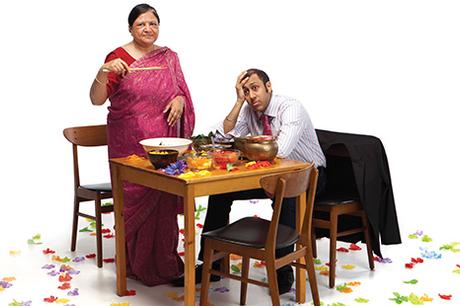
As the saying goes, if it’s not one thing, it’s your mother. For Indo-Canadian director/writer/actor Ravi Jain, the one thing is his mother Asha, or more specifically her unyielding insistence that he settle down and get married already. When Asha’s nagging turned to meddling in the form of trying to arrange marriages for him, Jain took his personal drama and channeled it for the stage. A Brimful of Asha is the true account of Jain and his mother at loggerheads over the question of when, to whom and by what means he should marry. If Jain had left the idea at that, the result might have been a quaint run of the mill culture clash story suitable for sitcom timing and stock characters. Instead Jain made the brave and very headline-grabby move of casting himself and his non-actor mother as themselves in the show. The result is a charming, if not altogether successful production that relies too heavily on casting and a one note narrative.

On a simple table and chair set we are told to imagine is the Jain’s family kitchen, the moon-faced Asha clad in a beautiful hot pink sari, tells us we are not here to see a play. Instead she gracefully informs us, we’re here to help her sort out a dispute with Ravi. A dispute, according to her, where he is wrong. Thus begins a comical, fourth wall-breaking  he said, she said recounting about the “absolute true” events that led Ravi’s parents attempts at arranged marriage during a trip he made to India in 2007. We listen as Asha explains that her duty in life is to see her children happily married and the pressure she feels from her community in Indian and Canada to make this happen. We see Canadian-born Ravi rail against the guilt put upon him by his parents traditional marital views and his need to come to marriage in his own way.  Mostly we just enjoy the bond we see between mother and son as they argue, make fun of each other and revel in the laughs their version of the story gets from the audience.

But somewhere just over halfway into this ninety minute production, the novelty wears off and the story stagnates. We get not one but two lengthy scenarios involving Ravi and a “marriageable” girl , Asha’s retorts of ‘because I’m your mother and I’m right’ become repetitive and large block of the tale takes place without Asha, leaving her sitting mute on the stage and leaving us wondering if and when she will fold back into the production.

That’s the problem with “absolute true” stories. Just because it happened that way doesn’t necessarily make it interesting.  Where A Brimful of Asha does shine is not so much in the repeated arguments/scenarios between mother and son, but rather the asides taken to give context. Asha’s description of her own marriage and move to Toronto from India shows the non-actress at her most natural story-telling and is a wonderful window into the immigrant experience. Ravi’s story about a Bollywood star who inspired him to become an actor is similarly unforced and delightful. But it was the smallest moment in the show that packed the most punch. While delivering yet another set of complaints against his mother’s traditional ways, Ravi takes a seat on the edge of the kitchen table. Asha taps to get his attention, then gently calls his name, getting louder to make herself heard. Whispering as though trying not to be heard, she shakes her head and tells him gently but forcefully not to sit on the table. Ravi looks stunned but slowly obeys and takes a chair. Whether this moment was planned or not (and I assume it was) it told us everything we needed to know about the dynamic between these two and it sealed our affection and laughter for both characters. Sometimes in comedy and drama the biggest bang comes with the smallest tap.


RATING

For Indo-Canadians – I heard many comments from Indo-Canadian audience members that amounted to – “We have these exact arguments in our home” and “This play is SO true” – so obviously the show resonates on a personal level with many in this cultural group. Always good to see your issues addressed and laughed at respectfully on stage.  SEE IT

For everyone else – The desire of a parent to exert influence over (control?) their child’s life is by no means exclusive to the Indian culture. This is both an educational and relatable story with some lovely giggles along the way in spite of the show’s shortcomings. SEE IT

For the occasional theater goer – The show is more of a recounting and conversation rather than a traditional play. But Ravi and Asha are charming and while their conflicts are real, they are presented as light comedy that can be easily digested and enjoyed. MAYBE SEE IT

For the theatre junkie – At ninety minutes this show felt very much like a great Fringe show that overstayed its welcome. While there is no doubt that the play’s idea is terrific and Ravi and his mom are charming on stage, the repetitive story arc and the “rehearsed” feel of the argument stops this show from being a must-see. MAYBE SEE IT

High Performance Rodeo 2014 Preview


HProdeo

It’s Rodeo time again! Lots to choose from and many interesting productions on my list of must sees. You can listen to my some of my picks for the 2014 High Performance Rodeo at http://www.cbc.ca/eyeopener/columnists/theatre/2014/01/06/jessica-goldman-previews-the-high-performance-rodeo/

Best of 2013 – Theatre year in review

For a theatre critic, an end of year ‘best of list’ feels completely unnatural and foreign. Theatre cycles are counted via seasons after all, not by calendar years. To consider a show from spring 2013 in the same breath as a winter production in the same year is for me like a blueberry bagel – an artificially constructed amalgamation of two things that simply do not belong together. So why then am I participating in this exercise? Well, I’m not sure I have a good answer. I’ve been asked to create a list by several people and I guess I’m flattered that there is someone out there wanting to know my thoughts.  My colleagues are doing it, and anticipating that I might scoff at their choices I suppose it’s only fair that I give them equal target back at me. But I think the real reason I’m doing it is that it’s miserable outside and I should be working out or at least doing laundry but today these tasks seem far more arduous that compiling a best of  theatre list. So, in that spirit here we go……

The first thing I notice in the 11 plays that jump out at me from 2013 is how many of them are solo shows. Granted Calgary gets a glut of these types of productions due to both the Fringe Festival and from smaller theatre companies looking for maximum bang for investment. But even I was astonished at how many of them managed to shine.

Doug Wright’s I Am My Own Wife produced by Third Street Theatre was a decent play made extraordinary by Paul Welch’s outstanding performance under the astute direction of Kevin McKendrick.  This story of Charlotte von Mahlsdorf, a German transvestite who managed to survive and thrive under both the Nazi regime and communist-controlled East Germany challenged Welch to play thirty-six characters of different gender, language, accent and age. I was mesmerized with the result.

Glen Berger’s Underneath the Lintel produced by Rosebud Theatre also had me searching for superlatives to describe a one man performance. Nathan Schmidt had already wowed me by his acting the previous year and once again he did not disappoint despite some shaky narrative and directorial moments in the production.  Playing a nerdy and stiff Dutch librarian who set off on a global quest after encountering a book that is one hundred and thirteen years overdue, Schmidt enchanted me with his boundless talent for onstage warmth, intelligence, humour and the ability to break the fourth wall as though it was the most natural thing in the world. His performance in combination with Jerod Falman and Rachel Peacock’s low tech slide show and sound design made this play a grand delight.

When it came to unabashed laughing, it was the Fringe Festival and two solo shows that ticked my funny bone to the point of reverence.  Till Death: The Six Wives of Henry VIII, written and directed by Ryan Gladstone and performed by Tara Travis was without a doubt the best researched and performed one-woman comedy I’ve seen. Travis, hysterically chameleon-like as all six of Henry’s dead wives in limbo on their way to regular heaven or royal heaven, had me laughing so hard I was crying and convinced that if history had been taught like this in high school I would have retained far more information. Nashville Hurricane was another unqualified tour de force by Chase Padgett, one of the most talented musician/actors/Fringe artists I’ve had the pleasure of watching. A side-splitting comedy with just a touch of melancholy, the story of a young painfully shy boy who is forced into country singer stardom is Padgett at his sweetspot best. He sings, he plays guitar, but mostly he plays distinctly unforgettable characters as he shows off his uncanny timing onstage that had me eating out of the palm of his hand.

However for overall excellence in every production aspect at the Fringe, my pick would be Kyall Rakoz’s wonderfully creative and stupendously performed one-man play, Ludwig & Lohengrin. Based on historical events, the play examines the life of King Ludwig II of Bavaria and his “madness” as a result of having to split himself into several irreconcilable pieces. Rakoz is astonishingly good in his many-character performance, but what really pushed this effort over the top for me was the brilliantly orchestrated design and direction. Never before has a plain white sheet been put to such good use on a stage in what can only be called linen choreography. When I learned that it was also Rakoz who directed and designed this gem of a show, my level of creative respect hit a record high note.

Getting out to the theatre has never been more fun and intriguing as Melanie Jones’ ENDURE: A Run Woman Show. Described as a performance in motion, audience members run or walk a 5k outdoor route following and listening to Jones as she prepares for a marathon. It’s the listening here that’s the terrifically creative bit as audience members are each given iPods that play Jones’ inner narrative throughout the show.  The whole thing could have been gimmicky had it not been for Jones’ punch in the stomach writing and thrilling execution. Totally unique and a thrill to participate in.

Rounding out the solo shows for me is Ins Choi’s spoken work poetry piece Subway Stations of the Cross which gives us a homeless man singing/pontificating from a subway platform while referencing everything from icons of 80’s pop culture to Japanese Anime love metaphors, all the while addressing notions of faith through the character of Jesus Christ. Choi’s cerebral writing excites and entertains and his embodiment of vagabond/messiah is as haunting as it is electrifying. Choi’s better known crowd-pleasing play, Kim’s Convenience, also makes my list this year thanks to the folks at Theatre Calgary who along with Toronto’s Soulpepper Theatre Company brought the play to Calgarians this year. The play about a Korean-owned convenience store in the early throes of gentrification and the intergenerational issues faced by immigrant families is a wonder of comedy and heartbreak and what it means to love your family. Choi’s writing is full of life but the true ingredients for success in the production are Ken Mackenzie’s hyper-real set design and the deliciously outsized performance of Paul Sun-Hyung Lee as Appa, the family patriarch.

The final three shows on my list range from a well-known tale to familiar trope to one that was completely new to me.  Lyric Hammersmith and Vesturport’s highly unique production of the Franz Kafka classic, Metamorphosis was a revelation. In this interpretation, the story of a man named Gregor turned into a bug is told not through his voice but instead via his family’s, illuminating the isolation and de-humanizing aspect of this surreal absurdist story. Mix in original music by Nick Cave and Warren Ellis and a physically amazing acrobatic performance by Gisli Örn Gardarsson as the insect and this was a production that affected me deeply long after the curtain went down.

From a man/bug to another kind of horror story, a play I had no expectation of liking easily makes my list this year. The Shakespeare Company, Ground Zero Theatre and Hit & Myth production of William Shakespeare’s LAND OF THE DEAD by John Heimbuch had me marvelling at the level of talent onstage and shaking my head in disbelief that a mash-up of the “Bard of Avon” and a zombie thriller could be so smartly entertaining. Once again Kevin McKendrick wowed me with his direction, never allowing the production to devolve into slasher stupidity and Haysam Kadri as a petulant William Shakespeare was a joy to watch.

Nothing makes me happier to end my best of list than with a world premiere play by a new Calgary playwright. Arun Lakra’s Sequence, thoughtfully directed by Kevin McKendrick never underestimates its audience’s intelligence as engages us in the notion of luck and chance and a heavy dose of high level maths.  In addition to some very human drama, the play asks us to consider arithmetic theories, probabilities of coin tosses, inherited behaviour, recursive numerical sequences and the very heated genetics vs. the hand of God discussion. There’s a lot going on in this play and in the wrong hands it could have ended up feeling more like a lecture than a piece of entertainment. Instead it was the most intellectually fulfilling and meaty play I’d seen all year and yes, it was highly entertaining.

Straight On ‘Till Morning – Review

Red Phone

(From left) Ryan Reese, Ian McFarlane, Jennifer LeBlanc, Kelly Malcolm. Photo Credit: Kathryn Smith

Straight On ‘Till Morning

November 26-30, 2013

EPCOR Centre Motel

http://www.redphonetheatre.com


Oh Peter Pan, what have they done to you? They’ve turned you into a dull as wood, French whorehouse receptionist named Gagnon who is slowly losing her memory but gaining a past life in her dreams thanks to a jealous spell cast by a lovesick Roma witch/psychic. What’s worse my dear Peter, is that they make us trudge through an hour of Gagnon’s dream sequences and past life remembrances, a non sequitur relationship with a Julia Roberts-like squeaky clean hooker and a creepy romance with a man named Darling before we even realize it’s you they are talking about.

I’m sure when Camille Pavlenko wrote, Straight On ‘Till Morning (a title taken directly from J.M. Barrie’s classic novel when Peter gives Wendy directions to Neverland  i.e. “Second star to the right and straight on till morning’) she did so with the best of intentions for our beloved Pan. After all, who wouldn’t like to know what happens to Peter and Wendy after she returns home to her parents and he goes back to Neverland? However, I can’t imagine that anyone, in their wildest Pan-inspired spirit of make-believe, would have come up with such a convoluted, incongruous, hot mess of an epilogue/sequel as this play.

Set aside the ridiculous premise and the cobbled together ending that has three of the four characters turning back into their Peter Pan personas, Straight On ‘Till Morning, doesn’t even work when it’s playing it straight. Pavlenko’s contrivance-filled dialogue hovers somewhere between oddly formal (“Birds, never have I seen such birds”) and a stilted conversational tone (“What do I care about you. Who are you?”). In either case, it’s the sound of the play talking we hear, not believable characters. But then with characters so thinly drawn what could they possibly have to say? There’s Gagnon (Kelly Malcolm) who is so soulless that even memory loss can’t make her hollower as a character. James (an overly broad and laughably brooding Ian McFarlane), the Roma witch seems only capable of comical menace or passive aggressive jealousy. Liliana the call girl (played with morning show perkiness by Jennifer LeBlanc) fits into the story like a square peg. Finally there’s Darling (a capable Ryan Reese), whose deepest moments are spent thanking people for something he can’t place his finger on. Collectively they are an exhaustingly tedious, one-dimensional bunch. Oh and did I mention they are in Paris? No? Well that’s because other than some clichéd accordion playing of French sounding tunes at scene changes, and just a smattering of actual French-speaking about halfway into the play, the city setting is totally irrelevant to the plot.

But even tedium and irrelevance is preferable to the sloppy, goofy mud-pile of dialogue and plot that occurs once the Peter Pan transformation happens. Up until this point, Director Geneviève Paré manages to eke out some lovely staging during the dream sequences using shadow, bed sheets and understated movement. But once the tick tock of a crocodile hungry for more of Captain Hook sounds off, it’s like nursery playtime on stage. There’s nonsensical running about, half-hearted fighting, fake sword-play and out of the blue merriment that simply doesn’t fit with the mystical, gloomy mood that’s come before it.

Ian McFarlane, who also doubles as set designer, gives the cast a well-conceived tightly designed space to move around and Lisa Floyd’s lighting gives gravitas to the narrative where the dialogue and characters cannot.

I distinctly remember my first exposure to Peter Pan and feeling  that even if I grew up and stopped playing make-believe, I would never forget Peter and the lessons he taught us. Now as an adult encountering  Peter again through this play however, I may need to take a page from Gagnon’s story and hope that my memory of this unfortunate chapter fades quickly and never, ever comes back.


RATING

For everyone – While one cannot help acknowledge the work and effort that this emerging playwright and these emerging actors put into the production – the results are so off the rails in so many directions that any enjoyment is utterly neutered. SKIP IT

Around the World in 80 Days – Review

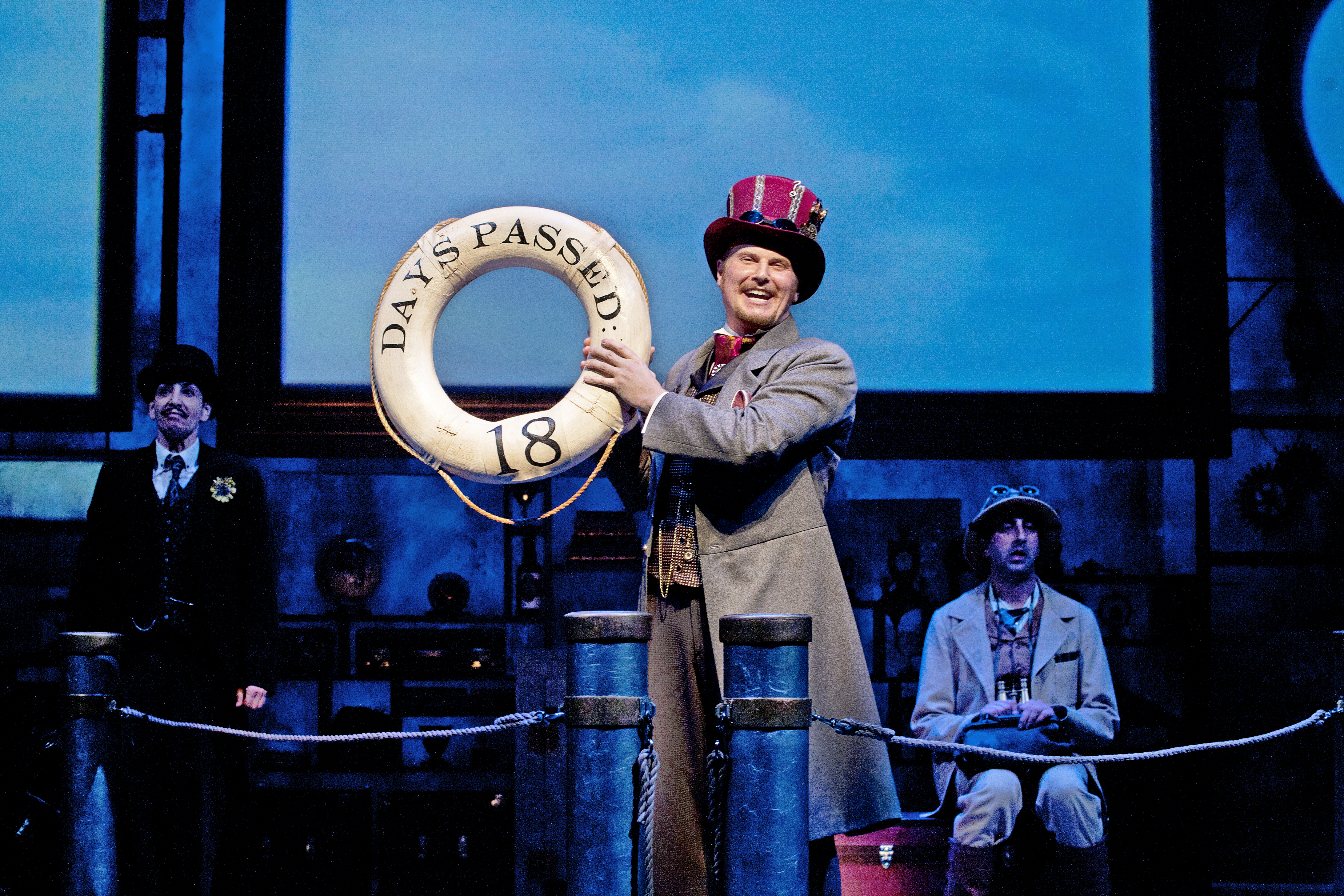
Around the World in 80 Days Natascha Girgis Rylan Wilkie Sanjay Talwar

(l to r) Natascha Girgis playing Passepartout, Rylan Wilkie playing Phileas Fogg and Sanjay Talwar playing Fix of the Yard.  Photo credit: Trudie Lee Photography.

Around the World in 80 Days

November 21 – December 29, 2013

Martha Cohen Theatre

http://www.atplive.com/2013-2014-Season/80_days/index.html

Listen to my full review of Around the World in 80 Days on CBC’s Calgary Eyeopener at http://www.cbc.ca/eyeopener/columnists/theatre/2013/11/25/jessica-goldman-reviews-around-the-world-in-80-days/


RATING

For the kids – The 10-year-old girls I went with (who previously had never heard of Around the World in 80 Days) throughly enjoyed themselves, laughing at all the different characters, accents and zany situations. Whether they should have been made to laugh at some culturally insensitive to downright racist material however, is questionable. MAYBE SEE IT

For the adults – Clever running gags, self-aware comedy that deprecates the plot, gorgeous production design and great energetic performances will keep your interest up. But a mature viewing of this play can’t help but notice the offensive cultural depictions in the script and that might make you wince instead of laugh. MAYBE SEE IT

For the occasional theatre goer – While the story is thin on plot, the result is still loads of fun. Three actors playing twenty characters will wow you and the gorgeous design will make it feel like a special night out. SEE IT

For theatre junkies – There is no doubt that the talent on stage, in the director’s seat and throughout the design team in this production is worth your attention. But if the inappropriate racist elements can’t be weaned out in a modern telling of a story originally written in 1873, then perhaps no matter how gorgeous the production is, it’s time to retire this play. MAYBE SEE IT

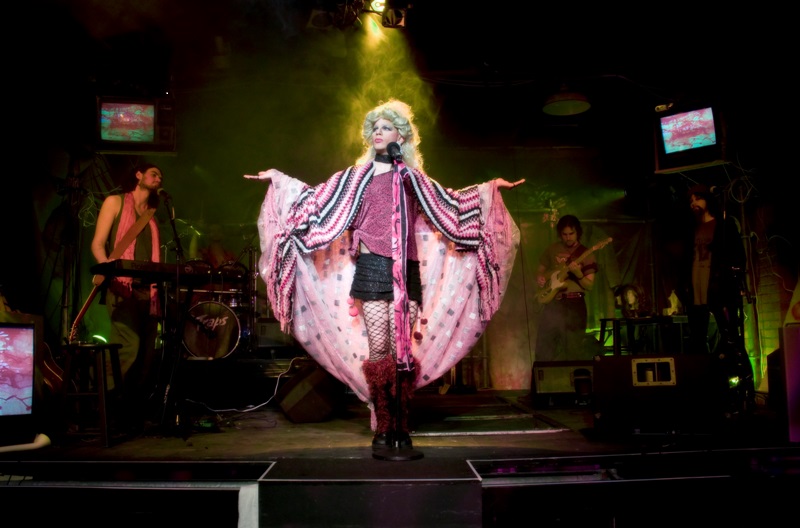
Hedwig and the Angry Inch

Hedwig

Photo Credit: James May

Hedwig and the Angry Inch

November 7 – 17, 2013

Studio in Vertigo Theatre

https://tickets.vertigotheatre.com/TheatreManager/1/login&event=0

Listen to my full review on CBC’s Calgary Eyeopener at http://www.cbc.ca/eyeopener/columnists/theatre/2013/11/11/jessica-goldman-reviews-hedwig/

RATING

For traditional musical lovers – Hedwig is more of a confessional monologue/rock concert than a typical musical. Add to it the sexual nature of the content and the volume of the music and this may not be your cup of tea. MAYBE SEE IT

For alt musical lovers – What Hedwig gets so right is that unlike other rock musicals that just use existing music (Rock of Ages) or those that claim to be rock musicals but are still firmly in show tune land (Jesus Christ Superstar) , the music here is real deal. Loud and raw and obviously influenced by Bowie, Iggy Pop and Lou Reed, Hedwig explodes with energy both musically and in the dialogue. SEE IT

For occasional theatre goers – The drag queen comedy may amuse you and although it’s essentially a monologue, you will not tire of Hedwig’s character. But make no mistake, this show is dark and loud and at times uncomfortable in ways that you may not find entertaining. MAYBE SEE IT

For theatre junkies – I hear so many of you say how tired you are of traditional scripted dramas. Well this will certainly cleanse your palate! Yes the structure is clunky at times and Hedwig’s relationship with his bandmate Yitzhak is poorly crafted and the band often drowns out the lyrics, but all can be forgiven thanks to Geoffrey Ewert’s superlative performance. This is en energetic, well-directed, explosive production that is well worth your time. SEE IT

Unsex’d – Review

www.JaimeVedres.com

Jay Whitehead (seated). Photo Credit – Jaime Vedres.

Unsex’d

October 29 – November 2, 2013

MOTEL in the EPCOR CENTRE

http://www.epcorcentre.org/WhatsOn/ShowDetails.aspx?show_id=F1A07365-B139-41E4-B0B0-1526EB799F45

Listen to my live review from CBC Eyeopener at http://www.cbc.ca/eyeopener/columnists/theatre/2013/10/30/jessica-goldman-unsexd/

Well, I now know what a catamite is. The gist of the word was made fairly clear to me when Wilburn Hussey and Humphrey Hughes, two boy players in Shakespeare’s company, talk about a nobleman with specific sexual proclivities to whom they are to become catamite to. But I confess it wasn’t until I got home and looked the word up that I fully understood the meaning. To save you the trouble, should you be as unaware as I was, a catamite is a passive partner (usually a boy) engaged in anal intercourse with another man (usually an adult). As a language junkie, I was pleased as punch to add a new word to my lexicon thanks to Unsex’d, the new two-hander raunchy comedy by Daniel Judes and Jay Whitehead. However, when learning the word catamite is one of the very few intriguing things a play has to offer, perhaps a night home with Wikipedia would have been time better spent.

Unsex’d , this year’s winner of  Third Street Theatre’s New Queer Theatre Playwriting Competition and co-produced by Theatre Outré, takes place around the 16th century when women were not allowed on stage and boy-players took on the female parts in plays. As the show opens, we meet Wilburn Hussey, a not-so-young and not-so-pretty-anymore boy player in Shakespeare’s company. Wilburn has just made his debut as Juliete in Romeo and Juliette and the reviews are not kind. Not because of his acting necessarily, but because the critics viciously maintain that he’s too old and ugly for the role. The campy, overly emotional Wilburn is devastated and asks the spirits for someone to help him overcome his plight, et voilà, he meets Humphrey Hughes – a young beautiful gay bread seller who happens to love the theatre and is a fan of the older boy player’s work. Wilburn convinces Humphrey to come under his tutelage knowing that if he can teach him to act, Shakespeare will give Humphrey the pretty girl roles and save the really juicy female characters for Wilburn. All goes according to plan until Shakespeare writes Macbeth – finally giving Wilburn a strong female role to play in Lady Macbeth.  Of course Wilburn is thrilled until he loses the role to; you guessed it, Humphrey who inspires the now famous “Out, damned spot” quote after spilling wine on his dress. With the roles reversed the rest of the play deals with themes of young triumphing over old, beauty winning the day and how fame changes people.

At this point let me say that there is nothing so frustrating as a good premise put to waste, and unfortunately this is the case here. Unsex’d  takes what could have been a funny and insightful look into the boy player’s experience and pelts it to death with repetitive and obvious bawdy humour, tiresome camp, and a “dark” side that not only has been done to death, but done with far more panache.

Whitehead and Judes cleverly have their characters speak in pseudo Elizabethan English with many incorporated Shakespearean quotes, but the dialogue is peppered with cussing that is distinctly modern. It’s a nice touch and the cause of many laughs. The cussing turns to more R-rated language when we discover that Wilburn is Shakespeare’s gay lover. The gags at the expense of Will’s apparently small penis may be amusing the first time round, but Whitehead and Judes seem to want to beat the joke to death (no pun intended) by repeating it in some form or another throughout the play. The obvious in the bum, up the bum, let’s show the audience our bum humour that ensues at various graphic levels was supposed to be  comically shocking and or titillating, but was so relentless and transparent that it was rendered boring at best and simply annoying at worst. I’m all for raunchy humour and in this case, the queerer the better in keeping with the theme of the play, but cheap humour is cheap humour no matter what sexuality you put on it. In the case of Unsex’d, these types of easy laughs might appeal to audience members amused by the sight of a gay boy learning to performing cunnilingus by chomping on a tomato, but for me it was yawn-inducing.

But I’ll take this bromidic brand of sexual humour over Wilburn’s ear drum-bursting shrieking any day. Played by Whitehead, eighty percent of Wilburn’s performance sees him in full decibel, over the top camp which gets really tired, really fast. The rest of his performance however when brought down a notch, shows Whitehead to be a far funnier comic actor and wonderfully able to deliver the one serious and poignant moment in the play. Adam Beauchesne as Humphrey seems to have the opposite issue. He’s quite lovely as the shy, gay, boy-player, but when he takes on Lady Macbeth and his fame grows, Beauchesne doesn’t show the ego transformation strongly enough to make the point. My sense is that these are two talented actors who were given some questionable direction by Director Richie Wilcox on how much gas to give their characters and when to ease off the pedal a little.

Which bring us to the claim that Unsex’d has a “dark” side to all its humour. I suppose this refers to the whole youth and beauty and fame thing that happens when Humphrey trumps Wilburn in the play and in Shakespeare’s graces. While no one can claim that the reverence we hold towards youth and beauty isn’t disturbingly skewed or that the desire for fame can make monsters out of us, simply staging these problems without examination is not dark, it’s lazy. Unsex’d brings nothing new to the youth/beauty/fame conversation and in doing so, misses the unique opportunity to discuss the issues from a gay male perspective. For a play written by gay men, produced by two queer theatre companies, this seems like the play’s biggest transgression by far.

In a discussion with a friend after the play it was suggested that there are gay characters, gay themes and then there are gay plays. Unsex’d they contended was a gay play. I interpret this as meaning that perhaps very few audience members outside the gay community would like a play like this. I completely disagree with this notion. Plays, no matter what their subject matter or point of view can be enjoyed by lovers of theatre as long as the quality is there. I have seen and enjoyed many pieces of theatre whose writers I could not personally relate to or whose subject matter was something outside of my individual experience. Unsex’d is a play with a great idea, some clever writing and a few honest laughs along the way. But regardless if you are gay or straight or somewhere in between, Unsex’d is simply not a great play. In fact, to put my own twist on the quote from both Shakespeare’s Macbeth and the characters in Unsex’d, ‘Fair is foul and foul is foul’ when it comes to the end result in this play no matter what your sexual orientation may be.

RATING

For the open-minded – Nudity, strong language, simulated anal sex….. the only caution missing here is violence. There is certainly envelope-pushing going on in this comedy. If this alone makes you giggle, then the play might be your cup of tea. If you want a smarter bite with your raunch, you will be unimpressed. MAYBE SEE IT

For the sensitive. Don’t…just don’t. SKIP IT

For the occasional theater goer – Much of the play is rather sit-comish in its style. If the hefty dollop of queer humour is good with you then this might tickle your funny bone. But be warned, there are elements of a Shakespearean story in this play in both content and language which might put you off. MAYBE SEE IT

For the theatre junkie – A good idea brought down by overeager titillation and comedy that belongs to a La Cage aux Folles era will leave you frustrated and bored. SKIP IT