You’re A Good Man Charlie Brown – Review

The Peanuts gang on their bus.  Sally  by Lisa Lennox), Linus (Guillermo Urra), Lucy (Katherine Fadum), Schroeder (Jeremy Carver-James), and Snoopy (Scott Shpeley). Trudie Lee Photography

You’re A Good Man, Charlie Brown

November 21 – December 30, 2012

Martha Cohen Theatre

http://www.atplive.com/2012-2013-Season/CharlieBrown/index.html

Listen to my live review on CBC’s Eyeopener on Wednesday, November 28 and 8:20 am

http://www.cbc.ca/eyeopener/

The overwhelming thought I had heading into watch ATP’s holiday show, You’re A Good Man, Charlie Brown, was that if the production in any way ruined Snoopy for me, I was never going to forgive them for it. I’m happy to report that my complete adoration of the feisty beagle is still intact and was possibly even enhanced by one actor’s fabulous performance. But puppy love aside, You’re a Good Man, Charlie Brown is no more than a series of comic strip sketches disguised as a musical, giving audiences nothing but thin nostalgia or shallow first discovery to bite into. A bite so unsatisfying that even Snoopy wouldn’t bother.

The show, based on a 1999 Broadway remount of the 1967 original production introduces us to comic strip writer Charles Schulz’s beloved Peanuts gang. Or some of them anyway. Only six of the characters make the cut in the musical: The lovable loser Charlie Brown, his impetuous sister Sally Brown, the bossy and crabby Lucy Van Pelt and her younger brainy and blanet-loving brother Linus, Beethoven fanatic Schroeder and of course Charlie Brown’s dog Snoopy. AWOL from the cast and story are characters such a Peppermint Patty, Pigpen and Snoopy’s sidekick Woodstock.

All hands are on deck in the opening number which sets up Charlie as a “good man” who questions his value and purpose and leaves him wondering, “When do all the good things start?” As I child I never once questioned Charlie Brown’s depressive state and self-hatred. It was just good comic strip fun to laugh at his misfortunes. As an adult I am struck time and time again at how terribly sad a character Charlie is and how his shame and fear speak to the insecurities in all of us. But this is a family musical, not a time for psychoanalysis and with Director Mark Bellamy’s quick direction and wonderfully spirited choreography along with Roger Schultz’s vibrant, colorful cartoon-like set design, the mood of the show is certainly all out fun.

Which is why it’s so disappointing when the fun never really fully materializes. Sure we get to see the characters doing their thing and there is great nostalgia in watching Lucy writhe on the piano lusting after Schroeder or Sally complaining about a bad grade or Linus being brainy. And there are some terrific musical numbers throughout the show. But none of this happens as part of an ongoing narrative. Instead what the production gives us are literal enactments of short cartoon strip gags with no continuing theme or storyline in sight. Some of this is alleviated by the fact that Schulz’s writing is still so witty that when a scene comprises solely of Linus walking onstage, sucking his thumb, taking it out of his mouth and declaring, “I think I lost my taste!” or when Snoopy is shown on top of his dog house musing, “Yesterday I was a dog, today I’m a dog, there is just so little room for advancement”, you can’t help but smile. But these flash card moments grow tiresome when that’s the only thing offered.

And what of the youngsters? Did they relate to this formula? I did hear a lot of giggles at the active gags in the show. But then I also heard a lot of silence during the more adult moments such as Schroeder’s musical number “Beethoven Day”, or Lucy’s rant about Socrates or Sally’s nod to Shakespeare. Whereas the adults seemed to have the most fun not in the action, but in the anticipation of what was to come – the rolling out of Schroeder’s piano, the wall Charlie and Linus rest on, Snoopy dressed as the Flying Ace. These were the moments that anyone over 30 reacted to the most. So who is the target audience for this show? To my mind, it misses both of them. You’re a Good Man, Charlie Brown is neither comprehensive enough for the adult crowd wanting to experience a full story along the lines of the TV specials, It’s the Great Pumpkin, Charlie Brown or A Charlie Brown Christmas. Nor is the show kid-friendly enough to really wow the younger set, many of whom I was told had no or little exposure to Charlie Brown previously and therefore no ingrained loved for the characters.

This is a shame because this hardworking cast did its best to bring the characters to life. Ron Pederson as Charlie, Jeremy Carver-James as Schroeder and Katherine Fadum as Lucy all did admirable jobs with the material they were given. They sang, they danced, and they played out the sketches with valiant talent. Guillermo Urra as Linus was wonderfully sweet in his naïve yet brainy delivery, but I do have to mention that there is something terribly creepy about watching grown man suck his thumb and lovingly caress his blanket without the slightest bit of irony.

However the night really belonged to Lisa Lennox (Sally) and Scot Shpeley (Snoopy).  Affecting a high pitch girly voice, Lennox was a pure ball of energy on stage whose dance moves were only matched by her singing that occasionally dropped the little girl act to reveal a strong, powerful and beautiful voice I’d be happy to hear more of. Shpeley’s Snoopy was an act of pure physical and comedic genius. Whether on all fours or standing upright, Shpeley managed to be dog-like without losing the somewhat human air that Snoopy affects.  And boy can he dance and sing. Shpeley’s big number “Suppertime” in the second act brought the house down and for me was the unmatched highlight of the whole evening. My one complaint about Shpeley has nothing to do with his performance but everything to do with his costuming. Snoopy had no ears. How could Snoopy have no ears? Shpeley was instead outfitted with a black painted nose and a black-brimmed white baseball cap worn backwards that I could only forgive through the force of his brilliant performance.

So between the lack of ears and more importantly, lack of story, in the end I have only two words to say about You’re A Good Man, Charlie Brown. Good grief!

RATING

For the adults – Yes there is nostalgia, but no there isn’t a story.  Yes there are good performances, but no they don’t really go anywhere with them. MAYBE SEE IT

For the kids – Yes there are giggles to be had but no, not all of it will be relatable. Yes there is singing and dancing but no, with a two hour run there isn’t enough to keep the really little ones interested. MAYBE SEE IT

For the theatre junkies – Shpeley and Lennox are terrific, but better to wait until they are cast in something far more interesting than this. SKIP IT
Noise – Review

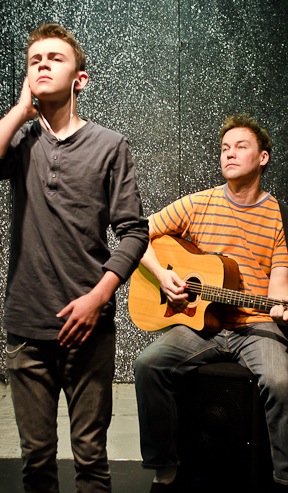
Kris Demeanor (right)  and Robert Morrison (left). Photo credit Justin Michael Carriere

Noise

November 22 – December 2, 2012

Big Secret Theatre

http://www.verbtheatre.com/season

Listen to my live review of Noise on CBC’s Eyeopener on Monday, November 26 at 7:40 am

http://www.cbc.ca/eyeopener/


Noise, Verb Theatre’s world premiere musical for Deaf and hearing audiences, is an extremely ambitious production. Not only does it tackle the challenge of trying to make theatre that has meaning for two distinct audiences, it also incorporates a multi-media element, live music, vibration based sound pieces (music you can feel as well as hear), contemporary dance and traditional acting from Deaf and hearing actors. It’s a lot to squish into one performance. And while I thoroughly applaud the creators for taking a risk and presenting a wholly unique type of theater experience, I left Noise feeling that it wasn’t a fully realized or ultimately satisfying time in the theatre.

Conceived by Verb Co-Artistic Director Jamie Dunsdon, who also directs the show, with live original music by Calgary’s Poet Laureate Kris Demeanor, Noise tells the tale of several different characters. Well truthfully it doesn’t really tell us much about any of the characters, but more on that later. The storylines include a DJ who is losing his hearing, a Deaf woman who has received an implant that lets her hear again, a Deaf astrophysicist who has recently lost her husband and is dealing with a young daughter and an angry, grief-stricken teenage son, a Deaf Occupy Calgary protestor and her interpreter and a man and a woman who meet on an online dating site. In each case, the musical tries to examine the characters’ relationship to sound as their stories get told through sign language, surtitles, dialogue, song, music, dance and video projection.

Many of these elements are done well. In every case that sign language is used, the audience is either given a spoken translation or the action is so meaningful on its own that no explanation is necessary. When the online daters message each other, their words appear as surtitles on the large screen that anchors the back of the stage in a cool bit of design that despite some technical difficulties on the night I saw the performance, was fun to watch. Kris Demeanor’s clever lyrics sung mostly off stage and not by the performers themselves are deliciously surreal yet applicable (big shout out to his line, “Colonel Mustard in the bedroom with the candlestick, maybe he was just trying to set the mood”, which gave everyone old enough to remember the game Clue a good chuckle) But by far the wow factors of the production were the projections courtesy of Production Designer Erin Gruber. I don’t think I’ve ever seen design and video used so extraordinarily and comprehensively in a show. From perfect scenery referencing to actual interaction with the performers to visual representation of sounds to simple mood setting I was totally transfixed by what was happening on-screen. This was a good thing because if I was left to concentrate only on the performers or the narrative, I would have been far less enthusiastic.

It’s often the case that theatre with lots of distracting multimedia effects often falls short in the character development area and Noise is no exception. Each scene is never more than a few minutes long as each performer pops on and off the stage playing one-dimensional characters that are never more than the sound deficit they struggle with. There is no backstory, there is no context, there is no way to engage with any of them. How can you feel for a DJ losing his hearing when you are given no time or space to care about who he is in the first place? How can you be happy for a woman regaining her hearing when that happiness has nothing to attach to?

I’m loathe to critique the individual performers given that they had so little to work with, but despite such weak material, one actress was able to shine. Robyn Mackie as the widow/Astrophysicist managed to draw pathos out of her character while employing her deafness not as an acting accessory but as part of a well-rounded performance.  Mackie is the kind of performer that I wager would be great to watch in any production regardless of the fact that she is a Deaf actress. Hers was the one strong performance in a cast that went from fine to forgettable to amateurish in a play that went on far too long without offering anything concrete.

In the opening scene of the musical, Mackie’s professor character says, “There is more to sound than what you see… today we will see sound, we will feel it.” And Noise, with all its thumping music and visual sound representation certainly lives up to this promise. However in the quiet parts of the production, the places where character and story grow, Noise was a cacophony without a compelling melody.

RATING

For the guys and the girls – I heard someone at intermission say that the projections were “wicked cool”. I’ll up that ante and say the music is interesting as well. But is this all you want in a musical about sound, deafness and character? MAYBE SEE IT

For the occasional theatre goer – Probably too experimental for your tastes regardless of the show’s shortcomings. SKIP IT

For the theatre junkie – It’s almost worth it thanks to the video projections. They will amaze you and up your benchmark for all other shows. But you have to suffer the rest. MAYBE SEE IT

Aviatrix – Review

Chantal Perron as Amelia Earhart in Avaitrix: an unreal story of Amelia Earhart by Matthew Heiti. Photo by Benjamin Laird.


Aviatrix

November 5  – 24, 2012

Lunchbox Theatre

http://www.lunchboxtheatre.com/aviatrix.html


I am a true sucker for a solo show. It strips bare all the bells and whistles of the theatre experience and demands greatness from both the actor and the playwright. When done well, I find this raw exposure of talent terribly interesting and exciting. Mathew Heiti’s  world premiere show Aviatrix, a mostly solo performance about Amelia Earhart’s final voyage, hits many of my excellence benchmarks for this type of one-woman show. Unfortunately, Aviatrix  is also littered with enough shortcomings to keep it from being a truly spectacular show.

The play opens with radio announcements rattling  off all of Amelia’s pre 1937 accomplishments – first woman to fly solo across the Atlantic, speed records set, awards from Congress and even breaking her own records. It’s an impressive list that sets us up to meet the woman herself, played by Chantal Perron who strides out in masculine-style fly gear complete with leather hood and goggles onto a dramatically lit bare stage with nothing but the radio and a stool. It’s her 1937 final flight where she attempts to circumnavigate the globe around the belt of the equator that she wants to talk about.

Heiti employs a past/present/future method to get at the story. Amelia weaves her tale for the audience in three time zones flipping back and forth between moments as the pieces of the story start to fill in. In a nonlinear fashion we learn how her father was the one who introduced her to planes long before he became a drunk and ruined the family. We hear of her relationship with her husband GP and his concerns about her flying. In real-time we get a front row seat to the actual flight as Amelia enacts the fatal trip moment by moment. And we also get a kind of hindsight/after world version of Amelia as she comments on her career and life and speaks to us post-crash. It’s a smart structure for the play and is well-written by Heiti who thankfully trusts his audience enough to be able to follow along with a non-traditional manner of storytelling.

It’s a shame then that Heiti doesn’t trust his audience or his actress enough to let Amelia be the only voice that tells the story. Peppering the play is an out-of-body voiceover (Tyler Rive) that alternatively plays the role of Amelia’s conscious as when it interrupts her talking about an incident to chide “Liar, liar, pants on fire. Tell them what you really told your husband”, to playing Fred, Amelia’s unseen flight navigator.  Both voice overs are utilized to help push the story along. In the first case, it allows Amelia to reveal hard truths or brings audience attention to difficult situations. In the second case, it gives someone for Amelia to banter with when flying. Neither case is necessary and to my mind felt like lazy writing. With stronger work on the narrative, Amelia could have had these conversations herself or with a silent imaginary voice to much greater impact. But my real issue with the voice, was the voice itself or more specifically the actor. Rive’s delivery of both portrayals smacked of amateurish smarm that, while occasionally getting laughs from the audience, was a total wrong turn in style when compared to the rest of the show. I don’t know if Director Pamela Halstead wanted to go for the cheap laughs here, but if so, she did at the expense of breaking the otherwise expertly directed and acted spell that Amelia herself cast.

And to say a spell was put upon us by Perron as Amelia is not just a clever turn of phrase. For the one hour I sat through  Aviatrix , Perron embodied her character with such a fine tooth comb that she became Amelia for me. Whether showing us the tough cookie side of her character, the ferocious intensity when talking about her love of flying, her insecurities about retiring or her pain at her father’s death, every emotion Perron gave us rang true and clear. Physically Perron also did a wonderful job of switching back and forth between walking freely around the stage monologue-style to mimicking her piloting using only a stool to sit on, several well executed leg shakes and shoulder shrugs to make us believe she really was in that cockpit. In fact, I enjoyed Perron’s performance so much that I could even excused the good chunk of overwrought narrative that comprises the last few minutes of the play. If it were not for her excellent handling of what I felt was a hackneyed overselling of the final moments of the show, I might have left disappointed with the play as a whole for ending up in that spot. Instead, I’ll just brush it off as best I can and be thankful that such a talented actress was able to navigate through and beyond it.

A final nod to the production must go to Anton De Groot’s moody and effective lighting which set the stage for the time zone changes and made an otherwise bare stage come to life in our imagination. The fate of Earhart in Aviatrix may have been imagined (as no one really knows what befell Amelia on that final voyage) but with some terrific writing, smart direction and an outstanding performance, the play, despite its flaws, was a theatrical trip worth taking.


RATING

For the girls – It’s a chance to learn more about a woman who, if she isn’t a hero to you already, will probably be once the show is over. At the very least, you would be well within your right to throw a little worship towards Perron for her performance. SEE IT

For the guys – Not a chick play by any stretch. There’s pilot stuff and wanderlust and lots of in-flight action from an Amelia who manages to be one of the guys without being unpalatable. SEE IT

For the occasional theatre goer – Yes the storytelling in unconventional and  there are time shifts to deal with. But with such good acting and a voice over that you will probably be grateful for, you will have no problem enjoying this production. SEE IT

For the theatre junkie – Just ignore the flaws, go for Perron and watch her shine in Heiti’s mostly clever script. SEE IT


Otello – Review

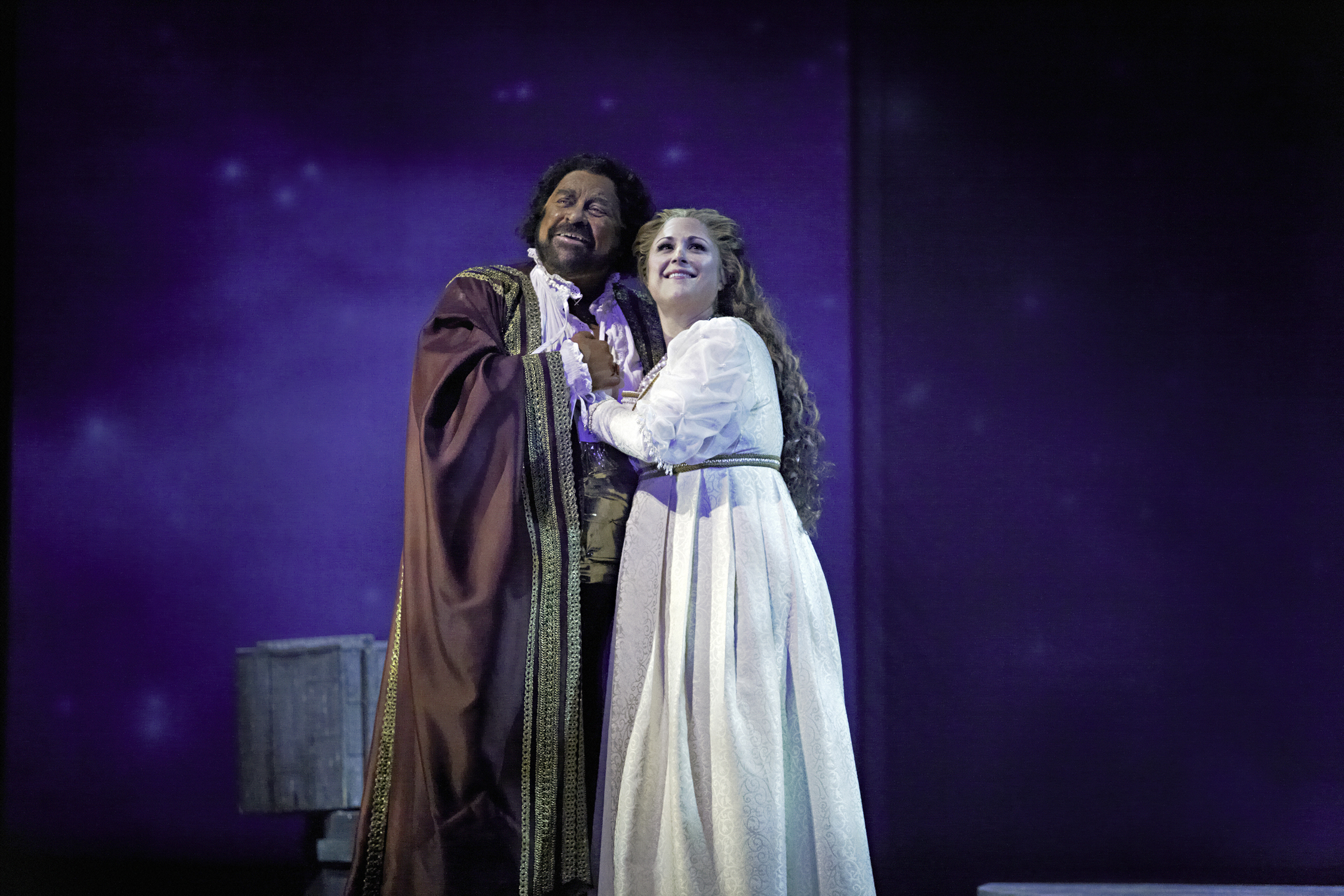
John Mac Master and Joni Henson in Calgary Opera’s Otello.  Photo by Trudie Lee.

Otello

November 17, 21 and 23

Jubilee Auditorium

http://www.calgaryopera.com/performancesandevents/otello/index.php

I had a very interesting discussion with a friend of mine at the intermission of Calgary Opera’s presentation of Verdi’s Otello.  We met up as planned to discuss what we had seen thus far and compare notes. But just as I was starting to lay out my thoughts on the production, my friend chimed in with, “I never actually WATCH an opera; I mostly just close my eyes and listen.” In spite of my issue with this manner of experience, I had to laugh. You see, if I were to employ his method, I would have thought Otello was a wondrously splendid production full of rich resonant voices and sweepingly dramatic music. But I am a theatre person at heart and as much as I find joy in the music/voices in opera, what happens on stage dramatically is crucial for my enjoyment. And in this regard, Otello fell short.

To get the facts and context out of the way first, Otello was Verdi’s penultimate opera and he had to be coaxed from retirement to compose it. It seems that after his masterpiece Aida, Verdi was content to rest on his laurels or perhaps just unsure he had another great work in him. But compose it he did after some encouragement from his colleagues and Otello premiered at La Scala (the world-renowned opera house in Milan) in 1887 to great acclaim. The story goes that when the opening-night curtain came down, Verdi was greeted with roaring cheers and audience members paraded him around the streets of Milan via carriage. Having never seen the production, and with the knowledge of its great reputation, I was extremely excited when, as part of its 2012-13 ode to Verdi, Calgary Opera chose Otello as the season opener.

The opera begins with the second act of Shakespeare’s narrative where we find Otello and Desdemona already in living in Cyprus. The Moor, with his dual titles of Governor of Cyprus and Venetian General, has just returned from a war against the Turks. A storm threatens to put his ship in peril, but the weather abates and Otello comes ashore triumphant. Almost immediately, Iago, still to this day one of literature’s most supreme villains, begins to plant the seeds of romantic suspicion and jealousy in Otello in an effort to advance his own nefarious ambitions.  It’s a powerful story with raw emotion that the audience is well aware ends in abject tragedy. Therefore, the challenge of the opera is to keep us enthralled as we witness such a well-worn tale.

Verdi’s score and Arrigo Boito’s libretto both do a wonderful job of this. Running the gamut between the moody and intellectual discussion of evil sung by Iago, to Otello and Desdemona’s tender love duet to the pledge of vengeance sung by Otello and Iago, the music takes the audience on the roller coaster ride of cresting emotion and out of control rage, jealousy and heartbreak.

Equally affecting are the beautiful voices that give life to the music with not a weak vocal performance in the cast. Of particular note is soprano Joni Henson making her debut with Calgary Opera as Desdemona. Henson’s clear, rich, resonant tones bring beautiful depth and meaning to her character’s confusion and heartbreak and she shines brightly throughout the performance. John Mac Master as Otello also delivers commanding vocal talent, although with very little bravo moments to perform, Mac Master had to settle with being good as opposed to having the opportunity to be great. The real star of the vocal field was Gregory Dahl as Iago. With a Baritone deep and enunciated, Dahl tore perfectly through his moments and offered up a stunning performance that left no doubt as to his evil ways and operatic prowess.

So yes, if I closed my eyes, all was peachy. But as I’ve already stated, look I did and what I saw was terribly disappointing. My most minor quibble was with Scott Reid’s unimaginative and unattractive set design in the first half of the opera which saw the stage wrapped by a dismal painting of a castle with a stone-like replica of stairs and columns in front. Not only did it feel cheap and flimsy but the lack of niche space caused the chorus to bunch up in clusters around the stage affecting a constipated feel to the action. Thankfully Reid greatly improved the visual interest in the second half with his well-realized armory and bedroom designs.

Whatever set issues I had, they could have been easily forgotten if Kelly Robinson’s stage direction provided anything compelling to watch. I have said this so often that I feel like tattooing it on my forehead to save me from one more utterance – opera productions that allow their performers to stand in one place and sing without any physical acting or emotive movement is unacceptable by today’s standards. To be fair, Robinson isn’t guilty of the extreme of this criticism, but more often than not during Otello, performers stood their ground and missed opportunity after opportunity to express their emotions visually. So much so that I found myself completely dismissing the passions they felt out of boredom. When Mac Master sings of his rage and jealousy and thirst for vengeance yet barely moves from the chair he is sitting on or his mark on the stage save for a couple of arm waves, I could barely bother to care.  When Henson sings her Willow Song and Ave Maria in her chamber out sorrow and confusion at Otello’s sudden anger with her yet remains fairly stagnant and stiff throughout, I could conjure no sympathy for the poor dear.

The one character who seemed capable of breaking through this painfully dreary staging was Dahl’s Iago. By far the best actor of the bunch, Dahl managed to emote not just with his magnificent voice, but with his whole body, making him easily stand out in every scene. Yet even with Dahl’s efforts, I thought his physical abilities were grotesquely underused.  Iago is an unctuous, manipulative, malevolent character that should be allowed to almost writhe around the stage with evil intent. I believe that Dahl had the capability (and perhaps the desire) to take his character to this level, but in a production that demands so little from its performers acting and dulls the staging to a slow drone, dramatic ability was obviously not the priority.

Verdi might have been carried through the streets in triumph after his premiere production of Otello, after the production I saw, I just went home frustrated.

RATING

For the occasional opera goer and the opera newbieOtello is a familiar and simple to follow story making it easy to engage with.  While the voices are beautiful, there are no moments in the music that you will recognize or leave humming. A fine but not great night at the opera. MAYBE SEE IT

For the opera junkie – If you are like my friend and are content to close your eyes and listen, you will be more than pleased. But take one peek and the magic burns out quickly. MAYBE SEE IT


It Could Be Any One Of Us – Review

It Could Be Any One of Us

Vertigo Mystery Theatre

November 10 – December 9, 2012

http://www.vertigotheatre.com/main/index.php?site=mystery&id=production&production=27

Listen to my review on CBC’s Eyeopener at http://www.cbc.ca/eyeopener/columnists/theatre/2012/11/16/theatre-review-it-could-be-any-one-of-us/


If I’m to be honest, I wasn’t especially looking forward to seeing Vertigo Theatre’s production of It Could Be Any One Of Us. Yes I know, it was written by acclaimed English Playwright Alan Ayckbourn who has written over 70 plays that have been translated into 35 languages and has been lauded with numerous awards including the 2010 Tony for Lifetime Achievement in the Theatre. Yes I know, multi-talented theatre darling Meg Roe would be directing. And yes, I even knew that the cast had the potential for great things. But see, the thing is, I’m just not a screwball mystery kinda gal. Or at least I wasn’t until all the talent mentioned above came together to create a fun, funny and thoroughly entertaining night in the theatre.

The play opens in a country house inhabited by three adult siblings – all of them total artistic failures. The older brother Mortimer is a composer of atonal and atrociously awful irreverent melodies who never amounted to anything despite winning a music award as a young man. His only talent these days is his ability to be cantankerous and downright nasty to his siblings. His sister Jocelyn is a well-meaning but flighty mystery writer who started to write 34 books but has never managed to actually finish a single one of them.  Then there’s Brinton, a tremendously odd and eccentric weasel of a man who claims he’s a painter though no one has ever seen his work.

The drama begins when Jocelyn’s boyfriend Norris (an insurance investigator who desperately wants to be a detective) comes home and gets into a fight with Mortimer who, in a fit of rage, reveals that he intends to shut his siblings out of his will and instead give the house to a former student of his named Wendy Jones. Carrying out his threat, Mortimer invites Wendy to visit the house and survey her inheritance and almost immediately the attempted murders begin with Wendy being the target of 3 separate potentially fatal incidents. Now of course there’s finally a real murder in the house and don’t worry, I’m not going to spoil the first part of the mystery here and tell you who is actually killed. But its giving nothing away to say that Norris, the wanna-be detective, is more than delighted at his chance to finally solve a real crime. He quickly takes up the murder investigation with gusto, but does about as good as you would expect from an untrained insurance salesman. There’s all sorts of wrong accusations and ridiculous deducing and hiding of evidence until the final scene when the real killer is revealed.

Or at least one of the three killers is revealed – it depends which night you see the play. Ayckbourn is known for experimenting with themes surrounding chance and uncertainty in his scripts and here he takes it one step further and has actually written three separate endings to the play. In the opening scene, the family plays a game of cards which the audience sees as just a regular part of the action, but for the actors, this is the critical narrative moment. Whoever draws the highest card (not shown to the audience) is the murderer for that evening’s performance and the rest of the cast has to adapt accordingly. Frankly I found it a little bit gimmicky and I don’t know that it really adds anything to the audience experience but I’m sure that its great fun for the actors and it certainly seemed like they were having a good time with it.

Goodness knows I was having a good time with them. This is one of the strongest ensemble casts I’ve seen in a long while, with every single one of them delivering a jewel of a performance that was equally funny, smart and fully realized. Russell Roberts as Mortimer was downright and deliciously insufferable, Elinor Holt as Jocelyn had warm but ultimately clueless caring down to a humorous art, Ella Simon as Jocelyn’s daughter Amy played teenage sulking and attitude without any of the usual clichéd sand traps and Vanessa Sabourin as Wendy played the straight woman with impeccable timing. With all these fantastic performers I’m somewhat loathe to single one out as the star, but for me it was Paul Welch as the idiosyncratic Brinton that shone the brightest. With no holding back, Welch gave a very weird and wonderful performance that could have been easily over the top and grating.  But with his balance of just the right amount of physical humour, high emotion and quirkiness I found myself soundly laughing every time he was on stage, sometimes even in spite of myself at things I normally wouldn’t have found funny. It was a tremendous performance in an outstanding cast.

Also impressive was Director Meg Roe. Perhaps better known for her work on stage, directing a mystery was brand new for the much awarded actress who has also never herself acted in a thriller type of play. However the newness didn’t damped the result and Roe’s direction was extremely sure footed and I believe played a large role in my enjoyment of the production. Roe moves her cast constantly throughout the play either in action or in scene and prop changes and her choices are visually stimulating and exciting to watch.  Just as important is her handling of the comedy in the play. Roe lets the reins out enough to let the jokes fly but never so much as to spiral into goofiness and that kept the show witty instead of slapsticky and kept me happily engaged and eager for more.

It’s not often I am this surprised at liking something in the theatre and sure, this type of genre is never going to be top of my personal favourite list. But It Could Be Any One Of Us is a great production, the performances are outstanding and it’s a witty enough script to keep your brain working. This is truly one of those, go and have a good fun night in the theatre, kinda shows. And with quality like this, I’m all for it.


RATING

For everyone – It’s funny, it’s light, it’s extremely well-acted, directed and produced. It might not blow your socks off or stay with you for years to come, but for one delightful night in the theatre, you can’t do much better. SEE IT


Gruesome Playground Injuries – Review

Jamie Konchak and Patrick MacEachern in the Ground Zero Theatre and Hit & Myth production of GRUESOME PLAYGROUND INJURIES by Rajiv Joseph. Photo Credit Trudie Lee 

Gruesome Playground Injuries

November 10 – 24, 2012

The Studio at Vertigo Theatre Centre

http://www.groundzerotheatre.ca/


Some people are bound together by love. Others by misfortune. Then there are some folks who find connection in their shared love of misfortune. Or as is the case for the characters in Gruesome Playground Injuries, their shared love of personal, painful, physical and not so accidental misfortune. Bumps, bruises, breaks and scrapes don’t even begin to describe what Kayleen (Jamie Konchak) and Doug (Patrick MacEachern) do to themselves and conjure in each other in this decidedly unique but not altogether satisfying play by Ravi Joseph.

Best known for his Broadway hit and Pulitzer Prize finalist, Bengal Tiger at the Bagdad Zoo, starring Robin Williams, American playwright Joseph once again peppers his script with the dark comedy he is known for (Joseph also wrote for the Showtime series black comedy Nurse Jackie for a couple seasons), yet Gruesome Playground Injuries somehow lacks the punch and the zest of his previous attempts. And unfortunately the same can be said for Ground Zero Theatre and Hit & Myth’s production which, despite some outstanding production touches and performance moments, missed the mark often enough to drain the bite out of the show.

As the play opens, Kayleen and Doug meet at the elementary school infirmary, he with a cracked head from riding his bike off the roof and she with an unexplained stomach ache that causes bucket-worthy vomiting. Instantly the two are as fascinated with each other’s wounds as they seem to be with their own pain and the play takes us on a 30 year reunion of sorts as they continue to come together in injury in hospitals, at funerals, at mental institutions and just the plain everyday life of harm-junkies. All this is accomplished via open flowing vignettes where the actors go from one age to another by changing clothes on stage and wiping off past blood to make way for the drawing on of new wounds. Set on an antiseptic bare white stage save for Set Designer Deitra Kalyn’s cleverly conceived connected set of cot-like hospital beds, the scene changes are helped along by floor projections giving title to each scene and informing the audience of the character’s age and injury at the time. So audiences are told that a scene is called “Eye Blown Out – Twenty Three” or “Face Split Open – Eight”. All great effects to be sure, but more often than not I found the techno stuff and the readying for the next scene to be far more compelling than the scenes themselves.

Part of the problem falls to the writing. Kayleen and Doug are characters that are barely developed past the injuries they sustain, making it difficult to empathize or care for them even as they suffer so. Joseph keeps the two platonic, but there is no doubt that their shared pain is a bond that is sexual in nature. However once again, without motivation for their actions or attractions, the audience is kept at a distance, fated to only watch, not experience. This would work if the play was a true dark comedy where the gross-out factor and the level of inappropriateness was so extreme that you really only want to watch as though witnessing a car crash. But instead the writing veers towards cutesy too much of the time to be biting:

Doug – I’m accident prone.

Kayleen – Riding on your handlebars down a hill isn’t accident prone, it’s retarded!

Doug -You shouldn’t say retarded; it’s rude to retarded people.

Kayleen – Sorry I offended you.

Ha-ha says the audience in a group giggle. But the spell of the weirdness is broken by the fairly mainstream joke, leaving us with neither darkness nor roaring comedy nor tragedy to hold onto.

The spell of this production was also broken for me by some questionable direction choices and an uneven performance.  With the actors on stage at all times, changing clothes, blood spatters and bandages, there is much to direct in this production and during the narrative part of the story, Director Ryan Luhning does a remarkable job keeping the pace and the pieces just right. It’s during the interstitial moments in the play that Luhning’s vision falters as he allows Konchak to dress and undress employing a silly, bop around the stage kind of treatment. Not only did it seem to mock the story and the audience, but when compared to MacEachern’s straight take on these moments, it felt totally out of place, grating and unintelligently farcical.

The issues with Konchak continued beyond some unfortunate direction. There is a lot to be admired in her performance of Kayleen – the way she brings emotion into the quieter moments of her performance and how she can maintain tension without having to say too much.  But my quibbles with Konchak in this role seem to be my issue with her acting in every role I’ve seen her in – namely that when she emotes strongly it feels forced, as though she has yet to really internalize the lines or the character. In all fairness, there really isn’t that much to inhabit in this role, but when compared to the excellent performance by her co-star, MacEachern, who managed to hit his emotional sweetspots throughout the play, Konchak seemed lacking at times.

There is no doubt that Gruesome Playground Injuries is not a play for everyone. But in the end I’m having a hard time figuring out who the play is for. It isn’t a true tragedy or a black comedy.  It doesn’t have great things to say about our state of connection or our use of pain to disconnect. It’s not that deep. Nor is it quirky enough to just stand on its own. The production certainly had many superb elements in it and while there were some weak spots it should be noted that the production I saw was a preview where the team was still taking notes and putting finishing touches on things. But is a great production worth a not so great play? Perhaps one day someone will make this show either more gruesome or a better story and I’ll feel its injuries more deeply.


RATING

For the guys – I don’t think you will relate to either character, but the manner in which the gore gets realized on stage is a very cool experience as is much of the production. MAYBE SEE IT

For the girls – Not for the weak stomached, but not for the gals who like good dark humour either. There is a self-harm scene that will wallop you emotionally, but the rest might leave you cold. MAYBE SEE IT

For the occasional theater goer – Nope. Not at all. SKIP IT

For the theatre junkie – You will find parts compelling. You won’t care enough to dislike the rest. MAYBE SEE IT