Alberta Ballet’s Othello – Comments

Alberta Ballet dancer Kelley McKinlay as Iago with company artists in Kirk Peterson’s Othello

Photo: Paul McGrath PMG


Othello

October 18 to 20, 2012

Jubilee Auditorium

http://www.albertaballet.com/page/othello/1000552


Let me be clear right from the beginning. This is not a review. While I’ve been going to the ballet for years and enjoy it immensely, I am not a dance critic. Nor would I ever insult the talented men and women who are by writing a performance critique. I am of the belief that if you don’t have the expertise or correct language to fully and cogently evaluate a subject, then it’s best to stay silent.

What these musings attempt to be rather, is nothing other than a compilation of my thoughts from the performance of Alberta Ballet’s Othello. Thoughts that can easily be dismissed as just my personal reaction or perhaps thoughts you can use to inform our own feelings about the production. Either way, here they are in no particular order

Hot for Iago

From the minute Kelley McKinlay took the stage at the start of the ballet in a raw, sinister and sensual solo to the last scene where he is strung up and punished for his crimes, I couldn’t take my eyes off him. Whether he was stunning me with his solo work, amazing me in his duets or simply skulking about at the back of the stage, my attention was riveted to him. Was it his uber talented physicality? Or did choreographer Kirk Peterson give him the best moves? Was it his penetrating acting and emoting? I’d say probably all three and for me it was electric. So much so that at one point I leaned over to my friend and said, “is it wrong that I have the total hots for  Iago?” One look from her told me I wasn’t alone.

That said, I’m not sure that this sexy a Iago works for the narrative of Othello. Why would someone so confident, alluring and masterful be so jealous? What’s the motivation? I have no answers to this and truthfully as I sat there watching McKinlay’s performance, I couldn’t have cared less.

Movie Music?

Jerry Goldsmith’s music for Othello struck me as moody, aggressive and at times overly soundtrack sounding. Not that I didn’t enjoy it, I did to a certain extent. But it was music that I think could have very easily been the backdrop to a Hollywood movie just as easily as it was used on stage.

Maleness

How nice to see a ballet that is so male dominated! Not that I don’t adore ballerinas, but my real joy at the ballet is watching the athletic power and elegance of the male dancers do their thing. And boy do you get a lot of it in Othello.  Of particular delight was the regular occurrence of male duets in the program, not something that is often done but something I would like to see more of. They were exciting and sexy and energetic and I loved every minute of them.

Minimalism

Don’t go to Othello expecting to see ornate sets or grand scenes. Alexander V. Nichols’ set design is economic and fairly bare. At times I felt it was too bare, but for the most part it worked for me. But I will say that just as tired as I was of the huge, dated ornate sets of yesteryear, I am equally getting tired of the minimalist sets that designers are turning out again and again for both the ballet and the opera. I’d like to see something new.

Final thoughts

I thoroughly enjoyed the performance. I found the story to be well told and the choreography and performances to be intriguing and entertaining to watch. Very little dragged for me and more than once I was moved. Usually in a swoony way by Iago (did I say that already? ) but also by many of the other emotional elements of the performance.

Lovely way to spend an evening.


Singing in the Rain – Review

Photo by Mateusz Blach, courtesy of Front Row Centre Players Society. Left to Right; Jarryd Baine, Tanis Laatsch, Graeme Humphrey


Singing In the Rain

October 5 – 20, 2012

Pumphouse Theatre

http://www.frontrowcentre.ca/


A silent-screen leading man finds love while trying to adjust to the coming of sound. No, I’m not giving a description of the recent Oscar-winning movie, The Artist, but rather the 1952 film, Singing in the Rain. And just in case you’re not catching my derisive tone here, I will go on record with my opinion that The Artist was merely a gimmicky imitative version of the far superior Gene Kelly/Debbie Reynolds classic.

In other words, I have fond feelings about the movie Singing in the Rain. Feelings that get rankled when remakes, remounts or retakes are attempted. So it was with some hesitation that I agreed to go and see Front Row Centre’s musical production.

Using the original stage adaptation that spawned the 1983 West End production and the 1985 Broadway run, Front Row Centre’s Singing in the Rain closely adheres to the original plot of the movie. Which is good. But at almost 3 hours running time, the production with its muddy sound, uneven performances and at times soulless efforts, left a lot to be desired. Yes there were some delightfully surprising moments and performances that distracted from the show’s shortcomings for a while. But those shortcomings were plentiful and unfortunately the bright spots couldn’t always make up for what was missing.

The story introduces us to Don Lockwood, a silent film star with roots in musical theatre and his ditzy and untalented beautiful co-star Lina Lamont. While billed as a real couple by the studio to help sell pictures, in real life Don can’t stand Lina, who is convinced that their screen romance is real. The pair and the studio face a crises after the first talking movie, The Jazz Singer, proves to be a smash hit. The studio decides that it has no choice but to produce a talking movie with their own stars, but production issues plague the set and Lina’s hysterically grating voice threatens to ruin not just the film, but the studio itself. After a disastrous first screening, Don’s friend Cosmo Brown comes up with an idea to have Lina lip-sync her part and instead use aspiring actress Kathy Seldon’s beautiful voice in the movie. Lina is furious at the idea, both out of ego and because she knows that Don is falling in love with Kathy. But the overdubbing goes ahead and the movie is a smash success. All seems perfect for the stars and the studio until Lina proves she’s not as dumb as everyone thinks and Don and Cosmo prove that in the end, the sweet and honest characters always have the last laugh in comedic musicals.

Most of the issues I have with this production fall in the lap of Director Jay Newman who seems intent on letting this show run extraneously long and with some serious sound issues. I appreciate wanting to give every single song its due, but with so many superfluous numbers and scenes, the action moved along at a slow jerky pace, often sapping the energy needed in a feel good musical. Half an hour or more could have easily been cut out of the production without affecting the story whatsoever and I was dearly sorry it wasn’t.

However, more problematic was the sound. When faced with a cast that almost uniformly suffered from soft or weak voices, it’s a director’s job to get the actors to project. As my colleague Louis Hobson (Calgary Sun Theatre Critic and director) says to his cast when in the director’s chair, “You can’t make ‘em love you if they don’t hear you!” Too many times during the show the cast was either drowned out by the 16-person live orchestra or could not be heard while simply delivering dialogue. I could have excused this if the production I saw had been a rehearsal or even opening night. But to have these types of missteps halfway through the production is unforgivable.

Not to mention a shame as there were some impressive performances I wish I could have had a clearer picture of. And some I was happy to not have had. Jarryd Baine as Don Lockwood lends a soft, but decent voice to his character and manages at times to exude the charisma required for the role. Baine’s dancing (expertly choreographed by Karen Iwanski) is well executed and while I found his “Singing in the Rain” number to be somewhat soulless in spite of the realistic rain pouring down on him, there is no question that his technical skills are there. Bethany McNab as Lina bites deliciously into her character role, obviously enjoying her turn as the whiny, dumb movie star. McNab really gets to show her stuff in the second act and easily grabbed our attention with her delightfully funny acting and singing.  A serious weak spot in the cast was Tanis Laatsch as Kathy Seldon whose lovely voice could not make up for her stiff and lifeless acting and less than inspired dancing. However, if I only had one performer to talk about, it would be Graeme Humphrey as Cosmo Brown. The most natural and talented dancer/actor of the bunch, Humphrey stole the show with his physically challenging scenes and comedic lines providing the most fun of the night. Whether it was it solo dancing/singing  in the famous “Make ‘em Laugh” number or his duet with Baine in the superbly choreographed and performed “Moses Supposes” musical scene, Humphrey’s combination of nimble dance moves, ease of delivery and comic timing made him the one to watch.

A particular challenge with the stage adaptation of Singing in the Rain is set design. With choppy flash-card scenes and multiple locations to accommodate, sets either need to change dramatically at a rapid-fire pace (which is labour intensive and expensive) or the sets need to be minimal and moveable. It was the latter that Set Designers Bryan Francis and Janos Zeller chose to do with this production, yet instead of being interestingly minimal; the design veered toward looking cheap. Most offensive was the black parachute material curtain used as both a scrim to project the silent and talking movies on and the background for many scenes. Wrinkled as though packed in the bottom of a suitcase and forgotten about for days, the unevenly hung curtain made the projections look amateurish and the scenes it backdropped, unkempt. It was an easy thing to fix and a glaring sore thumb that it wasn’t.

In the end though, Singing in the Rain is really about the songs. Most people know them and love them and go to see the production to hear them all over again. In this regard, the production does deliver nicely. Even with the sound issues and some performance disappointments, the songs were honourably presented and I defy anyone from not singing along in your head or smiling a bit as the favorites play out on stage. If Singing in the Rain was a better show than I’d expected but a less good one then I hoped, well at least I got to hum along with the crowd.


RATING

For the guys – Watching Don and Cosmo horse around and be boys will leave you wishing you could sing and dance. If only the rest was that well done. MAYBE SEE IT

For the girls – The leading lady certainly doesn’t lead in this production. But the boys will charm and you’ll laugh at Lina. MAYBE SEE IT

For the occasional theatre goer – If you loved the movie and want a chance to see the songs done live accompanied by some outstanding choreography, you’re in luck. SEE IT

For the theatre junkie – Keep an eye out for Humphrey in future productions, but stay home and rent the movie if you need a Singing in the Rain fix. SKIP IT


Intimate Apparel – Review

Esther (l) played by Karen Robinson and Mayme (r) played by Abena Malika.  Photo by K&K courtesy of HarderLee Studios.

Intimate Apparel

October 9 to 27, 2012

Martha Cohen Theatre

http://www.atplive.com/2012-2013-Season/IntimateApparel/index.html

Listen to my live review on CBC Eyeopener on Monday October 15th at 7:40 am

http://www.cbc.ca/eyeopener/


If I were asked to create a secondary title for Lynn Nottage’s play, Intimate Apparel, I would call it, ‘Wow it really sucked to be a woman in the early 1900’s’. Black or white, righteous or scandalous, rich or poor, the women in Intimate Apparel are all a deep degree of miserable, powerless, and abused in some form or another. But rather than rising above or striking out at their wretched circumstances, Nottage’s women turn on themselves and each other becoming shallow, weak and frankly pathetic.

This was most certainly not the play I expected to see by a Pulitzer-winning playwright who brags freely that her stories contain strong “warrior women”. If these are the most courageous female characters Nottage can come up with, I would hate to see her take on the frail side of womanhood.

Yet in spite of this tiresome and often times infuriating character development, I couldn’t help but enjoy the production thanks to some superb elements came very close to compensating for an otherwise disappointing whole.

Set in 1905, the play follows Esther (Karen Robinson), a 35-year-old single black woman living in a New York boarding house. To support herself, Esther sews intimate apparel for wildly diverse clients such as Mrs. Van Buren (Julie Orton) a wealthy, white, unhappily married and unloved socialite to Mayme (Abena Malika) a black singer who never realized her dreams of making it big and has turned to prostitution to make a living. Being successful at her job and living a modest lifestyle, Esther has managed to save enough money to open the beauty shop she dreams of owning. But more pressing on her mind is the fact that she is still single, a social status not kindly looked upon for a woman of her age. So when romantic letters start arriving from a Caribbean man named George Armstrong (Andre Sills) who is working in Panama, Esther is quickly smitten. Or as smitten as she can be with someone she has never met. This in contrast to the fact that she’s hiding her affection for a man that she actually knows but can never have, Mr. Marks (Graham Percy) , the Orthodox Jewish fabric salesman Esther buys her materials from. The pair has obvious chemistry and blossoming love for each other, but a more impossible relationship couldn’t exist given the era and their very different religious, ethnic and social backgrounds. Choosing the possible over the desired, Esther agrees to marry George, but is deeply disappointed by the man she finally meets. George, it turns out, is a man who not only shatters her illusions of a happy marriage, but also destroys her ambitions for the future.

Sound depressing? Well, yes sure it is. But that’s not my issue with the storyline. Many of the most lauded plays (and ones I hold dear) have at their centre a dark or gloomy premise. But unlike, say, Death of a Salesman which is depressing in order to address the falsity of the American Dream and the tragic reality of the dysfunctional family, Intimate Apparel says very little via its depression.  Esther is weak and gets taken advantage of, Mrs. Van Buren simply accepts her husband’s abuse and Mayme sleeps with other women’s husbands without compunction because she herself is so broken. All this despair teaches us, is that these women live a victimized spiritless existence with no impetus to change things. While this may have been true for many women of the time, a play that simply snapshots an issue without adding discourse is, to my mind, thin and uninteresting storytelling.

Thankfully however, this can almost be forgotten once you factor in the uniformly outstanding cast, some very deft and creative direction and a set that beautifully allows all the numerous scenes to take place on one, unchanged stage.

Director Nigel Shawn Williams does a fantastic job of moving his cast swiftly and confidently from scene to scene with many details that feel exactly right. Most notable, is his direction of the final scene of Act 1, where Esther and George meet and marry in a matter of seconds with little to no dialogue. It was pure perfection in its elegance and simplicity and a packed a dramatic punch way above its weight class.

There is rarely a time when I am not a fan of Terry Gunvordahl’s imaginative and striking sets, and this is no exception, save for one element. Using only beds and dressing tables and a fantastic representation of a fabric sample shelf stacked high with colour explosion, Gunvordahl creates fully realized separate spaces for the cast to populate.  Shame then about the incongruous modern sunbeam-shaped rod structure that umbrellas the stage. I kept waiting to see if it would become essential or participatory in the action, but was instead disappointed by the fact that it just stood there like a sore thumb you learn to ignore.

Thankfully we don’t wish ignore the fine, hardworking cast in this play. Robinson and Sills as Esther and George both do an impressive job of bringing more depth to their characters than the script actually allows. Kim Roberts as Mrs. Dickson, the boarding house landlady, also manages to give a decent performance  despite having the most clichéd character to work with.  But it was the remaining supporting roles that stole the show in this production.  Orton’s Mrs. Van Buren was a lightning rod on stage commanding and rewarding our attention at every turn. Equal parts entitled and dejected, Orton delivers a character that audiences can guiltlessly hate and love at the same time. Malika’s turn as Mayme is a lesson in ease of intensity and the ability to own a role so fully that one sits in anticipation, waiting to see more of her. Finally, Percy as Mr. Marks is so heartbreakingly sad in his obvious but unexpressed feelings of love for Esther that you literally hold your breath every time he meets her. Percy’s outstanding projection of sweetness and repression was in fact the most interesting thing that happened on stage. If I had my way, Intimate Apparel would have focused far greater on this complicated relationship, giving audiences something more substantial to chew on and a discourse worth having.

RATING

For the girls – You will either spend the play thanking your lucky stars you don’t live in this era or being angered at the weakness and inertness of these female characters.  Your enjoyment will depend on which side of the fence you land. MAYBE SEE IT

For the guys – Women made miserable by men and a male dominated society may not be high on your list of must sees. But the sweet futility of Esther and Mr. Mark’s relationship gives hope that not all men are dogs. MAYBE SEE IT

For the occasional theater goer – The first act drags a bit, but the action is stronger as the play moves along. It’s a very well done production of a simplistic notion that in the end will leave you feeling like you got your money’s worth. SEE IT

For the theatre junkie – Sometimes the joy at seeing an excellent production and outstanding cast trump the fact that the play itself isn’t all that strong. MAYBE SEE IT

Second Chance, First Love – Review

Wes Tritter as Stanley, Adam Beauchesne as Jason and Valerie Pearson as Zelda in Second Chance, First Love by Caroline Russell-King. Photo by Benjamin Laird.


Second Chance, First Love

October 8 to 27, 2012

Lunchbox Theatre

http://www.lunchboxtheatre.com/second-chance-first-love.html


When describing my creative tastes, friends have often remarked that the more disturbing, challenging or dark something is, the more guaranteed I am to like it. And while this is true most of the time, I am by no means immune to the charms of a cute but smart comedy. After all, you’ve gotta lean into the light and laugh once in a while! Happily, Caroline Russell-King’s world premiere of Second Chance, First Loveaffords this pleasure quite heartily through a sweet but intelligent story of former lovers reuniting for a possible return to romance. Actually, when I say heartily I should qualify that the pleasure factor for me rang at high levels for the first 90% of the performance and then distinctly went off the rails at the close of the play – but more on that later.

The story takes place entirely in a room in the Palliser, a swanky hotel in downtown Calgary (designed disappointingly threadbare by Julia Wasilewski). Zelda, a 64-year-old ex-actress has rented the room for her former stage partner, Stanley (a minor acting celebrity also in his sixties) who is in town to perform at the less than critically esteemed Stage West Dinner Theatre. Originally Stanley’s agent had him booked at the downmarket Blackfoot Inn, but Zelda, who has gone on to great wealth due to marrying well, has arranged better digs for her old partner. As she nervously arranges the room and herself for Stanley’s arrival it is apparent that the two were not merely work partners but also romantically paired and that this reunion may not just be Platonic.

It doesn’t take long after Stanley’s arrival at the hotel (which is one of the funniest entrances I’ve seen in years) for the two former lovers/partners to cut through the small talk and expose the raw and sometimes funny truths about their personal lives and theater careers and the possibility of an affair. Or at least an affair for Zelda. Stanley’s wife passed recently and although he was a serial cheater all during his marriage, he promises his feelings for Zelda are relationship-driven and that he wants a second chance to make a life with her. Zelda’s husband is still very much in the picture but is, as she describes him, “a human doing, not a human being” who works all the time and barely see her. Feeling ignored and unloved and bored with her choices in life, it doesn’t take Zelda long to wriggle out of her clothing and ‘support’ underthings in a hilariously written and performed scene and climb into bed with Stanley.

Russell-King is not bashful in the admission that her play is an homage to the great American playwright, Neil Simon. Like Simon, Russell-King’s script tackles the issues and concerns of regular people through a dialogue-rich mix of humour and bittersweet seriousness. It’s a popular model that many have imitated but not all have gotten right. Second Chance, First Love, while not being of the same quick wit and erudite dialogue as a Simon, gets the formula mostly right never falling into cliché or farce to make a point. Or at least it didn’t until the last scene. But for the second time in this review, I’ll reserve discussion of that until later.

First though, a nod to the performers that helped make this play so much fun to watch. From the moment he entered the stage, dressed for Calgary like we lived in perpetual horrific winter, Wes Tritter’s Stanley was a comedic gem to watch. Never overplaying his lines or physicality, Tritter gives us a Stanley that is part cad, part little boy, but all loveable in spite of his failings. A character that we may not know personally, but in Tritter’s hands, one that we absolutely believe could exist and would probably love to hang around with.

Valerie Pearson as Zelda brought the house down in her undressing scene due to her comedic timing and brave ability to show vulnerability on stage in both her physical and emotional semi nakedness. Kudos must also go to Director Gail Hanrahan for her superb staging of this scene. However, playing a somewhat repressed and uptight woman can dangerously lead to some stiff and uptight acting and while Pearson avoided that pitfall whenever playing against Tritter onstage, I felt that without his foil her performance was much less dynamic and natural. Thankfully these scenes were few and of less importance and gave ample room for her to show off her potential in this script.

Less successful was Adam Beauchesne as Jason, the hotel worker. Partly due to a poorly written role (note to the playwright, don’t make Guns N’ Roses jokes to an audience that you know will be predominantly senior citizens) and partly due to acting that felt thin and disconnected, Beauchesne’s time on stage was throw away at best and his plot points unnecessary distractions.

But even with some rough character and narrative edges, Second Chance, First Love had the elements to be a splendid middle brow comedy with an unexpected and extremely moving and compelling ending. But instead of dropping the curtain when Stanley had to suddenly leave the hotel to tend to an ailing friend, the play barreled onward and downward into farce-ville. Pairing Zelda and Jason once again for the final scene simply brought together the two weakest components of the story to undo all the brilliance that went before it. The narrative was absurd as was the acting that accompanied it. I actually found myself wishing I could block out the final minutes of the performance so as not to have to mar my memory of the play. Unfortunately as a reviewer, this isn’t part of my job description. So I watched, and I have now commented. Hopefully with a little luck and time, I’ll forget the last 10 minutes or so and instead remember fondly this delightful and clever play that made me happy not to be disturbed.


RATING

For the guys – Whether you’ve let one get away or not, you’ll relate to Stanley’s desire to rekindle past love and find his methods hilarious in the process. SEE IT

For the girls – Zelda’s undressing scene alone is worth the price of admission. But so are many of the other discussions and situations the narrative covers. SEE IT

For the occasional theater goer – You will laugh all the way through and never be uncomfortable with the language or sexual situation. SEE IT

For the theatre junkie – If you can turn off your brain during the final few minutes of the play, you will enjoy a fabulously fun, not overly formulaic hour in the theatre. MAYBE SEE IT

Pink Sugar – Review

Paul Sutherland as Max and Laryssa Yanchak as Sylvie


Pink Sugar

September 25 – 29, 2012

Theatre Junction Studio

https://tickets.theatrejunction.com/TheatreManager/1/login&event=0


I had initially decided against seeing and reviewing Pink Sugar. Not because the play didn’t interest me, but because my schedule only allowed for one play this week and a highly recommended production of The Shakespeare Company’s Hamlet won that slot. Decision made, end of story. Or so I thought.

But yesterday I got an email message from Pink Sugar’s playwright urging me to reconsider my choice:

“Come See Pink Sugar! I remember reading a review from you here where you were wishing that a show that dealt with human trafficking would have dug in a bit deeper…. Pink Sugar is really an attempt to do this. Shakespeare is dead and unlikely to benefit from the critical exchange. Seriously, if you can squeeze it in would love to hear your thoughts.

Natalie Meisner (the writer)”

Apart from making me laugh, Ms. Meisner’s comments cleverly threw my own theatre criticism back at me. She was right; I had been disappointed by a recent human trafficking play and was looking for a better treatment of the subject.  So the claim that her story was superior and the invitation to see and provide feedback was just too tempting. Squeeze it in I did.

Meisner was certainly right, Pink Sugar does dig deeper and provide the more complex and nuanced examination of human trafficking that I was hoping for. It does this however through a deeply uneven narrative that unnecessarily mixes genres, relies at times on gimmick and doesn’t know when to end.

The story is told through a series of four interwoven monologues that occasionally cross paths to form two-character dialogue. Spencer is a Canadian 20-something who takes a post-graduation trip to a World Cup match in a foreign country that either I failed to catch or wasn’t mentioned. At the match he spots Elan, an enticing Moldavian girl who quickly seduces him and whisks him away to countless countries under the haze of the drugs she feeds him in order to eventually steal his kidney.  Providing the counterbalance to this story is Max, a 40-something looser in life dialysis patient driven by desperation and lack of other options to illegally purchase a new kidney. Sylvie, a high stakes dealer in all things illegal from weapons to drugs to people to people’s parts provides the means for Max’s purchase.

All four characters populate the stage throughout the play as they each take turns telling their part in the organ trafficking and the backstory of how they came to be involved. It could have been a smart and powerful way to get at this intricate, nefarious and emotional issue. And in the case of three of the characters it was.

Sylvia Niederberger as Elan not only nailed her accent with precision and authenticity, her haunting delivery of a woman so broken by psychological and physical trauma and terror was flawless.  Meisner’s writing of this character as a villain/victim beautifully highlighted shades of gray, the grit of the issue and provided some hard truths to absorb.

Laryssa Yanchak as Sylvie, the hard as nails contraband dealer, also delivered a strong performance and pulled as much believability out of this over the top role as she could. In another actor’s hands Sylvie could have been dominatrix-like or even campy, but Yanchak found the subtleties in Meisner’s not too subtle writing of this character and rounded just enough edges to make her darkly and disturbingly compelling.

But for me, the standout was Paul Sutherland as Max. His ability to simultaneously play his character’s backstory and present day reality in a quiet elegant whirlwind of tension and emotion was magic to behold. Whether playing his character drunk or scared or bitter, Sutherland moved effortlessly inside Max and presented us with a performance that penetrated far beyond the role he was playing.

Unfortunately when it came to Spencer, things fell apart on all levels. Far from the interesting yet troubled realities of his co-characters, Spencer is one-dimensional, weirdly sarcastic and without authentic motivation. I didn’t believe his instant love for Elan or his somewhat comedic suffering post-surgery and I had to hold back gags when despite everything he still says he wants Elan back. Making matters worse was Kyall Rakoz’s performance. William Shaterner-esque in his cadence, Rakoz came across as smarmy and cardboard as though he himself didn’t believe the lines he was delivering.

If Meisner was trying to infuse some levity and dark humour with Spencer’s character, she blew the flippancy top off with Spencer’s kidney. Projected on a screen as a crudely drawn cartoon character, the animated kidney shows up three times throughout the show to sling dark jokes about the organ trade and the value we place on life. I’m the first person to applaud black humour, but in this case, the kidney wasn’t all that funny or interesting and it felt like I was watching Meisner’s conceit rather than an integral part of the performance.  More importantly, the jarring juxtaposition of the serious and disturbing narrative of Elan, Sylvie and Max against the barely amusing kidney cartoon felt extremely disjointed. Meisner would have been far wiser to make the kidney a more sinister and dark character and leave the gimmicky yuks for another time.

Directed with economy that was simple yet visually interesting, Jason Mehmel does a nice job allowing each character room to tell their stories.  But even his sure-footed staging can’t stop the play from rambling at the end, way overshooting the high note it could have gone out on. Instead we get silly resolutions to some characters and just too much dialogue from others. This is too bad as there was a moment about ten minutes from the close of the play where Max calls for one last drink that I think would have been a superb and dramatic final line.

I think given time I will mostly remember the good of this production due to the fantastic performances of three talented actors and some intelligent writing by Meisner. But for now I can’t help feeling the frustration of seeing another yet play about human trafficking that didn’t hit the mark.


RATING

For the guys and girls – Some very good insights into the issue of human and organ trafficking delivered by some excellent performers. But the play itself is lacking the weight of its subject. MAYBE SEE IT

For the occasional theater goer – Way too alternative and nonlinear for your liking. Neither successfully serious nor laughably funny, this play will lose you right from the start. SKIP IT

For the theatre junkie – What works well, works really well and the parts that don’t are bearable. Especially when you consider Sutherland’s outstanding performance. MAYBE SEE IT

Back at it

Forgive my absence over the past two weeks, but even declared theatre junkies need a vacation once in a while. Mine came in the form of lions and leopards and elephants all courtesy of the remarkable and beautiful country of Kenya. Sadly the safari is over, I survived the 22 hour flight home yesterday and once I shake the jet lag I’ll be back to reviewing as usual.

There were four plays that I missed being out-of-town and all four are coming to a close this weekend or shortly after. Between taking a day or two to recalibrate and getting ready for the next round of productions, I decided that I only had the bandwidth to see one of them. My choices were, Double Indemnity at Vertigo Theatre, Pink Sugar at Theatre Junction GRAND, A Steady Rain at EPCOR Centre’s Motel or Hamlet also at Vertigo Theatre.

I saw A Steady Rain in New York with Daniel Craig and Hugh Jackman a couple of years ago and while both actors did a fine job, I wasn’t a big fan of the play. I found it to be wordy without necessarily being interesting and infused with shock value more for the sake of  sensationalism than a compelling story arc. Ok , so that was out.

Double indemnity, to be frank, just didn’t interest me all that much no matter how gorgeous I hear the set design is. With Terry Gunvordahl as the designer I have no doubt that the stage looks spectacular. But I need more than that – so pass on that one.

So it came down to a play I know very well to one I haven’t seen before – the famous story of a troubled Prince or a play about stolen body parts. And while I wish I could see both Pink Sugar and Hamlet, I’ve decided that Hamlet it is. Mostly because of the onslaught of emails I received from sources I trust telling me it is a must see on several fronts and also because I’m a fan of The Shakespeare Company’s work and am eager to see their first production with Haysam Kadri as Artistic Producer and director.

Yes, I am having guilt pangs at missing Pink Sugar. And given the right circumstances MIGHT be talked into squeezing it in. But I’ll need your help with that. Please, if you see it and feel it is something I should catch, drop me a line and let me know. Unfortunately I won’t be able to offer up full reviews for either production because of timing issues, but every show I see does become eligible for our annual Calgary Critics’ Awards.

Look forward to your thoughts and see you in the theatre!


Next to Normal – Review

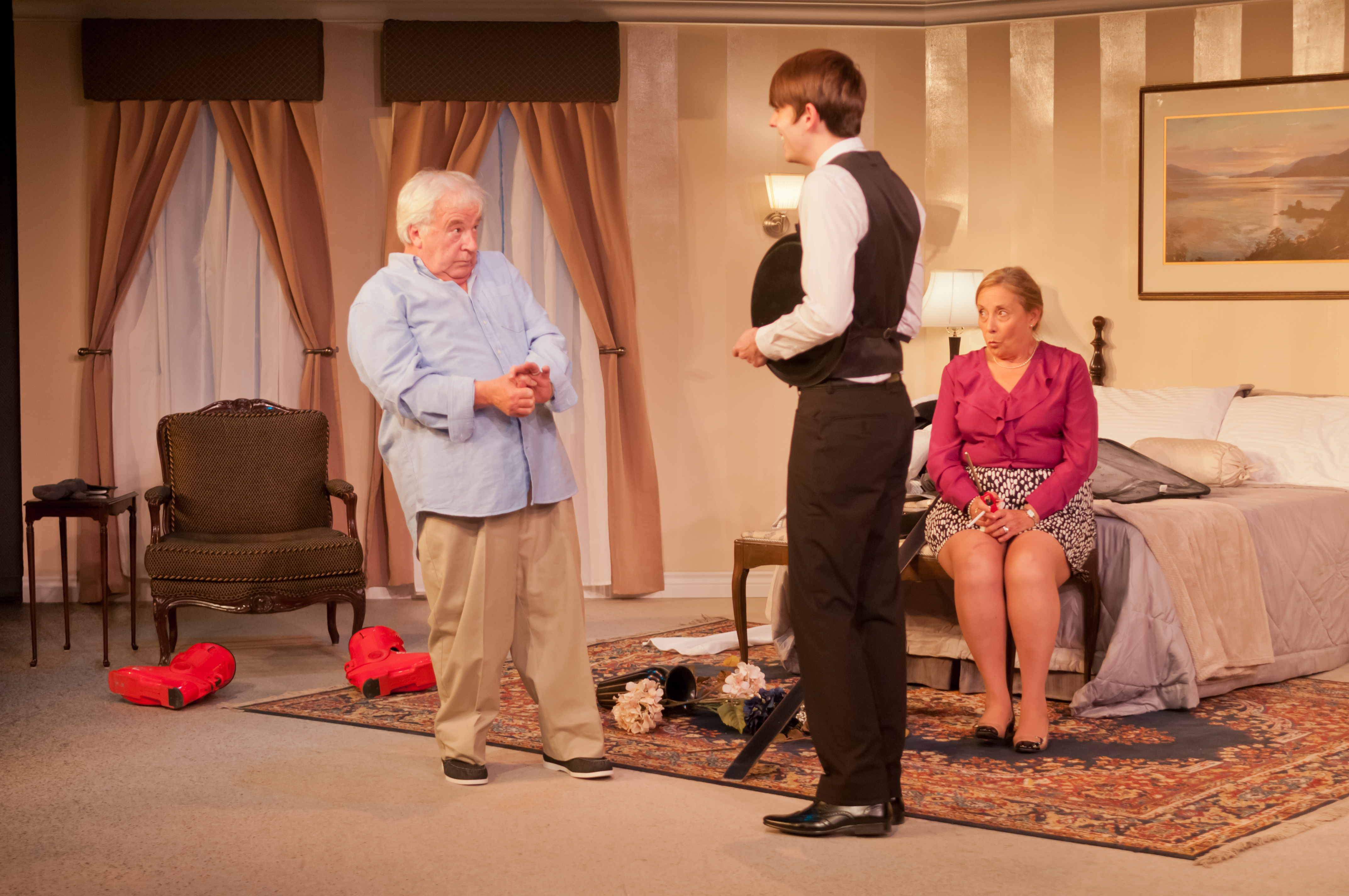
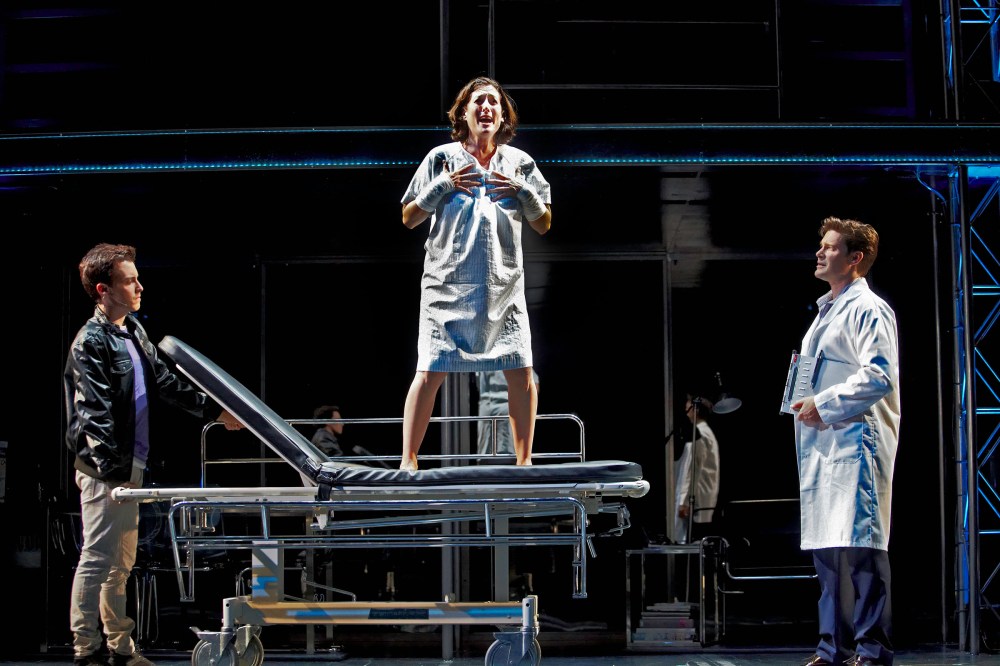
(l to r) Robert Markus as Gabe, Kathryn Akin as Diana, John Ullyatt as Dr. Madden in NEXT TO NORMAL.  Photo by Trudie Lee.

 Next to Normal

Sept 11 to 30, 2012

Max Bell Theatre

http://theatrecalgary.com/plays/next_to_normal/more_info/

Listen to my live review on CBC Eyeopener on Monday September 16th http://www.cbc.ca/eyeopener/


I might as well just come out and say it. I am so proud of Theater Calgary for starting their season off with Next to Normal. It’s a thoroughly modern, unique and risky production and I heartily applaud their gutsy decision to bring this little known (in Calgary), but critically acclaimed huge Broadway hit to their stage. I believe Calgary audiences are sophisticated and curious enough to embrace this kind of intelligent and entertaining programming and not just settle for the same old rehashes of “safe” plays. Yes CATS and Shirley Valentine and To Kill A Mockingbird…. I mean you!

OK, soapbox put away. Let’s get to the business of reviewing.

Next to Normal opened on Broadway in 2009, was nominated for 11 Tony Awards and won three including Best Original Score. Perhaps even more importantly, it won the 2010 Pulitzer Prize for Drama, becoming just the 8th musical in history to receive that honour.  (Two other such honorees you may know of being Rent and A Chorus Line.)

The story centers on the Goodmans, a seemingly normal family that is being slowly torn apart by the fact that Diana, the mother, has been suffering from bipolar disorder for the past sixteen years. Also called manic depression, bipolar condition is a mood disorder that results in serious, even drastic changes in personality alternating between highs (mania) and lows (depression). The family has pretty much learned to take it day by day with Diana as they never really know which side of her they’re going to get. Even more upsetting is that despite all the pills and the therapy Diana is getting no better and is perhaps even worse. As the musical opens, we witness Diana’s latest mental crises and the story chronicles her attempts to get better, this time through some pretty extreme types of treatment. In addition to Diana’s struggle, the musical presents a refreshingly realistic look at the effects of bipolar disorder on the family and how each of them is affected and compromised as a result of the illness.

With a subject like this, Next to Normal could have easily been a heavy dramatic play. But what makes this such an interesting production is that Tom Kitt who wrote the music and Brian Yorkey who did the book and lyrics decided to tell this story in short, flashcard type scenes using rock music and singing that pretty much populates the entire performance.

The music comprises mainly of electric guitar and bass with a lot of heavy drum beats and occasional softer rock ballad type numbers that use acoustic instruments for effect. None of the tunes are particularly memorable or hummable but in this musical that’s okay, it’s the lyrics that count. Concise and clear, clever and intellectual, emotional and raw, the lyrics to the songbook of Next to Normal carry the story and bring it to life for us. When Diana, dulled by the medication she’s taking, longs for an end to the fog, she sings a number called I Miss the Mountains about wanting to be able to feel the highs and lows of life again.  It’s a beautifully articulated number that elicits the kind of sympathy and understanding mere dialogue wouldn’t  be able to create.

Another song, this time sung by Diana’s daughter Natalie, called Superboy and the Invisible Girl, powerfully illustrates her feelings of neglect and abandonment because of her mom’s situation. Again it’s raw and real and the lyrics tug at you without an ounce of drippy sentiment.

Sound, however was a big issue in the performance I saw.  With a sound mix that saw the music thoroughly overpowering the singing on almost all counts, I found myself either straining furiously trying to hear the lyrics or simply not being able to hear the words at all. It was a frustrating and headache-inducing experience that I’m sincerely hoping they quickly resolve as this is a show where you don’t want to miss a word.

Especially since they are sung by some impressively strong performers. Kathryn Akin as Diana delivered a performance with flawless tonal and emotional accuracy. She gracefully imbued her character with intelligence, humour and a believably fragile mental state.  Akin’s duality of a strong yet subtle at times singing voice brought lovely nuances to this complex character. Sara Farb as Natalie, the daughter was stunning in her frustration and pain communicated through strong and emotional singing. Robert Markus as Gabe, the son, plays a pivotal and surprising role in the musical (no spoilers in this review) and was without a doubt the strongest and most compelling voice on stage. A surprise standout for me was Michael Cox in his supporting role as Henry, Natalie’s boyfriend.  Natural in his acting and captivatingly sweet in his singing, Cox was a small gem of a performance to watch.

I wish I could praise the cast as a whole, but there was one disappointing weak link for me. Rejean Cournoyer as Dan, the father, lacked any real chemistry with the other cast members and his somewhat stiff and forced performance made it seem as though he was uncomfortable in the role. To add insult to injury, his voice while passable, just didn’t seem up to the demands of this production. It wasn’t a tragic turn by any stretch, but with such a good cast around him, Cournoyer seemed lacking.

Rounding out the production were Cory Sincennes’  simple and stripped down set designs composed of steel girder-like structures supporting two catwalks, turning the stage into a  three-storey structure for the actors to populate.  Chairs and tables were wheeled in and out when needed, but the effect was distinctly bare with dark lighting and ethereal rain effects in the background. Minimal sets don’t always succeed or enhance a production, but in this case I think the choice worked. Perhaps a kind of a metaphor for the dark and stark emotions the entire family is feeling or at the very least providing no distraction from the powerful emotions being communicated in the show, the unadorned set was something I was actually grateful for.

If there is one final thing to be appreciative of in this production, it’s Ron Jenkin’s sure handed direction.  An immense talent, Jenkins once again populates his stage with visually interesting movement and some tremendously courageous performances. Whether the scene was dark and upsetting or lighter and even humorous, Jenkins never over-wrings the emotion out of the script and instead trusts in his audiences’ acumen to connect strongly with the action.

Next to Normal is a roller coaster of a story where nothing is neatly solved or even solved at all. Dubbed an anti-musical by some, there is most definitely no light and breezy ‘Surrey with a fringe on top’ kinda number. And while I certainly don’t think that every musical should aspire to this type of production, I really respect the story Next to Normal tells and how they tell it. It is utterly unique to see a musical tackle real, messy, disturbing situations and present it an entertaining but also thought-provoking kind of show. A show that doesn’t talk down to its audience or try to heavy handedly teach us something about mental illness. Next to Normal present the reality and then lets its audience sit and think about it. This is definitely the kind of theatre I embrace and if Calgarians are willing to try something new, I think they’ll feel as excited by this production as I am.

RATING

For the guys – Don’t let a bipolar female character scare you away. Mental illness knows no gender and neither does this story. The issues and emotions will affect you deeply as you find ways to relate to each of the characters in this show. SEE IT

For the girls – No ‘crazy lady’ stereotypes here. The women in Next to Normal are treated with respect and offer up remarkably realistic portraits of emotion and frustration and even moments of joy. SEE IT

For the occasional theatre goer – Probably not the feel good musical that you gravitate towards and this may be too modern and alternative for you. But if you want to stretch yourself and see what a musical about real life problems is like, this is the one to go to. MAYBE SEE IT

For the theatre junkie – It’s an important and compelling show to add to your cannon and happily, Theatre Calgary presents a performance worthy of all the accolades. SEE IT

The Bob Shivery Show – Review

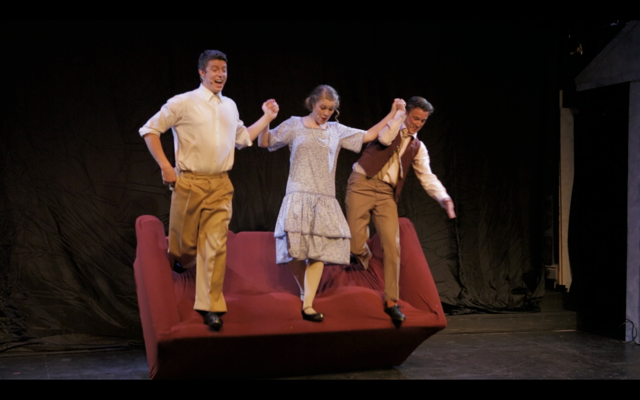
Esther Purves-Smith as Germaine, David LeReaney as Frank, Trevor Rueger as Bob Shivery and Karen Johnson-Diamond as Corporal Blunt in The Bob Shivery Show by David Sealy, directed by Michael Kennard. Photo by Benjamin Laird.

The Bob Shivery Show

September 10 – 29, 2012

Lunchbox Theatre

http://www.lunchboxtheatre.com/the-bob-shivery-show.html

Listen to my review on CBC’s Eyeopener at http://www.cbc.ca/eyeopener/columnists/theatre/2012/09/11/jessica-goldman-reviews-the-bob-shivery-show/

Lunchbox Theatre kicked off their 2012/13 offerings with the world premiere of David Sealy’s The Bob Shivery Show, a comedy about one man’s journey to win back the girl he loves.  It’s only the second play I’ve seen this season and I’m already willing to bet that it’ll be the worst show I will see all year. Or at least I’m hoping it will be, because frankly I won’t be able to take many more like it.

Not witty enough to be interesting, not slapsticky enough to be funny, the play’s dialogue and characters are terribly one-dimensional (sometimes even half dimensional if there is such a thing), the set design is pathetically ugly, the performances weak and the gimmicks so poorly conceived that I truly have nothing positive to say.

Unfortunately being a critic, I can’t abide by the old adage of saying nothing when the saying will be unkind. Instead I will do my best to explain.

The story is essentially a poor man’s comedic riff on the famous German Faust legend in which a man signs a contract with the Devil to get what he otherwise can’t have. In this case Bob Shivery is a nerdy Saskatchewan postal worker in love with Germaine, a mousey public school principal. We have no idea how they met, why they are friends or even what Bob sees in Germaine, yet we expected to believe that he is desperately in love, but too afraid to tell her. Cue obvious fawning and awkward body language.

Two minutes into the play Germaine tells Bob that she’s met someone in Calgary – a big shot lawyer working for an oil company (and by the way we’re all supposed to find this hilarious in a ‘poke fun at Calgary’ kinda way). Germaine announces that she is moving to Calgary to live with the lawyer for a bit before she decides whether or not to accept his marriage proposal. Bob is devastated, but still inert – until he meets Frank, a flashy insurance salesman who offers him a contract where he can get whatever he wants, even Germaine, for an undisclosed price to be named at a later date. Bob resists the agent, who he outs as the Devil right away, or at the very least an agent of hell, and decides to chase after Germaine all on his own. With Frank following him and tempting him every step of the way, Bob encounters several ridiculous and tiresome scenarios until he finally finds Germaine.

As if this wasn’t bad enough, throughout the show are two recurring gimmicks that were at once out-of-place and unnecessary. The less egregious of the two was the game show voice-over treatment that popped up every time a scene change was going on. Modelled after the “This is your Life” type of bio snippets, the voice would espouse updates on Bob’s progress with catch phrases to no great effect. In fact, other than the title of the play which is obviously game-showish in its wording, I have no idea what the point of this effect was. It didn’t add or enhance anything in the script and as far as I can tell is just an excuse to use the disco ball and distract the audience from the sloppy scene changes.

The other ploy was to give voice to Germaine’s cat Snowy via a hand puppet with a French accent. Several times in the play, Snowy speaks to Bob encouraging him to go after Germaine and tell her how he feels. I’m sure it was meant to be hilarious, but my feeling is that if you need to rely on an anthropomorphic kitty to get laughs, maybe you should rethink your script.

Here’s what really boggles my mind about this play, it’s been workshopped twice already in Calgary at Lunchbox’s Stage One Festival in 2010 and 2012. What that means is that The Bob Shivery Show was seen and worked on by professional directors, actors, writers and even had public feedback sessions and yet it’s STILL this bad. I cringe to think what Sealy’s script was like before it was helped along. Not to mention the fact that thousands of dollars have been spent developing this show – money that in my opinion could have been put toward a much more worthy production.

I have great pity for actors who find themselves in less than stellar plays. I often feel embarrassed for them as they try to make some good out of a bad script. But in this case, I felt that for the most part, the performances were as weak as the play itself. Trevor Rueger plays Bob, or should I say shouts Bob. Lunchbox is not that big a theatre and I have no idea why Rueger felt the need to bellow his lines like he was performing at Lincoln Centre. Perhaps it was to make up for his inability to bring any warmth or humanness to his mechanical character. Karen Johnson Diamond, playing a painfully unfunny police officer, took on most of the physical humour but played it heavy-handed and just too overly broad to be considered humorous or decent acting. Part of the blame for this must go to Director Michael Kennard of Mump & Smoot fame, who let his actors flail around gracelessly and stiffly from one scene to the next sucking any possible humour out of the experience. Fairing a bit better was David LeReaney as Frank the insurance salesman/Devil character and Esther Purves-Smith as Germaine. Both actors had some success at not falling into the clichéd trap of the dialogue and at least delivered performances that didn’t make me wince.

When it came to the set, the issue was the opposite from the script. Whereas the dialogue was over the top and laden with loud and obvious jokes, Scott Reid’s set was stark and cold and just plain ugly.  I have no issue with a propless set. For some shows it adds tremendous drama and tension to the performance. But with bare walls, and one or two unremarkable props in each scene, it felt cheap and unfinished and not befitting a professional theatre company at all.

Do I have ideas on how to make this play better? Sure, I guess. But rather than rework the tired old contract with the Devil, love the girl but afraid to tell her tropes, I would much rather spend my time seeing new and interesting stories that take a risk and offer up a unique theatre experience. The Bob Shivery Show, no matter how many time you workshop it, will never be that show.

RATING

For everyone – I disliked this play so much that I simply can’t bring myself to spend time thinking about why each of you shouldn’t go. SKIP IT

Sexy Laundry – Review

Sexy Laundry

September 5th – November 4th, 2012

Stage West

http://www.stagewestcalgary.com/shows.html

Listen to my review from this morning on CBC Eyeopener http://www.cbc.ca/eyeopener/columnists/theatre/2012/09/06/jessica-goldman—sexy-laundry/


You know those obvious but mildly amusing PG-rated risqué jokes that you can tell your grandparents without feeling embarrassed? Well expand that joke into a one-act, two-hander comedy about a married couple trying to put the spice back into their relationship and you have the play Sexy Laundry.

The show, written by Canadian playwright Michelle Riml, was first performed at the Vancouver Fringe Festival in 2002 and has  gone on to become something of a world-wide phenomenon in the light comedy circuit. To date, Sexy Laundry has been performed not just across Canada, but also in the US, Britain, South Africa and Germany with several translations pushing  the wide appeal of the play.

The show opens with Alice and Henry, a married couple of 25 years, in a room at the L Hotel, the latest, hottest, trendy, expensive hotel in town. Alice has rented the hotel room for the weekend so that she and Henry can spend some time trying to spice up their relationship and bring romance and passion back into their marriage. You see, Alice is pretty dissatisfied with the way things are going and Henry is pretty dissatisfied with Alice’s nagging him to change all the time. Cue standard comic fodder.

The added amusing catalyst to the story is that Alice has brought along a Sex for Dummies manual in the hopes that the book’s exercises will help the couple become more connected sexually. Alice and Henry make half-hearted attempts at activities such as  ‘share your fantasy’ or ‘give nicknames to your partner’s sexual body parts’,  but instead of getting closer and more intimate, the couple spend most of the time fighting about their relationship and what is missing from the marriage. Possibly to the point of a breakup.

So we watch as the obvious lines, arguments and punch lines get thrown around and occasionally they are amusing, as when after hearing Alice’s threesome fantasy Henry says he wishes she fantasized about some more normal like meadows and white knights. Alice responds with “I think you are confusing my fantasies with a Maxi-pad commercial!” Cute enough.  Sometimes the writing is even surprisingly insightful on the gender divide and the problems that arise when a marriage goes stale, as when Henry complains that he signed up for a weekend of passion and all he’s got is Alice complaining about everything he does. “I am who I am, Alice”, he says. “No you are not Henry”, says Alice. “You are a shadow of who you used to be”.  Nice line I thought.

But other than these few little lovely moments, the script lurches from one clichéd joke to another with comedic writing that personifies a ‘been there done that’ experience. Sure they get the easy giggles from audience members who like to see the same old dynamics played out on the stage, but frankly I was bored and ached for a more inventive and surprising way of telling this story.

So I suppose I can’t completely fault ex Falcon Crest star, William Remington Moses for his fine but not great performance.  Moses plays Henry, a straight-laced, mildly successful, frugal engineer who just wants to come home, watch the news and not be bothered with talking about feelings or worrying about intimacy issues. Not a bad guy, just a middle-aged man who loves his wife and doesn’t want to think too much about it. On top of the mostly banal writing, Henry is not a particularly interesting role to play –  a fairly obvious kind of character who is dramatized for his quirks rather than as a full character. Without much to work with, Moses does a fine job, however I found him a little too unmodulated in his emotional range at times. In his hands, Henry seems the same whether he’s mad or surprised or upset and it further dilutes his already dull character. But the sameness wasn’t intolerably glaring and Moses did manage to bring a nice ease to the role that at least made Henry somewhat believable and made the clichéd lines bearable to watch.

Ease however is not how I would describe Jane Spidell’s acting. Alice’s character is the one that gets all the personality and all the funny lines and it should be a role an actor has fun with. Spidell was caught up in trying so hard to “Capital A” act this part that she felt forced and stiff and pretty much undercut any chemistry the couple had on stage.  However, just as I was going to write Spidell off completely, she delivered a monologue about three-quarters into the play about going back to the gym for the first time in years – and she did a great job. She was funny, and relaxed and well-timed and brought a much-needed spark to the production. That’s when I realized, Spidell was fun to watch when she was delivering solo lines but the minute she had to interact with Moses, she lost it again. I’m not sure what that says about her as an actress or maybe the casting choice of putting these two together, but regardless of the reason, Spidell’s Alice was mostly lacking.

Also lacking was Sean D. Ellis’ swanky hotel room set which was anything but swanky. More Ramada Inn than Ritz Carlton, the room was decorated in hues of brown and orange (hello 1970’s!) and not in a retro cool kinda way either. In what I suppose was an attempt at minimalist chic came off as cheap and dingy which would have been fine, but for the big fuss the script makes about how chic the L Hotel is.

Director J. Sean Elliot does an acceptable job moving his two-hander show around the stage with enough diversity to keep the action interesting. However I wish he’d been more succinct with some of the more physical gags instead of letting them drag on to the point of way past funny. In particular, the scene near the end of the play where Alice brings out all the stops to seduce her husband milked the joke so hard I was literally cringing and looking at my watch.

So no, Sexy Laundry is not the type of theatre that turns me on. That said, I can’t say I completely hated it. Even with all the many faults, the show does have its charms and some of the insights into male/female relationships are well presented. To be fair, there was plenty of giggling going on around me, so I believe most of the Stage West audience were amused by it even if I wasn’t. For me, the most ringing endorsement I can muster is to say it was a passably fine light night in the theatre.


RATING 

For the guys – Lots of jokes about nagging wives and the impossible pressures they put on men. But nothing you haven’t heard before, told better. MAYBE SEE IT

For the gals – Lots of jokes about unromantic husbands and how hard it is to be a middle-aged woman. But nothing that you haven’t heard before, told better. MAYBE SEE IT

For the occasional theatre goer – Familiar comic territory that delivers exactly what you expect it done well enough. SEE IT

For the theatre junkies – Nothing for you here. Move along. SKIP IT


Blind Date – The Gentleman Clown Version – Review

Blind Date

August 29 to September 1, 2012

Loose Moose Theatre

http://www.loosemoose.com


It was just a year ago that I saw Renee Amber take the stage in Calgary for her first go as Mimi in Rebecca Northan’s award-winning, interactive hit comedy, Blind Date. (See my review at https://applause-meter.com/2011/08/31/blind-date-review/) Several years before that in Toronto, I had the pleasure of seeing Northan herself perform the role in one the first productions of the show. So when the press release announcing yet another staging of Blind Date hit my Inbox, I could really see no reason to review it again. I knew the show well, thought it was good cute fun and I had nothing new to say about it.

That is until I saw the line about the Gentleman Clown twist.  In a departure from the show’s usual female leading lady format, the first four performances of this three-week limited engagement features Northan’s brother Jamie as Stuart, the lovelorn clown, inviting a woman to the stage to be his date. And unlike Mimi who tries to mold her audience gentleman into her perfect date, the Gentleman Clown is meant to be putty in the hands of his female audience date as she takes the reins to make him the man she’s always wanted.

Yeah, I was curious. So yup, I’m reviewing once again.

The show begins with Rebecca Northan and Renee Amber taking the stage as Stuart’s sisters (donning the show’s trademark red clown noses) explaining to the audience that they are here visiting Canada on a mission to find their sweet brother a lady friend. The two have chatted up the audience before the show and, as in all Blind Date performances; have found an audience member they would like to participate in the show. This is always an interesting moment in Blind Date, who have they chosen and will they say yes when identified? Kathryn was the name of the woman chosen for Jamie’s inaugural performance. She said yes and so on with the show.

Despite the gender swap, this version of Blind Date pretty much follows the tried and tested format. Clown and date drink in a bar as they get to know each other, they dance, drive in a car, end up at the clown’s apartment, get into some smooching and then via audience choice either continue the date or fast forward to 5 years from now to see where the couple ended up. There’s a reason this show just won Best Revue at the recent Canadian Comedy Awards, it works every time no matter who the audience member is due to both the wonderful improvisation possibilities of the set up and the talent of the actor.

In this case, Jamie Northan is no exception. He is adorably delightful as Stuart, with just the right touch of wit and sensitivity needed to make the show funny without overly exploiting his female volunteer. Whereas the female clown can be aggressive, bawdy and over the top for her laughs, the male role needs to be a bit more subtle in his humour and Jamie manages to walk a perfect line between sarcasm and deprecation putting Kathryn at ease and allowing her to finally relax and play along with the situation. The audience laughs with and at him and while it certainly isn’t as outrageous a comedy as when Mimi takes the stage, with Jamie in the lead, this Blind Date is surprisingly funny in unexpected ways.

In addition to Jamie’s talent in the role, there are a few new additions to the show assisting the male lead scenario. Without giving too much away, I will send applause out to the traffic cop scene as a hysterically clever way of making the female volunteer more comfortable and the use of puppets in the more intimate moments for great comedic and pragmatic effect. Not only are these smart additions to the performance, but they by far got the biggest laughs of the night.

Blind Date – the Gentleman Clown version isn’t exactly a new or necessarily better show than the original rendition. But between Jamie’s excellent performance and the injection of some different ideas, I can happily say I was glad to have made this my third and last time seeing the show.


RATING

For the guys and gals – It’s a blind date where you get to laugh at and with both genders equally. Good, somewhat racy fun all around. SEE IT

For the occasional theatre goer – Jamie’s version is wonderful and well worth attending. But if you haven’t seen this show yet, Rebecca Northan herself is performing Sept 12 – 15 and you may want to wait to see the woman who started it all. SEE ONE VERSION OF IT

For the theater junkie – You’ve probably seen this show already and no, you don’t need to rush out to see it again. But watching Jamie take a crack at the role is rewarding and the new elements are impressive. MAYBE SEE IT