The Last Five Years – Review

Five Years

Madeleine Suddaby and JP Thibodeau in The Last Five Years

The Last Five Years

Storybook Theatre

June 7 to 22, 2013

http://www.storybooktheatre.org/l5y

Every once in a while a theatre critic gets so crunched for time that she simply cannot manage to do an on-air review of a show AND write an additional online version as well. Unfortunately this is one of those cases. Which is in no way to say that this immensely talented cast isn’t worth oodles of my time. They are and then some. The play and direction a little less so. To get the full review experience, here’s my review from Calgary Eyeopener http://www.cbc.ca/eyeopener/columnists/theatre/2013/06/18/jessica-goldman—the-last-five-years/

Or if you simply want the bottom line (and shame on you if so) here’s my rating:

For the guys – No doubt you will sympathize with Jamie, the husband. And why wouldn’t you. He’s by far the more reasonable character in this thin,unevenly written musical. But with a superlative cast, some great numbers and a terrific live band, much can be forgiven. SEE IT

For the girls – Yes Cathy is weak, submissive and save one or two moments, quite pathetic. It may anger you. But don’t let it get in the way of enjoying two of the best musical performances you could ask for. SEE IT

For the occasional theatre goer – The forwards/backwards chronology of the storytelling and the fact that the two characters barely interact might not be to your liking. But there is no arguing about the talent of the actors and the quality of the music. The standing ovation was fairly universal. MAYBE SEE IT

For the theatre junkie – Yes, I know there is a lot wrong with this musical. The ethnic element that doesn’t really go anywhere, the unevenness in the couple’s flaws, some unimaginative and stiff direction and lighting that seemed lacking for half the stage. But oh to see Madeleine Suddaby and JP Thibodeau knock it outta the park!! You haven’t seen actors give a better musical performance this year. Especially Suddaby, who professional companies had better start paying attention to or risk being called utter fools. SEE IT

PLEASE NOTE – There are four actors trading off parts in this production. My review is specifically for the show I attended which featured the mentioned cast. I cannot vouch for the alternate performance.

The List – Review

The List - 1

Esther Purves-Smith as the Woman in The List. Benjamin Laird Photography


The List

May 30 – June 8, 2013

EPCOR CENTRE Motel

www.urbancurvz.com


Wrap gifts, thaw chicken, hair appointment, milk, bread, cheese. Common items that could be found on any housewife’s to do list. But this isn’t any common housewife. And The List isn’t about any common To-Do list. Jennifer Tremblay’s ‘La Liste’, which received the Governor General’s Literary Award for French Drama (2008), is a meditation on female isolation and the repetitive numbness employed to fill the gaps in a hollow life.

As the play opens we are confronted by Set Designer, David Fraser’s white-walled bare minimum stage. The only thing stopping it from being stark is the precisely drawn words that litter the walls – words drawn from the never-ending list of the one-woman narrator of the play. Groceries, rake leaves, pay credit card, iron black shirt. These items are read aloud to us by the woman (Esther Purves-Smith) with passionless mechanical drone. We soon learn that this mother of three young boys has recently moved out to the country (“I wanted to inhale my husband”) in an effort to thwart the growing inattentiveness shown to her by her spouse. But instead of the country bringing them closer, the husband now has more reason to leave. He says it’s due to the long drive into the city to work, she believes it’s because, “she’s a bitter fruit”, regardless of where she calls home.

Instead of trying to make a go of it in her new country village, the woman reverts to list making and precision-like task-doing in a zombie-like state, engaging with others (even her own children) only in a perfunctory manner. But a kind and caring neighbour, Caroline, decides to befriend the woman in spite of her standoffishness. Despite their very different personalities (Caroline runs a house where the laundry basket often sits overflowing in the living room), Caroline breaks through to become a friend of sorts. That is until tragedy hits.  An indirect result of the woman’s list-making causes Caroline’s death and plummets the woman into even greater rote-like despair.

Are we all depressed enough yet? If not then Micheline Chevrier’s direction should do the trick. Taking minimalism to an extreme, Chevrier keep Purves-Smith stationary and still for most of the performance. When she finally is allowed to get up from her table and chair, unclasp her hands and actually bring some corporeal breadth to her acting, Purves-Smith simply stands ram rod straight and keeps on talking. If Chevrier’s intention was to mimic the tension the woman feels by rendering her physically inert, then she has done so with as little charm as possible making the staging stiff with its own seriousness.

Good thing then that Tremblay’s writing (and Shelley Tepperman’s translation) is so compelling to listen to. Even better is that Purves-Smith manages to draw out real drama in the words and characters in spite of her directorial handcuffs. But something interesting occurred to me about half way through the sixty minutes or so that the play inhabits. With nothing visually to provide real connection with the play or the actress, The List started to seem more and more to me like a script or short story simply being read aloud. Like an audio book. To test this theory I closed my eyes for portions of the play to see if I got anything less out of the experience than when I watched the non-action on the stage. The answer was no. In fact, I slightly preferred not looking as it allowed my own imagination to colour the story in ways that the direction simply wasn’t doing.

For me, a play that I’d just as soon listen to driving in my car or doing housework as watch onstage is not really a play at all. This is not to say The List is a poor experience.  It’s an interestingly bleak, cautionary tale about the decisions we make and how trapped we can get in our own unhappiness. But don’t necessarily worry if you can’t make it to this show, I recommend you read the script.


RATING

For the guys – Despite the woman’s semi justified unhappiness, she is an utterly unlikable character that will frustrate you from the outset. With not much to cling to story or staging-wise, your desire to close your eyes may be more the sleep than to listen. SKIP IT

For the girls – Empathy with the woman will take work, but it’s there to be found. She is what we fear of becoming. Let the words and Purves-Smith’s strong delivery provide the experience and you can overcome the deficits in this production. SEE IT

For the occasional theatre goer – Stuff happens, but being told about it in such a stiff manner will be unsatisfying. SKIP IT

For the theatre junkie – It’s a good performance of an interesting script, but the overly taut production tends to neuter it in too many places. MAYBE SEE IT

ENDURE: A Run Woman Show – Review

Endure

ENDURE -London August 2012 performance. Photo by Suchan Vodoor.

ENDURE: A Run Woman Show

May 23 – June 2, 2013

Various Locations

www.runwomanshow.com

Listen to my review on CBC Eyeopener at http://www.cbc.ca/eyeopener/columnists/theatre/2013/05/28/jessica-goldman-1/

Generally when runners, joggers or walkers plug their earphones into an iPod it’s to listen to music. On occasion they might even listen to live radio (CBC anyone?) But what if while out exercising you instead listened to the inner most thoughts of a fellow runner as she preps for a marathon? And what if that exercise wasn’t really for the benefit of your health and wellbeing, but instead was all part of a 5km theatrical performance? This is the idea behind the terrifically conceived and expertly performed ENDURE: A Run Woman Show.

Described as a performance in motion, audience members (outfitted with race day banners) run or walk around with the action of the show as the story moves from one place to another. To begin, everyone is given a synched iPod which plays the original music and narration of the show. Once plugged in and all the tech stuff is taken care of, a guide escorts the audience (there are about 20 people per show) on a brisk warm up walk to meet up with Melanie Jones, the creator and one woman performer of the show. Once we find her – the performance begins.

Endure offers up two related narratives during the one hour show. The big picture story follows a woman as she runs a grueling marathon. When the show begins we are metaphorically and physically with her at the starting line listening to her private thoughts as she preps for the race and tries to rev herself up for the run. The other storyline that unfolds as the audience follows her around for 5km in parkland and running tracks and some urban areas – is what drove her to want to run in the first place.

Through this inner voice narration, we learn about the difficult demons that drive her running obsession and the backstory that led her to this particular marathon. The whole show is like listening to the secret voice in someone else’s head, making this a very intimate and personal experience that can’t help but set off a few a-ha moments where the audience taps into their own feelings of struggle.

But for every moment of the show that painfully describes feeling like “a paper cut out of myself”, there are sassy and funny moments as well.  Musings on why drag queens will always have fabulous thighs and why, despite several fantastically funny sex scenes, the pink-shirted investment banker guy just doesn’t turn her on, get hearty laughs from the audience. This all plays out for us electronically via the iPod narration but is equally performed live through Jones’ combination of mime, dance and audience interaction which truly bring the show to life.

This is why it’s best to keep up with her.  Jones does run for a good portion of the show and the audience has the choice to run with her or to walk and catch up to her when she stops – which she does quite a bit as the running bursts are one to two minutes maximum with breaks in between. I both ran and walked during the show to see how it affected the experience and story-wise, ENDURE works regardless. But I liked being able fully to see Jones’ performance, not just hear her for most of the show. For me, running yielded the fuller experience. That said, if one can keep up a brisk start-and-stop walk for about 5k (one hour) there is plenty to enjoy in this performance and many opportunities to watch Jones in the more stationary parts of the play.

To date, ENDURE has enjoyed successful productions in New York (where it won two Innovative Theatre Awards) in London during the 2012 Olympic Games and at the world-famous Edinburgh Fringe Festival. This is the second time the show has played in Calgary and I was therefore more than well versed on all the buzz that comes with this performance. Happily, the raves were correct. I’ve seen a lot of this type of roving immersive theatre over the years and I’m an unabashed fan of the genre. The problem is that it’s not always done well. Sometimes the moving around feels forced or the story isn’t all that compelling. But ENDURE is the perfect idea for movement theatre with a unique and wonderfully poignant story everyone can relate to on some level. It’s about pushing yourself beyond obstacles and all the self-doubt and self-awareness that comes with that kind of endurance – physically and emotionally. The whole thing feels like a true experience and from start to finish it’s smartly directed and superbly performed.

I’ve heated up many times at the theatre for various reasons, ENDURE will go down as one of the best theatrical performances to cause me to break a sweat.

RATING

For the physically and moderately fit – Strap on your runners and go! It’s a real treat to see immersive theatre in Calgary and this show works on every level. SEE IT

For the occasional theatre goer – Yes this is different from the shows you are used to but you might get a kick out of the fun and easily digestible quirkiness of the experience. MAYBE SEE IT

For the theatre junkies – Yeah….you’ve been yearning for this kind of immersive and interactive theatre, I know. But it’s here and it’s great. Believe the buzz. SEE IT

Ganesh Versus The Third Reich

Ganesh

Brian Tilley (l)  and Simon Laherty (r) in Ganesh Versus the Third Reich. Photo Credit Jeff Busby.

Ganesh Versus the Third Reich

May 22 – 25, 2013

Theatre Junction

http://www.theatrejunction.com/2012-13-season/ganesh-versus-the-third-reich/

I love the idea of a play that pits the elephant-headed Hindu deity, Ganesh, up against Hitler in a fight for the rightful ownership of the swastika symbol. I also love the idea of a play about actors of varying intellectual abilities (from slightly impaired to almost non-communicative) trying to write and produce a piece of theatre under the thumb of an increasingly mercurial able-minded director. I’m even fine with all these ideas being part of the same production. But when this translates into an overstuffed ninety minutes that is far more conceptually interesting than experientially fulfilling, it’s hard for me to love Ganesh Versus the Third Reich.

Devised and Directed by Bruce Gladwin, Artistic Director of Australia’s Back to Back Theatre Company, Ganesh Versus the Third Reich features five actors, four of whom are intellectually challenged, as they conceive of and rehearse an original play. The story they’ve chosen to tell depicts what would happen if Ganesh, God of Obstacles, were sent to earth to reclaim the swastika symbol that Hitler stole from the Hindu tradition and perverted with his evil intentions. Alternating back and forth between staged scenes of the show in progress and the rehearsal room, the audience is given two very different yet related plays to watch. Both narratives address issues of power, cultural appropriation, domination, the right to speak and be heard, possibility, limitations and hope. The Ganesh play, gives us these themes as starchy metaphor through the deity’s evolving love of a Jew, the lessening of his godly powers, his unflinching determination to get to Berlin, a run in with Joseph Mengele and his ultimate anticlimactic standoff with Hitler. Told through a mixture of German, Sanskrit and English and utilizing strikingly creative shower curtain-like set design and lighting,  these moments certainly carry the weight of their historic and cultural gravity, but ultimately lack any emotional impact.

More interesting are the rehearsal room scenes which give us these same themes, this time directly through the heated discussions and arguments amongst the actors and with the director. Is it right for them to be playing gods and Jews, one actor asks? Should a less abled actor be allowed in the show? Will the audience only come to see the play for the ‘freak’ factor? Is it OK for intellectually disabled people to play at being someone else? And how far will these actors allow themselves to be pushed? These are interesting questions from a community we don’t hear enough from with many refreshingly honest, sometimes funny and vulnerable responses. There is no doubt that this is a group of brave and hard-working performers. At least the ones that could be heard and understood.

Too often we needed to strain to comprehend the more vocally compromised actors as they delivered ideas or arguments crucial to the discussion. The frustration lay not with the actor’s delivery, but at the production for not helping the audience follow along more clearly. Sure, you could get the gist, but that’s not the point. This is a play about having a voice, and if the audience isn’t privy to the breadth of what is being said, we then aren’t fully experiencing the play as we should. Far more problematic and unfortunate were the numerous audio lapses due to technical glitches. Throughout the play, several actor’s microphones went dead leaving whole scenes unheard and completely stripped of their meaning and effect.

But no need to dwell. If one scene goes unheard, there are twice as many where that came from. More arguments in rehearsal, often the same ones played over and over to greater or lesser success. More non-sequitur but visually stunning Ganesh scenes that land strangely hollow for such obvious metaphor. Plus there’s the false-feeling story arc that sees the director go from benevolent leader to cruel dictator bent on total domination. By the time the play lands at the frustratingly schematic and risibly staged rehearsal room climax, far too many potentially engaging scenes come and go with only a few hitting the sweet spots advertised by the play’s ideas.

“Challenging”, was the way one audience member described the show post curtain. Was that because the show challenged his ideas about people of different abilities and the questions they addressed? Or was it because he found trying to engage with a play that thwarts its audience in so many ways, challenging to connect with? I’m not sure which he meant. But I do know on which side of the challenge question I land and I’m terribly disappointed to be there.

RATING

For the guys and the girls – The idea for this show compels and the cast will win you over with their courage and honesty and humour. But the questions you are asked to think about are like confections whose taste disappears once you’ve eaten them, leaving the experience somewhat hollow. MAYBE SEE IT

For the occasional theatre goer – A play starring a mostly intellectually disabled cast is certainly something worth your time. However the bizarrely metaphoric and meta nature of the show will leave you less than pleased. SKIP IT

For the theatre junkie – You’ll really want to love this show. It’s intellectual, its ground breaking and it’s one of the more clever set and lighting designs around. But great ideas don’t always translate into great shows and this one runs far too away with itself even as it offers up some exciting moments. MAYBE SEE IT

Panic – Review

PANIC by Joseph Goodrich IMAGE TWO by Benjamin Laird

Sasha Barry and Stephen Hair in Vertigo Theatre’s production of PANIC by Joseph Goodrich. Photo by Benjamin Laird Arts & Photo.

Panic

May 4 – June 2, 2013

Vertigo Mystery Theatre

http://www.vertigotheatre.com/main/index.php?site=mystery&id=production&production=30

Listen to my review on CBC Eyeopener at http://www.cbc.ca/eyeopener/columnists/ae/2013/05/13/jessica-goldman-panic/


There is nothing subtle about the nods Joseph Goodrich gives to Alfred Hitchcock in his 2008 play Panic, billed as an ode to the great director. The show begins with Mr. Lockwood, a Hitchcock-like director in conversation with a French film critic, unabashedly referencing the famous 1962 interview Hitchcock gave to critic and aspiring director Francois Truffaut. The play continues to offer up a robust checklist of Hitchcock elements from the one room setting to untrustworthy characters to the use of the iconic Eifel Tower as a visual.  But simply throwing a historical element into the narrative and jazzing it up with devices does not a Hitchcock-worthy plot make.  In fact, Goodrich’s distinctly verbose and relatively suspense-less script is about as anti-Hitchcock as you can get, resulting in a tiresome and lengthy theatrical experience despite some fine acting and imaginative multi-media design.

Unevenly directed by Mark Bellamy, Panic, reimagines Hitchcock as Henry Lockwood (wonderfully played by Stephen Hair), a celebrated suspense movie director. Lockwood, his wife Emma (the insightful Valerie Ann Pearson) and their secretary Miriam (Jamie Konchak) pace  grand Paris hotel room, nervously awaiting  the premiere screening of ‘Panic’, Henry’s latest film. Joining the threesome is Alain (a wooden Stafford Perry), a French critic and want to-be director in the midst of a lengthy interview with the great film-maker.

Problematic right out of the gate, Goodrich’s script does nothing to plunge audiences into the action or give them a mystery to hold onto. Instead of intrigue or even character development we are given exposition in the form of lengthy film discussion by both Mr. and Mrs. Lockwood. Henry exhaustingly tells us the plot of a movie he has already made and Emma tells us about a book that she’s like to make into a movie. I suppose Goodrich was attempting to show how the couple collaborates and creates, but it’s about as interesting as viewing the travel photos of a trip you didn’t take.

Finally the action begins when Henry leaves to attend his premiere and Emma, who is too ill with a heart condition to attend, retires to bed. Miriam, who remains awake working,  is startled by a French woman threatening to kill her unless she gets an audience with Mr. Lockwood. Liliane Bernard (the horrendously accented Sasha Barry) explains that she played a small role in one of Lockwood’s movies and that while filming, he raped her. Her proof she says are the letters Henry sent her  apologizing for ‘an unfortunate incident for which he takes full responsibility’. Now, penniless and with a child she claims is Henty’s, Liliane wants reparation in the form of money. The ever loyal employee, Miriam offers to pay the girl in return for the letters and the two women agree to meet the next evening for the exchange.  Miriam shares the scandal with no one other than Alain, who claims the girl also came to him to plead her case and they both agree to handle the matter quietly. But before Liliane can be paid, she is murdered and the Lockwood’s get a visit from her avenging  sister Juliet (a mediocre Sasha Barry) who spills the scandal and accuses Henry of Liliane’s murder.

All this action is terrifically echoed by Kaely Dekker’s projections that alternate between  a  glorious Eifel Tower skyline to moody, black and white imagery. Close up of clocks, smoldering ashtrays and tape reels from Lockwood’s recorded interview all provide a much-needed feeling of darkness and anticipation as they assist scene changes. Andrew Blizzard’s sound is less effective and somewhat jarring when going from the big screen to the stage but his original music composition gleefully and successfully captures Hitchcock’s style.

At first glance, Panic seems to have a solid enough murder mystery plot of sorts. But brought to life, there is little to no suspense or engagement to help the audience give a damn. Liliane is a wet dog of a character that frankly we are glad to be done with. The accusation of rape is a serious one, but at no point does the possibility of the crime really stick to Lockwood’s character making the scandal a minor one at best. Goodrich gives away his twist far too early in the plot (which I will not spoil for you even though  you will see it coming and probably not care) and Bellamy stages a laughably horrendous final murderous fight scene that manages to suck any and all the energy from this otherwise banal script. If this isn’t bad enough, the audience is forced to relive the tedious plot all over  again through Miriam, who as part of the ill-conceived fight scene, frustratingly recounts the entire play’s storyline. It’s as though Goodrich knew that people would be bored and falling asleep during  his show and would therefore need to catch everyone up last-minute when they were awoken by the onstage shouting.

Goodrich does manage to give the audience one perfect scene that has nothing to do with murder or mystery or violence of any kind. After Emma learns of her husband’s indiscretion the couple have a poignant and honest discussion of their relationship that surprises in its elegance. It’s a wonderfully quiet and thoughtful piece of writing that Hair and more specifically Pearson deliver with emotional expertise. Perhaps if Goodrich had written a different play with more of this kind of treatment and had left the pseudo Hitchcock stuff alone, Panic, might have actually captured something other than a fan’s weak attempt at homage.

In fairness, Panic did win the 2008 Edgar Allan Poe Award, given by the Mystery Writers of America. But to paraphrase the writer Charles Bukowski, often people see so many plays that when they finally see one not so bad as the others, they think it’s great. An Award means that you don’t stink quite as much as your cousin.

RATING

For everyone – Panic will bore you and then give you a plot that is neither suspenseful or all that interesting. Hair and Pearson do a fine job with the characters they are playing, but even these seasoned actors can’t bring true excitement to the play. SKIP IT

Badger – Review

Badger

Heather Pattengale as Hester. Photo taken by Fleur Bromfield & Christie Thompson.

Badger

May 8 – 18, 2013

EPCOR Centre Motel

www.theatrebsmt.ca

There are some shows you can review without giving away the twist that makes the plot tick. Badger, the latest play by Andrew Torry, isn’t one of them. The twist, you see, is the hook from which all drama in this one-woman, multi-character issue play hangs and to keep it secretive would result in a skeletal review at best.  So, the spoiler alert has been given and you now have a choice. If you want to know whether I’m recommending you see this play, then skip right down and glance at the ratings really fast through squinty eyes. But if you want more information and insight to help you decide if this play is for you, then read on.

Badger, the winner of the 2012 BSMT Dwellers Playwriting Competition takes on the socially charged issues of religion, abortion and organ donation and wraps them in a story about sisters. Hester grows up in a devoutly Evangelical Christian family with a younger brother Glenn and her older sister Charity, whom she adores and shares a close bond. We see them playing together, praying together and sharing bedtime chats. We also learn that Charity has a liver condition that causes great occasional pain and will one day cause her untimely death unless she gets a transplant. As much as Hester loves her family, her dream of becoming a science teacher necessitates leaving home to attend University where, away from the strict protection of her parents, she meets and becomes involved with a boy.  Somewhat jarringly, before we have a chance to become accustomed to Hester’s new reality, she finds herself pregnant and in a quandary. Can a pro-lifer have an abortion if she feels it’s the best thing for her future? In Torry’s play the answer is decidedly yes and it’s this decision that sets in motion the remainder of the plot arc. Sisterly rejection, family ex communication, secrets from a soon to be husband and Hester’s broken hearted need to be loved and accepted by her kinfolk make up not only Hester’s own emotional baggage, but the audiences’ empathy for her as she spends the rest of the play trying to get back what she has lost. That is, until an opportunity to literally sacrifice a piece of herself for her sister arises that might bring back Charity’s love and her family’s approval.

Rather than give us a play that tackles the ethics of abortion and handcuffs of religion straight on, Torry uses the old pill in the applesauce trick to make us take our medicine. We are somewhat distracted by what could have been a preachy and insufferable “issue” play, by the decision to focus the narrative instead on the sister’s volatile rapport. Early on, Hester describes her and Charity’s relationship through the metaphoric hunting dynamic of the coyote and the badger. A coyote she says, while stronger and more cunning (Charity), will often hunt with the badger (Hester) for prey. But every once in a while, given the right circumstances, the coyote will turn on the badger and rip its throat out. It’s this throat-ripping that motivates Badger and shapes the story. Unapologetic in its views (and believe me, from the characterizations in this show there is no doubt that Tory has views on these subjects), the play never shies away from unpleasant characters, uncomfortable situations and ambiguous outcomes.

Under the almost dance-like, beautiful direction of Barrett Hileman, Badger thankfully does shy away from the overwrought and melodramatic. The abortion and aftermath scenes in particular were skillfully staged; evoking emotion without stereotype and shunning biased theatrics. For sure there will be people offended in one way or another by the politics behind these scenes, but provocation when it’s not shoved down your throat is a refreshing change that was handled here with aplomb.

But really, the success of Badger lives and breathes with the acting and Heather Pattengale is more than up for the challenge. Playing all twenty-something roles in a play is, by now, the expected output of most solo performers. And Pattengale is quite wonderful at morphing from lead character Hester to her sister to an abortion clinic doctor to her brother Glenn to her future husband etc. But it’s not so much the transitions here that compel, it’s Pattengale’s unabashed emotional commitment to the story as a whole that makes her so intriguing to watch. The dialogue in the show is written for Hester in the first person as if she were having a real or imagined conversation with her sister. “Then you said”, or “After you left”, are oft-used devices to allow Hester to both command the play’s voice and switch to those she’s talking about. Regardless of which role is center stage, the performance is electric. Whether artfully playing an enthusiastic and impish young Hester or a repressed churchly mother, Pattengale is all in, elevating the show from a well-veiled ethics class to a story about characters we feel we truly know.

Yet at the end of Badger, with its entertaining and intriguing moment by moment elements, I’m not sure what the playwright was trying to say. Through distinctly unlikeable characters and despicable behaviour, Tory does show us which side of the ethical divide he’s on and which characters he wants us to connect with, but so what? A play without credible tension between philosophies ends up being nothing more than an op-ed essay and Badger, with all its clever sister narrative bells and whistles  feels little more than that. This doesn’t stop the show from being good, the audiences is happily along for the ride. But it stops it from being great. Watching a coyote rip out the throat of a badger may be thrilling but it’s only when a coyote is equally matched with another coyote that true drama is born.Heathe

RATING

For the pro-life/religious minded – I don’t want to tell you not to see it, but be warned, your views are not sympathetically portrayed in this show.  In fact, everyone who opposes Hester’s choice is made to look shallow, unfeeling and cruel in a dismissive, passive aggressive kind of way. And theatrically, this is the weakness of the show. MAYBE SEE IT

For the pro-choice – The weakness in the ‘other-side’ won’t bother you as much (even though you will recognize the deficit) and you will be intrigued at the mixture of Hester’s faith alongside her decision. It’s certainly a story you haven’t heard before and Pattengale astounds with her talent. SEE IT

For the occasional theatre goer – There are a number of directorial and script affectations that might confuse you (Hester sneezing and blowing her nose inexplicably throughout the play and a number of surreal dream sequences for example). But it’s a story you can get caught up in and a performance that will thrill you. MAYBE SEE IT

For the theatre junkie – Funnily enough, the affectations that might bother a less rabid theatre goer will also irk you. Not out of confusion but out of irritation knowing they are cutesy and unnecessary ploys in an otherwise unpretentious script. And of course the lack of credible foils will present a problem as well. But with many moments of sublime direction and a solo performance that grabs you and doesn’t let go, you’ll forgive what doesn’t work in the moment and enjoy. SEE IT

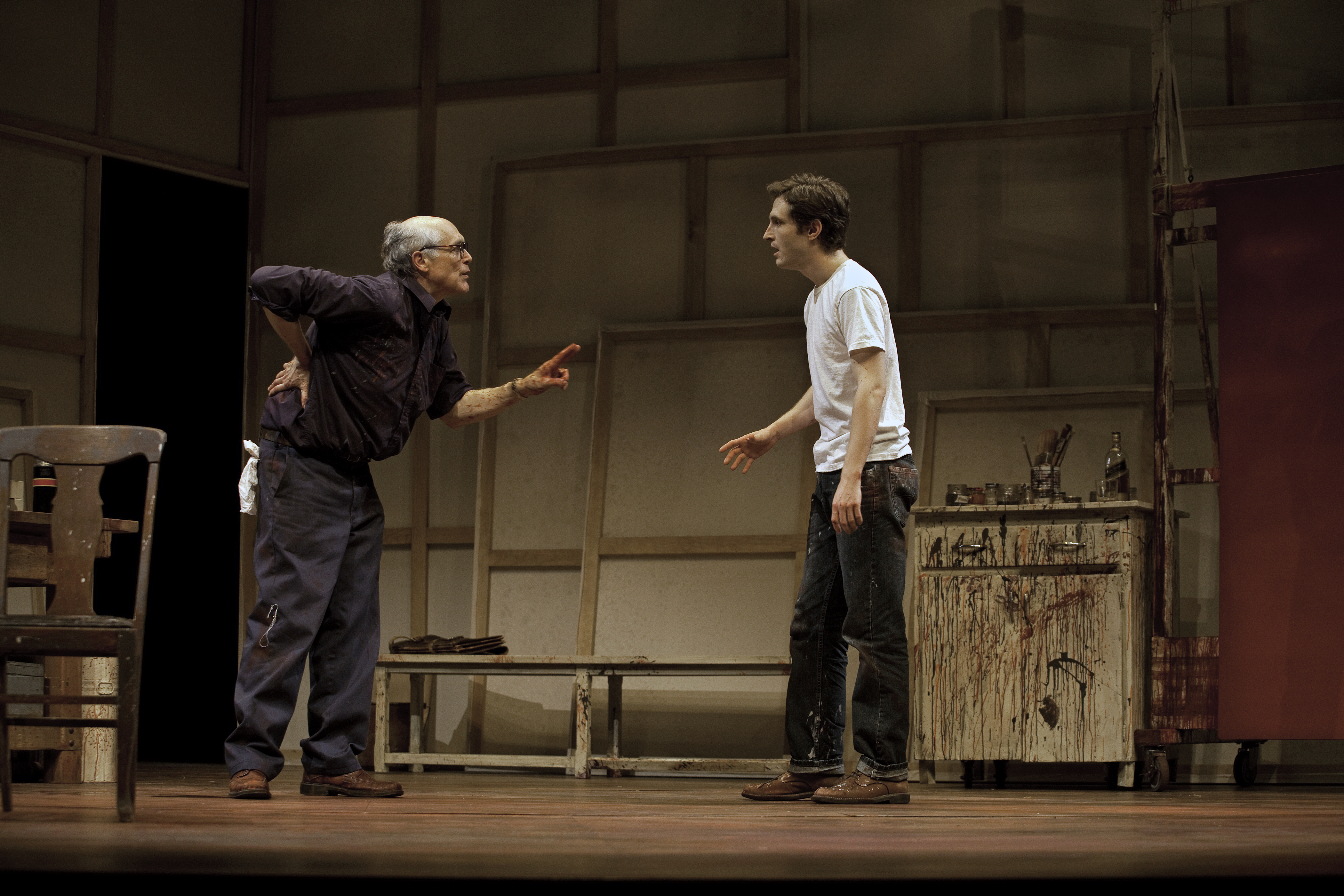
Red – Review

RED 198

Allan Morgan as Mark Rothko and Braden Griffiths as Rothko’s young assistant. Photo credits Trudie Lee Photogaphy

Red

April 30 – May 18, 2013

Martha Cohen Theatre

http://www.atplive.com/2012-2013-Season/Red/index.html

Listen to my review of Red on CBC Eyeopener at http://www.cbc.ca/eyeopener/columnists/theatre/2013/05/06/jessica-goldman-reviews-red/

“What do you see”? It’s the question Mark Rothko, the famous abstract expressionist painter asks his new studio assistant as he considers one of the works in progress. “Red”,  the assistant replies causing Rothko to condemn his quotidian response and embark on a profound lecture about hues, palates and the art of viewing one of his paintings. Rothko’s diatribe is wordy, cerebral, insightful, full of ego and most of all opinion.

This expounding dynamic delivered in a series of acerbic arguments is played out en masse in John Logan’s Tony Award winning Red, a slice of life biography of a fifty-five year old Rothko. Set in 1958, the play takes place over five days in Rothko’s studio as he works on a series of murals for the posh Four Seasons restaurant in New York’s iconic Seagram Building. Rothko has been paid an exorbitant commission ($35k) to create these site-specific works and his dream for these paintings, anthropomorphically referred to and thought of as his children, is that they will transform the space into a chapel where people will contemplate the work and nothing else.  The audience knows Rothko is kidding himself if he thinks a high-priced restaurant for movers and shakers is the right place for his creations. The young nameless studio assistant also knows Rothko is making a mistake. The trajectory of Red then is watching the assistant go from scared underling to boldly challenging Rothko on everything from his views of modern art to his decision to accept the Seagram commission.

Directed by Vanessa Porteous with an ironically colourless set design by Narda McCarroll, Red gives us plenty of intellectual meat to chew on but somehow the passion isn’t there. Alan Morgan’s Rothko is a superlative mix of physical tics ranging from a hunched back to anxious smoking to squinty eyed thinking to a kind of angsty shuffle. Even his New York whine is well crafted. But what Porteous and Morgan don’t give us is the mercurial side of Rothko, the side that bullies and frightens his assistant and is therefore something powerful to overcome when the protégé finally stands up. Just as problematic dramatically is the lack of torture in this Rothko. Morgan’s take is more neurotically pissed off (think a more serious Larry David) than deeply wounded soul. The result is that when Rothko’s heart is finally broken at the end play, the audience’s heart doesn’t break along with him.  Looking beyond the play, there is no indication in Morgan’s performance that Rothko’s despondency and tortured soul will finally get the best of him. In 1970, 10 years after the events in Red, Mark Rothko overdosed on barbiturates and cut an artery in his right arm with a razor blade. This may not be part of the story we’re being told in this play, but it’s an important character motivation that was sorely lacking.

Braden Griffiths as the assistant has far less to work with in this fairly thankless role and he does so with varying degrees of competence. A superfluous scene that deals with his parents’ murder feels forced while his darting and weaving with Rothko is a decent if all too earnest foil. Ultimately it is not the assistant the audience wants to see but what Rothko makes of him and of himself with the assistant. However with any real tension neutered between the two men, who often come across as peers instead of master and servant, the assistant is thrust too far into the spotlight showing the flaws in Logan’s two dimensional treatment of his character.

But where Logan fails in creating a compelling assistant, he triumphs in dialogue. An unabashed ‘thinkie-talkie’ play, Red grabs you by the brains and doesn’t let go. Art vs. commerce, the evolution of an artist and his place amongst peers and a new generation, Nietzsche, the tyranny of feeling ‘fine’ and the fear of being found wanting. These topics all get full consideration making Red one of the most heady bio-pic pieces of theatre ever written. Throw in plenty of voyeurism about what really goes on in an artist’s studio (eggs in the paint, anyone?) and you certainly have a smartly entertaining 90 minutes of theatre. But just as Rothko asserts that he wants his paintings to “tear your heart out”, I too wanted to feel more deeply than this production allowed. Instead I fear that Rothko’s deeply disliked notion of ‘fine’ is probably an apt word for what was presented.

RATING

For Rothko fans or visual art buffs – Getting inside the famous painter’s process and thinking is fascinating and you’ll be delighted with the many references to painters and styles throughout the play. Will this production jibe with your greater knowledge of Rothko and his fate? Probably not. But that doesn’t mean you can’t enjoy the ride. SEE IT

For non-art fans – To say the themes in this play are universal would be stretching it somewhat. Yes, Red is ultimately a character study beyond just Rothko’s vocation as a painter. But no doubt you will miss many of the references or contextual arguments and that might put you off. MAYBE SEE IT

For the occasional theatre goer – Thinkie-talkies are generally not your speed and this one may be far too much talk and not enough action for your taste. SKIP IT

For the theatre junkie – It’s a lesser production of a powerfully interesting play. If you’ve seen it elsewhere then preserve your memory, if not, then sure, add it to your canon. SEE IT

Almost a Love Story – Review

AlmostALoveStory0031 NB2_0865

Hal Kerbes as Henry, Frank Zotter as Callum, Christopher Hunt as David and Joe Perry as Daniel in Almost a Love Story by Louis B. Hobson. Photo by Benjamin Laird.

Almost a Love Story

April 29 – May 18, 2013

Lunchbox Theatre

http://www.lunchboxtheatre.com/almost-a-love-story.html


When I get asked if I know a particular Calgary actor or director or playwright, my answer is usually yes, but not in person. People are always surprised by this. “You’ve never met them? But you’re a theatre critic?” Exactly, I say. As a critic, I don’t want to know the actor or the director or the writer. I want to be able to watch them work with no prejudices or attachments or personal feelings whatsoever. And I manage to pull this off pretty well most of the time. But the Calgary theatre scene is a tight community and every once in a while it’ll happen than I will meet someone I have to review. And that’s fine. I keep it casual and write it off to just being part of the gig I need to deal with. But now, a colleague of mine has gone and completely mucked up this whole arm’s length arrangement for me.

Without any consideration for my professional ethics whatsoever, Louis B Hobson, theatre critic for the Calgary Sun and one of my favorite people, has written a play and darned if the folks at Lunchbox Theatre aren’t producing it as their final show of the year. At first I considered not reviewing Almost a Love Story, a play about a son who discovers his dead father had a secret male lover. Not because I couldn’t be honest about the show, but for fear that if I was, and if I disliked the play, I might be hurting a pal and jeopardizing a friendship. To his credit, Louis told me that this was unacceptable. I absolutely was to see the play, review it, and if I hated it we’d still be a right as rain. Well, with permission like that (and curiosity to see what he’d come up with) I took the plunge. And now I’m hoping Louis meant what he said, because I found Almost a Love Story to be lacking in almost every way possible.

Directed by Pamela Halstead, the play tells the story of Daniel (Joe Perry), a young adult aspiring actor who seeks out his dead father’s drama teacher colleague Callum (Frank Zotter) to help him prepare for an audition. Callum agrees to help but privately airs his anxieties about the situation to his ridiculously and pejoratively flamboyant friend Henry (Hal Kerbes). Turns out that Callum and Daniel’s father David (Christopher Hunt) were engaged in a secret four-year affair that ended when David realized he had terminal cancer and needed to call things off and concentrate on his wife (Lindsay Burns) and son. Far from finding comfort in the brief love they had, Callum struggles to let go of David both emotionally and in a more physical remembrance manner.  In an expected and obvious narrative arc, Callum and David’s secret is found out and the ramifications of David’s other life affects all who loved him.

But just because the general plot is an oft written and popular model (Brad Fraser’s True Love Lies and Mike Mills’ Beginners come to mind) doesn’t mean it can’t be written with adroitness and invigorated with new feeling.  Unfortunately what Hobson have given us instead is, to paraphrase David Mamet, melodrama without invention or believability.

In their first audition rehearsal, Daniel segues from a discussion about natural acting to accusing Callum of being his father’s lover without so much as an emotional change in tone or pace. Much worse however is that Daniel goes from being angry to being fine with the whole situation in a matter of seconds, so much so that he asks Callum to continue helping him with his monologue prep. I know that Lunchbox shows are only 50 minutes long, but surely more time could have been given to what should have been a complex and sensitive scene.

The writing continues in this emotionally wallop-less and unrealistic manner throughout the show taking us from a flaccid flashback of David and Callum’s first pangs of lust to an ill-conceived scene of Daniel’s sexual confusion to David’s lacklustre admissions of illness to his lover and wife.  Layered onto these script issues is a heavy helping of Shakespeare mixed into the dialogue. A portrayal of a scene in Hamlet is what brings the male lovers together; it is Iago’s monologue that Daniel initially wants to perform for his audition; the superstition of Macbeth is bantered about the one time David, Daniel and Callum actually meet and I believe it’s a quote from Two Gentleman of Verona that Callum uses to eventually send Daniel on his way.  Mixing metaphors in this dialogue manner is fine and dandy, but for it to work the actors have to be able to do the words justice and that just isn’t the case. In fact even without the famous lines, this cast can’t seem to rise above the problematic script.

Perry as Daniel makes the best of the character he is given and at times delivers the most natural acting of the cast despite scenes that render him implausible. Zotter as Callum tries his hardest to tug at our heart-strings, but more often than not ends up whining and whinging his discomfort in an effort to bring some emotion to the words. Burns manages to conjure some anger in her final scenes, but her milquetoast performance up until that point makes her an afterthought at best. Kerbes goes full throttle as a screaming Kimono-clad queen who prefers to dole out clichéd barbs as show tunes rather than plain English.  He does illicit a few giggles from the audience, but to my mind this type of hackneyed acting is cheap laughs at best. Most disappointing is the feloniously wasted talents of Hunt as David. Monotone, hands in pockets and without one ounce of the passion or excitement we are told the character exudes, Hunt numbly wanders on and off the stage in flashback scenes that are so bereft of impact they manage to neuter the play as a whole.

They say in the theater that the writer creates the blueprints and the actors are the bricks, but it is the director that is the architect of the whole structure. It is for this reason that much of the responsibility for the failings of Almost a Love Story fall with Halstead.  The dubious scenes, the poorly performed Shakespeare, the groan-worthy camp and the waste of talent all happened under her watch. With direction that either could not or would not challenge the problems this play needed to overcome, Halstead was yet another disappointing element in show that desperately needed a strong hand to whip it into shape.

Hobson claims that his goal for Almost a Love Story was not to shock, but rather to “encourage dialogue and to look at love in all its glorious diversity.” I have no doubt that this was his sincere intention.  But in a line that Henry would no doubt approve of, the road to hell is paved with a playwright’s good intention.

RATING

For the guys and the girls – You know this story. You know these characters. They will surprise you at times, but you won’t buy it. Or if you do, it happens and is forgotten so fast you won’t care. SKIP IT

For the occasional theater goer – Maybe you haven’t seen this story before and maybe its simplicity and non-introspective nature will appeal to you. MAYBE SEE IT

For the theatre junkie – If like me you are a Christopher Hunt fan, then save a broken heart and miss him in this one. In fact, just miss it altogether. SKIP IT

Chicago – Review

????????????????????????????????????

Photographer: John Watson. Stage West Theatre Restaurant Calgary


Chicago

April 18 – June 23, 2013

Stage West Theatre Restaurant

http://www.stagewestcalgary.com/shows.html


How many 37-year old musicals can you name that still resonate today? West Side Story still speaks to our harmful ‘them and us’ attitude, My Fair Lady can touch present day nerves about class, appearance and acceptance and Tommy still shines the light on our current religious cult of personality. No doubt there are others. Now ask yourself, how many decades-old musicals are not only resonant but thoroughly modern in their relevance, and I’ll bet that Chicago is the top of a very short list. Dealing with themes of media manipulation, the obsession with fame and the fleeting nature of instant stardom, Chicago could just as easily have been written about a 2013 reality TV, paparazzi, spin doctor world as it was about the windy city in the 1920’s. Add in a slew of jazzy, sexy musical numbers and choreography by the inimitable Bob Fosse, and it’s no wonder that Chicago is one of the longest running shows Broadway has ever seen as well as an Academy Award winning movie.

The latest incarnation in Calgary is brought to us by Stage West Theater Restaurant in an energetic and mostly successful production that stays true to the original and will satisfy fans of the both the stage and film versions. As the show begins, Roxie Hart (fantastically sung, danced and acted by firecracker Marisa McIntyre) shoots the man she’s having an affair with. Thrown in jail, Roxie meets Velma (an underwhelming and somewhat gawky Andrea Wingelaar) a notorious murderess who is the sensational toast of the headline-hungry media. Both women have hired the cutthroat PR savvy lawyer Billy Flynn (the terrific Matt Cassidy) to sell their innocence to jury and make them media stars in the process. But instant fame is fickle as is Flynn’s attentions, and both women have to fight each other as well as other inmates for the media spotlight they crave and the innocent verdict they desire.

The decision to locate a live four-piece band in the centre back of the stage means Director Max Reimer is given a very shallow space to work with and he does so with taut yet spirited direction that never feels crowded or compromised. Which is a good thing because the cast needs room to show off some wonderful dancing. Fans of Fosse will be happy to know that Choreographer Phil Nero doesn’t mess with the master’s signature style and the cast rises to the occasion giving us the sultry, sexy jazz-handy moves we want to see. Standout numbers We Both Reached For The Gun, Me and My Baby and Courtroom Scene explode with outstanding showmanship and receives hearty cheers from the audience.

For those cast members whose role is more about song than dance, this Chicago delivers unevenness.  Playing Roxie’s cuckold pushover husband, Amos, Ed Sahely wonderfully milks audience sympathy with his number Mister Cellophane and gets one of the biggest audience reactions when he is finally tossed aside. Conversely, Elizabeth Stepkowski Tarhan is woefully miscast as the tough talking prison matron Mama Morton. Unable to physically pull off the character’s swagger or vocally settle into the street-talking potty mouth lines, Stepkowski Tarhan is a disappointment despite her strong singing voice.

Having the characters of both Velma and Mama not up to snuff was a distinct let down in the show, but not enough to extinguish the fun of watching Roxie, Flynn and the rest of the cast do their stuff. This production of Chicago might have been missing the full gamut of the ‘old razzle dazzle’, but like the fleeting fame Roxie seeks, disappointments in the show disappear fast to make way for brighter, shinier star moments.


RATING

For the guys – No sappy love songs or delicate dance numbers here. Chicago is a sexy scrabble of a musical with great moves, music and lyrics. This cast keeps the pace and will make sure you have fun. SEE IT

For the girls – Sure women are portrayed as fame-whore, adulteress, vapid characters with no heart of gold lurking beneath. But still you can’t help rooting for Roxie and loving McIntyre’s portrayal. Drop any indignation and sing along. SEE IT

For the occasional theatre goer – Yes, just yes. SEE IT

For the theater junkie – While not a must see (especially if you’ve already seen one version or another) McIntyre’s Roxie is astoundingly good and just might make you forget the others before. MAYBE SEE IT

I Am My Own Wife – Review

I am my own wife

Paul Welch as Charlotte von Mahlsdorf. Photo credit Aaron Bernakevitch.


I Am My Own Wife

April 24 – May 4, 2013

EPCOR Centre Motel

http://thirdstreet.ca/12-13-season/wife/


How do you curate a life? It’s the question asked by playwright Doug Wright, as himself, in his compelling 2003 Pulitzer Prize and Tony Award winning play, I Am My Own Wife. Wright’s challenge is made all the more complex by the very real and controversial life he is attempting to dramatize for us. Born in 1928 under the name Lothar Berfelde, Charlotte von Mahlsdorf was a German transvestite who managed to survive and thrive under both the Nazi regime and communist-controlled East Germany.

Upon hearing Charlotte’s story from a reporter friend, Wright travels to Germany hoping his interviews with her will allow him to pen a tale of gay heroism in the face of terrible adversity. This was the play we wanted to write. But the more Wright learns about Charlotte, the more imperfect she becomes. Did she kill an abusive father or a father she simply didn’t like? Was she a passionate antiques collector and museum owner or a thief who stole Jew’s furniture when they were carted off to the camps? Was she a protector of the gay community or a secret Stassi spy? With no way to discern what truly happened all those years ago, Wright gives us a play that embraces the full ambiguity that was Charlotte’s life and lets the contradictions stand as both intriguing drama and intellectually juicy questions.

However, more than the story itself which at times is overly matter of fact and lacking emotional punch, it’s how Wright configures his drama and how Third Street Theatre’s production brings it to life that makes I Am My Own Wife truly enthralling theatre.  The play is written as a one-man show with no fewer than thirty-six characters of different gender, language, accent and age. Played here by the incredibly talented Paul Welch, with astute direction from Kevin McKendrick, we are treated to vivid characters in a performance that is wonderfully self-aware and perceptive. Welch’s chameleon-like ability to morph from a sixty-five year old distinctly unglamorous but sweet transvestite with a heavy German accent to a southern-drawl American reporter to an oily German TV talk show host is remarkable. Equally impressive is Welch’s ability to switch back and forth between English and German without sacrificing one iota of acting prowess. Frankly my tongue got tied just listening to him chew through the plentiful dialogue that would have left a lesser performer gasping for air.

Complementing the richness of the subject and dialogue is the relative simplistic elegance of Deitra Kalyn’s set design. Respecting the smallness of the theatre, Kalyn does not try to replicate the grandness of the show’s Broadway set which was strewn with the antiques that comprised Charlotte’s Gründerzeit Museum of furniture, gramophones, clocks and records. Instead, dozens of pencil illustrations of the objects are hung reverently, creating a collage that echoes the clutter. Pieces are talked about, moved, played with and even dusted. But all this is done through exquisitely directed mime with not a real object in sight. It’s a shame that this elegance is disrupted by a small video screen showing signifier projections like Are you a boy or a girl? and Listening or Curating, to identify the quick chapter-like scenes in the play. For the most part these title projections were redundant and at worst meaningless.

But by the time the play winds down to its 75 minute mark, whatever deficits of emotional connection or quibbles with design choices, there is no doubt that we have witnessed a little piece of greatness. I have long ago given up believing that a play will be terrific simply because it has an award attached to it. But Wright’s beautiful dialogue and structure in combination with McKendrick’s sensitive direction and a thoroughly outstanding effort by Welch, makes I Am My Own Wife, one award-winning play I can happily cheer for.


RATING

For the guys and the girls – Drop your image of Rocky Horror’s Frankenfurter, Charlotte is the farthest thing from a campy transvestite you’ll ever see. In fact, to my read, the show is not so much about Charlotte’s difference but instead her commonality. Good and bad. And while you’ll wish you had more of an emotional tug from the character, her story will fascinate you. SEE IT

For the occasional theater goer – Charlotte is a tough character to get to know in a narrative structure that will be too disjointed and possibly frenetic for you to enjoy. Plus loose ends are generally not your cup of tea. SKIP IT

For the theatre junkie – When direction this good meets an actor up to the challenge, magic happens. SEE IT