The Hunchback Variations – Review

The Hunchback Variations Directed by Greg Dean Written by Mickle Maher Staring Jeff Miller and Greg Dean

(l to R) Jeff Miller and Greg Dean. Photo credit: Anthony Rathbun

The Hunchback Variations

Written by: Mickle Maher

Directed by: Greg Dean

Starring: Jeff Miller and Greg Dean

Company: The Catastrophic Theatre

Run Dates: April 10 – May 2, 2015


Quasimodo and Ludwig van Beethoven walk into a bar and discuss Chekhov. Well kind of. Actually they walk into a panel discussion (featuring only them) to report on their collaborative attempts to identify and replicate the elusive and nebulous sound cue described at the end of Anton Chekov’s, The Cherry Orchard. The sound Chekov describes as, “Coming as if out of the sky, like the sound of a string snapping, slowly and sadly dying away.” Quasimodo and Beethoven have failed miserably in their efforts as they will tell you. And oh, yes … they’re both deaf.

If this sounds like the set up to some absurd egg-headed joke meant to tickle the brains of Mensa members you’d be half right. But thanks to playwright Mickle Maher’s terrifically funny for even non-geniuses script, whip cracking tight direction by Greg Dean and two outstandingly funny yet thought-provoking performances, this is a theatrical experience worthy of wide attention.

I’m calling Maher’s 40 minute long,  The Hunchback Variations, an experience rather than a play or even a show because the very structure of it is as absurd as its subject. On a set featuring only a black skirted long table outfitted with two microphones, two glasses and a generous pitcher of water, Quasimodo (a superlatively physical Greg Dean) lumbers in. Huffing and puffing under the weight of his generous hump and other corporeal maladies, he drags in several briefcases to the panel table and unpacks what looks like to be a flea market array of items. A violin, mini piano, wine glass, balloons, nuts and bolts and of all things, whip cream are among the voluminous booty. Dean, face half obstructed by a bug-eyed horror of a mask calling to mind a bad acid trip viewing of Phantom of the Opera, grunts and groans through the rotten couple of teeth that protrude his mouth as he sets up his station and waits for his panel member.

In sharp contrast Beethoven (played brilliantly suave without one iota of Deutschland in him) takes to the stage propless, wigless and in modern business dress with cool confidence, stopping to nod and smile to the imaginary crowds gathered to hear him speak. “Good evening”, he says with the dulcet tones of every stereotypical NPR announcer you’ve seen spoofed. “And welcome to the panel discussion on impossible and mysterious sounds. But first, an opening statement from Quasimodo.”

They are lines that will be repeated over and over during the performance that organizes it’s self as mini sketches with blackouts in between like a looping, surreally funny odd dream that you can’t seem to wake from. Each sketch starts with Ludwig’s welcome, altered slightly just to make sure we’re all still paying attention, followed by a despondent opening statement from Quasimodo bemoaning the pair’s failure and utter futility of the endeavour in the first place. All the while, a gently trilling piano plays in the background as though urging the men forward.

Do they hear it? Do they hear each other? They are both deaf we’re told, but they seem to understand each other. And the myriad of sound effects Quasimodo makes with his bag of tricks to illustrate the dozens of attempts made to replicated the sound seems to register with them both. “That is not the sound,” assures Beethoven to the audience after each of Quasimodo’s attempts.

While the structure is minimal, Maher has much to say. Quasimodo is defeated by the experiment yet shows his willingness to try and try again even though he believes the whole thing to be doomed. Beethoven, we learn, has barely contributed to the work at all (has he even read The Cherry Orchard?), is only mildly put off by their inability to reach perfection and instead seems confident in the fact that his reputation is all his needs for success. Through this juxtaposition of attitudes as well is the class, health, economic and happiness divide that differentiates these two characters, Maher introduces some wonderfully meaty questions. Is attaining artistic perfection possible or even desirable? Is there even such a thing as perfection in art? Which is more valuable, the artist that can only do one thing but do it perfectly or the artist who toils and slogs at many talents? Does positively propel creativity or is it only in misery and toil that beauty is created? Is it better to make a lot of noise and not be perfect or to be silent and have no one know you failed?

Most importantly, Maher makes us laugh even as we ponder these important questions. Dean’s direction gives ample room for the characters to one up each other in dual straight man absurdity and doesn’t ever rush the punchline. The comedy includes highbrow notions such as Beethoven flipping the pages of an Emily Dickenson novel in an attempt to make the elusive sound even though she wasn’t yet born at the time of Chekov’s play. The humour also comes from less lofty notions such as the ongoing argument between the pair about how it was unfair to hold the experiments in Quasimodo’s odorous mud hut when Beethoven has a lovely swishy flat they could have used.  It takes a confident director to breathe so much room for pause and reverberation into a script and Dean shows a masterful hand in the process.

Equally exquisite are the two performers. Dean’s Quasimodo is a lesson in less is more. Sure he’s a physical sight to behold on stage, but Dean never overplays it. Instead he finds subtle ways, like a constant slight tongue thrust or lightly worn English accent, to ensure we not only gawk at his character but listen intently as well.

With no costume, accent or any Beethoven-ism whatsoever to rely on, Jeff Miller delivers a terrifically controlled performance bathed in barely hidden smarm meant to charm and sooth all that listen. The perfect foil for Dean’s emotional Quasimodo, Miller keeps cool as an oily cucumber in his comedic willful refusal to admit defeat. As the sketches go on and on and Beethoven’s resolve begins to crack, Miller beautifully opens the door just enough for us to get a grand laugh at the maestro’s budding shame.

By the time the last welcome and blackout has occurred, we’re no further along in solving the Chekhov sound puzzle and Quasimodo and Beethoven certainly haven’t accomplished or discovered anything useful in their quest. But the gift of this production isn’t the definitive answer to the quandary or the journey of the characters towards the perfect sound, it’s the twang of thought we are left in consideration of what they failed at. And that to me, is the most important beautiful theatrical sound there is.


RATING

For the deep thinkers – Yes the premise is absurd, but don’t mistake comedy for fluffiness here. Maher poses big thinky questions that will leave you chatting wildly over your post show drinks. SEE IT

For those in need of amusement – I haven’t laughed this much at a show in an awfully long time. But take note, this isn’t necessarily an easy guffaw, snicker out loud,  joke a minute type of comedy. It’s smart and sly and sneaks up on you in places. In other words, Dumb and Dumber it ain’t. If you’re good with cleverness and a lot of quirk with your humour, you’ll be rewarded. MAYBE SEE IT

For the occasional theater goer – This is far too experimental and unstructured and frankly too much work for most folks. But then you probably already knew that after the first line of the review. SKIP IT

For theater junkies – Yes. For every reason I can think of Yes. Direction, script, design, performances and for the chance to see something terribly funny,  unique and risky that works. SEE IT


Vanities, the Musical – Houston Press Review

Vanities

(l to r) Shelby Bray, Danica Johnson and Robin Van Zandt. Photo courtesy of Theatre LaB.


Vanities, the Musical

Adapted by: Jack Heifner

Music and Lyrics by: David Kirshenbaum

Directed by: Jimmy Phillips

Starring: Shelby Bray, Danica Johnson and Robin Van Zandt

Company: Theatre LaB

Run dates: April 8 – May 3, 2015


Read my review of Vanities, the Musical for Houston Press at 

http://blogs.houstonpress.com/artattack/2015/04/vanities_the_musical.php

What I Learned in Paris – Review

What I Learned in Paris (3)

Detria Ward as Eve Madison in What I Learned in Paris. Photo credit David Bray.


What I Learned in Paris

Written By: Pearl Cleage

Directed By: Eileen J. Morris

Starring: Yunina Barbour-Payne, Cynthia Brown Garcia, Kendrick “KayB” Brown, Detria Ward, Mirron Willis’

Company: The Ensemble Theatre

Run Dates: March 19 – April 12, 2015


In reflecting on the aftermath of his successful efforts to get the first African-American elected as Mayor of Atlanta, bombastic lawyer JP Madison remarks with bittersweet insight, “Before I wanted something for him, now I want something from him.” The him he’s talking about is Maynard Jackson, the real life historic figure who served two terms as Mayor of Atlanta and the when is 1973, the day after the historical election. It’s one of those pithy lines that make you sit up, take notice and think that – yes, this playwright has something important to say. Not to mention the idea’s relevance today as the United States reflects on what its first African-American President has done and meant for black America. But if you expect this notion or any of the other social/political issues swirling around the black community at the time to get treated as anything more than a throwaway line or two in Peal Cleage’s thinly drawn but entertaining comedy, What I Learned in Paris, you’re at the wrong play.

Cleage, who was a speechwriter and press secretary for Maynard back in the day, has drawn on the heady time not to  school us on the struggle and successes of the era or to even reflect on how far or not things have come. Instead, Cleage gives us a by the books, sitcom-ish romantic story where new relationships are doomed and old flames ultimately win the day. Laughing rather than thinking is what this story is going for. Yes the missed opportunities are plentiful, but if you can put aside what this play might have been and settle instead for being mildly amused by what it is, all is not lost.

JP (an overly broad Mirron Willis) and Eve (Detria Ward marvellously putting the capital D in Diva and mixing it with a Flower Power sensibility) were once married. JP stayed in Atlanta to work with black political candidates and Eve went to find herself in Paris and San Francisco. They are reunited the day after Maynard’s election when Eve, hearing the news and wanting to contribute and be part of the action, comes back to Atlanta and the house she owns that is now being used as Maynards’s campaign headquarters. JP is coupled up with Ann (Yunina Barbour-Payne showing too little confidence in the role) a young woman in love with John (Kendrick “KayB” Brown giving a naturally terrific love-crippled performance) another member of Maynard’s campaign. John more than returns Ann’s feelings but is hamstrung because of his allegiance to JP and his belief that the two are legally married. Filling out the cast is Lena (a nicely understated Cynthia Brown Garcia) a get-out-the-vote professional who has made Eve’s house her home for the duration of the Maynard campaign.

While there isn’t much doubt as to who will eventually end up with whom, Director Eileen J. Morris keeps the pace quick enough that any boredom is easily brushed away by the expected yet amusing action on stage. The majority of the comedy comes courtesy of Eve, who is a stirring the pot force of womanly nature. When she isn’t dressing down JP for his “tone” she’s requiring that he engage in yogic breathing to make him more palatable to her.  She is a character who believes that it’s always time for champagne and isn’t beyond moving onto stronger intoxicants. Sashaying around in glorious caftans of riotous hues, Ward gives us a charismatic performance that finds the funny in the familiar and conjures undeserved freshness in the dialogue.

At odds with Eve’s grand fashion statements is the rest of the set and costume design. It’s as though Morris’s team blew all their 70’s ideas on Eve and just didn’t have enough steam to be bothered with the rest of it. James V. Thomas’  interior house design that serves the entire two act show , with its mushroom walls, tastefully neutral microfiber couch and IKEA like color block art pieces looks like something out of the neutered 90’s not the swinging 70’s. The two storey effect, with its staircase that the performers stomp and down  is a nice touch for visual diversity, but simply throwing a fern in a corner on the landing does not a period home make.

But if the set design is bland, Andrea Brooks’ costuming is confusingly inopportune. Other than Eve, none of the other characters seem to be channeling any 70’s sartorial vibes. Brooks clads the women in skirt or pant suits that look very similar to present day office wear and only gives us glimpses of the bell sleeved, platformed,  poly-friendly fashions that ruled the day. But it’s the men that fare the worst here. Where are the large lapels? Where is the longer hair? The wider ties? The pleatless flared slacks? None of it is present on stage, sapping the characters from time and place and even further neutering the social significance of story.

In the end I suppose the design doesn’t matter much. What I Learned in Paris may be set in the 70’s against the backdrop of one of the most important moments  in American black political history, but all of that is simply window dressing for what Cleage is really after – an African-American romantic comedy that doesn’t dwell too hard on anything but how to amuse. Like I said, if you can pack up expectations of anything beyond this, you just may crack an easy smile or two.


RATING

For social justice/political story lovers – The frustration of missed opportunities in this show will drive you mad. Not that there is anything amiss with giving meaning a comedic twist, but allowing the comedy to quash the meaning all together makes this is a no go for you. SKIP IT

For the occasional theater goer – Nicely paced light comedy with the barest whiff of social commentary might be up your alley this time. Despite the design disappointments, you’ll like the look and feel of the show and Ward’s Eve will give you many moments to remember. SEE IT

For the theater junkie – Even theater junkies deserve to sit back and just be easily amused once in a while. It’s too bad that this show tries to do it while ignoring all the potential it’s time and place offers. Ward and Brown are worth your attention here but there are also performance and design issues that will stick in your teeth. MAYBE SEE IT


All My Sons – Review

all my sons

(L-R) Elizabeth Bunch as Ann Deever, Jay Sullivan as Chris Keller, Josie de Guzman as Kate Keller and James Black as Joe Keller in the Alley Theatre’s production of All My Sons. Photo by John Everett.


All My Sons

Written by: Arthur Miller

Directed by: Theresa Rebeck

Company: Alley Theatre

Starring: Elizabeth Bunch, Jay Sullivan, Josie de Guzman and James Black 

Dates: March 27 through April 19, 2015


I recently read an interview with Julius Novick, a veteran theatre critic whose work appeared in the Village Voice, Newsday and New York Observer among other outlets, in which he offered some thoughts on critical responsibility. To paraphrase his succinct yet weighty views, our job as critics is never to simply say if a show was good or not. Despite the fact that this is what most people want to know up front. As critics, Novick says, our duty is to look at a play within the context of our world and question what it is trying to tell us, how it’s attempting to do that and where the notions come from in the first place. Simply talking about how a show works or doesn’t work misses the point. Perhaps there is no better play to put this approach to practice on than Arthur Miller’s All My Sons, now in performance at the Alley Theatre under the direction of Theresa Rebeck.

Miller’s world for this play (penned in 1947) is post World War 2 America dealing at once with the tragedy of young soldiers lost and the gleeful greed that a post war booming economy begat in America. These societal issues are filtered by Miller through the Kellers, a family that has been touched by and reacted to both extremes. Father Joe Keller ran a factory during the war which sent out faulty airplane parts that resulted in the death of twenty-one American soldiers. Rather than see his business falter, Joe lies when accused and lets his partner take the blame and do the time. While Miller makes it clear to us that those innocent soldiers were in fact metaphorically all Joe’s sons, he makes sure that Joe has a blood related son of his own (Larry) to mourn, even if his wife Kate is still holding out hope that he may one day return. Chris, the Keller’s other son, also fought in the war but returned home idealistic,  moral as ever and more problematically in love with his dead brother’s girlfriend,  Anne, who also happens to be Joe’s incarcerated partner’s daughter.

There’s no question that what Miller first envisioned as a commentary on time and place still has relevance for us as a modern audience. Themes of war profiteering are played out daily in our news cycles as are issues of corporate greed supplanting human compassion. And what of the family? Is it ever okay to do harm to others in order to do good for your loved ones? Miller is a playwright not afraid to hold up a capital M moral mirror in front of his audience and demand that they do and be better. The sermonizing aspect of the script which leaves little room for areas of grey may seem somewhat old-fashioned in the face of the everyone gets a say plays that continue to be en vogue. However we accept our ethical medicine in this case thanks to Miller’s superb character development and the heightened drama than unfolds as the Kellers’ lies and secrets crumble.

Or at least that is what should happen. However in Rebeck’s castrated production, all tension is sapped out of the story leaving us with an extraordinary relevant play with much to tell us that unfortunately is just not all that good.

The neutered nature of the show is apparent from the first seconds of the play when a windstorm causes a tree planted in Larry’s honour to crack and break outside the Keller’s handsome mushroom-coloured tony house (beautifully realized by Alexander Dodge). The limp toppling of the tree in a windstorm that barely blows the hair or dress of Kate who is outside to witness the felling, is the first disappointment in a string of lukewarm moments that sees the performers delivering the lines but not the impact.

As Joe Keller, James Black fares the best of the central cast, depicting a man quick with a joke and seemingly not all that perturbed by his corruption. He entertains us with his simple man jovial style but stiffens and cools when fear and guilt is called for leaving us questioning where the stakes are in his story? Joe’s whole life unravels in one moment yet Black fails to make us feel like all is lost for his character.

Kate Keller is a woman numb in her denial, but in Josie de Guzman’s hands she is numb on the stage as well. Relying too often on direction that has her tautly speaking to the darkness of the audience rather than her cast mates, de Guzman projects neither a woman with clueless conviction nor the wounded mother that knows deep down her son is dead. Even when given juicy lines and scenarios such as her prickly dressing down of Ann or her subtle nod that she’s in fact not clueless about her husband’s actions, de Guzman’s performance seems matter of fact as opposed to the gasp Miller intended it to be.

As newly minted sweethearts, Chris (Jay Sullivan) and Ann (Elizabeth Bunch) show painfully little chemistry together. Bunch is happy to swing around in her summer dresses, accepting lascivious praise and trying to conjure the young woman in love, but can then only manage awkward shrug after cutesy shrug when called upon to show her delight at being near Chris. When faced with the awful truth about her father and the family she intends to marry into, Bunch continues unmodulated, seemingly untouched by the drama that was supposed to be unfolding around her.

Chris is the other big stakeholder in Miller’s play. It’s his love and belief in his father that’s on the line here and Sullivan tries to shout and angst it out in the final confrontational scenes. But his previous inability to tug out our emotional strings when placidly recounting what should have been his heart wrenching war-time experience, bring us into the scene disconnected from the character.  It’s truly the shame of the production as the father son showdown serves up some of Miller’s best writing and most subtle commentary. In defending himself to his son, Joe asks Chris if he did anything another man might not have done. Even with his moral stance, Chris acknowledges that Joe’s actions were how most men would have behaved, but then follows up with the stab in the heart lines, “I never saw you as a man, I saw you as my father…..You are no better. You can be better.” These are lines meant to bruise us all as who among us at some point hasn’t idealized a parent beyond the very real person they are. Unfortunately here, it’s the stab that barely produces a welt.

Oddly, while Rebeck shows little flair with her main characters, her supporting cast are warm, relatable and fall nicely into Miller’s naturalistic style of writing. Of particular note is Jeffrey Bean as neighbour Dr. Jim Bayliss who manages to both touch us with his unfulfilled dreams and surprise us with his revelations when the cat is out of the Keller’s bag.

Miller may have wanted us to examine the ills of society through the lens of the family unit, but in Rebeck’s production, the Kellers may be all that’s wrong with the world, but it’s the neighbour that has our attention. And that’s a different play altogether.


RATING 

For Miller/All My Sons newbies – There was a woman sitting behind me who had never heard of Arthur Miller – “do people read him in school?”, she asked. At first I cringed, but was then comforted by the fact that for whatever reason, she was in attendance and would therefore never again have that level of Miller ignorance. However, is lukewarm Miller better than no Miller at all? Could a novice audience appreciate the story if not the production? I sit on the fence with this one. MAYBE SEE IT

For Miller fans – Stay home, read the script, avoid the castration. SKIP IT

For the occasional theater goer – It’s a handsome looking production in a digestible two acts. The moral questions are big and no one walks out of the theatre feeling good about having answered them. Had the riveting factor been present in this production though you might not have minded.  SKIP IT

For theater junkiesAll My Sons is not an oft produced play. At least not in my experience. For that reason I’d say see it so you know it and can appreciate why it’s still an important play to produce. But if you do, be prepared to bring your own imagination for what it might have been. MAYBE SEE IT

The Skin of Our Teeth – Review


Skin


(L to R) Wade Gonsulin, Giovanni Sandoval, Andrea Taylor Rodriguez, Carol Davis. Photo credit – Scott McWhirter.


The Skin of Our Teeth

Written by: Thornton Wilder

Directed by: Kathy Drum

Company: Theatre Southwest

Run Dates: February 20 – March 14, 2015


The Skin of Our Teeth is one of those plays. At the first intermission the kindly gentleman next to me shook his head and left, wishing me “good luck trying to review this one.” At the second intermission I overheard an eager but utterly confused audience member asking the company dramaturg what on earth the play was about and who, metaphorically, the characters were supposed to be. As I left the theatre post curtain I heard one couple say to another couple, “well, that was weird” and then drop all conversation about the play in favour of picking a suitable dessert spot.

From my small, unscientific sample, you’d think Thornton’s Wilder’s The Skin of Our Teeth was some kind of flop as opposed to the 1942 Pulitzer Prize winning play that it is. There’s no question that this allegorical absurdist play that tackles the resilience and failings of mankind in the face of catastrophes both natural and manmade while playing fast and loose with our understanding of time, isn’t for everyone. Truly, how many people can wrap their heads around a seemingly modern New Jersey family having dinosaurs as pets while trying to survive the ice age and invent the alphabet at the same time? Or a mammalian president who presides over feathered and finned constituents but is still human enough to fall for the Vegas showgirl and ignore the impending flood? Or a boy turned terrorist who seems unable not to turn on everyone and everything as if compelled by curse?

Truth is, that as much as the play sounds (and even is) like one of Hunter S Thompson’s more PG rated acid dreams, The Skin of Our Teeth is a bitingly clever comedic play with plenty of pithy things to say about us as a species. Or at least it is when the production is up to the task. But here under Kathy Drum’s laboured and often clunky direction, the humor lands with a thud and the insights fizzle out like wet sparklers.

Set on Drum’s post explosion looking set strewn with ragged books, an island riser, a garbage filled river and an impressionist looking backdrop depicting an inner wall of a house, we are introduced to the Antrobus family.  Derived from the name from anthropos, the Greek word for man, the Antrobus’s are our one continuum in this three act time-warping play that has the family facing extinction from the ice age, a great flood and a species clearing war.

There’s the moody Mr. Antrobus (a played with unwavering straight man humorlessness by Wade Gonsoulin) on whom Wilder bestows the invention of many of man’s great achievements such as the wheel and the multiplication tables. Mrs. Antrobus (strongly played by Carol Davis) who’s main concern is keeping her husband and children flourishing. Daughter Gladys (Annabelle Dragas Xanthos expertly channelling a young teen), a young woman who knows that to please her father with her cleverness is the only safe route for both her and her family and Henry (a terrifically angry Giovanni Sandoval) who stopped going by his real name Cain (wink wink) when he killed his brother and developed a scar on his forehead. Also part of the family is Sabina (the Norma Desmond-esque Autumn Woods); a siren of a gal who used to be Mr. Antrobus’ mistress but now is relegated to the kitchen.

Sabina is our guide during this play that refuses to let us forget that we are watching a play. Never mind fourth wall breaking, Sabina not only speaks often to the audience but announces several times that she hates the play and refuses to say the lines or perform certain scenes. Action is broken, stage managers must cajole to get things going again and the audience is left to ponder just what Wilder wanted us to take away from this play within a play within his absurd confines.

But taking anything away from this production is difficult due to Drum’s inability to find the groove in the tone and timing of the piece. Ensemble members playing crowd scenes are shuffled inelegantly off and on the stage. Human sized dinosaur plushies dodder in one place instead of going for the bigger physical gag. Actors yell over each other and the din off stage threatens to distraction. It all feels like a bit of a mess. More importantly however is that Drum seems to have forgotten that while yes, there is a message to Wilder’s madness, it’s via the comedy that we get the message. Other than Sabina, no character shows one iota of camp or irony, which would have been fine had the straight ahead treatment elicited the humour necessary to abide this crazy wonderful script. Instead it feels like the very talented cast were given the incorrect director’s notes for the entire show.

The final moments of The Skin of Our Teeth are always a letdown for me. Wilder can’t seem to resist the gooey moistness of a happy ending. Or as happy an ending as one can expect from this show. But historically I’ve been forgiving of this minor blip in an otherwise astonishing wild ride of a play that so pointedly has us questioning why how it is that mankind persists. We laugh, therefore we understand. Sadly in this production despite the valiant efforts of a stellar cast, we don’t laugh that much and our understanding suffers as a result.


RATING

For fans of Wilder – Well this ain’t Our Town, that’s for sure. And if that’s the only Wilder work you’ve seen, boy are you in for a surprise with this show. One that perhaps you need to experience. But while this production of The Skin of Our Teeth boasts a great cast who make the most of a low tech set, it just never gets up to revving speed the way you want and need it to. MAYBE SEE IT

For the occasional theater goer – No, just no. Do not pass GO, do not collect $200. In fact, if someone offers you $200 to see the show, turn them down. SKIP IT

For the theater junkie – If the actors are the building blocks, then the director is the architect. You’ve seen enough to know when great work is being conjured or not. Yes the performances here are grand, but they don’t quite make up for the lack of feeling and comedic cohesion in the production. SKIP IT


A Funny Thing Happened on the Way to the Forum – Review

FORUM4

(l to r) Luke Hamilton as Hero, Nicole Norton as Philia, Will Ledesma as Senex Photo credit: BCT Staff.

A Funny Thing Happened on the Way to the Forum
Book by: Burt Shevelov and Larry Gelbart
Music and Lyrics by: Stephen Sondheim
Directed by: Colton Berry
Choreographed by: Luke Hamilton
Company: Bayou City Theatrics
Run Dates: February 13 – March 1, 2015
Je ne sais quois. It’s a French term used to describe an intangible quality that makes something distinctive or attractive. It’s a term I kept coming back to while watching Bayou City Theatrics’ production of A Funny Thing Happened on the Way to the Forum. More specifically, I kept coming back to why I couldn’t quite figure out what it was the production was lacking.
The building block elements were there. The singing voices in this musical are decent enough to very good. The acting is also on point in many cases. The set design on the teeny tiny stage is as clever as the matching costumes and makeup. Add in the award-winning, smartly comedic, tongue in check book by Burt Shevelov and Larry Gelbart and Stephen Sondheim’s trademark delicious lyrics and memorable music, and you’d think this production would hum along nicely. But instead, the jokes fall flat most of the time and the wind is sucked out of the revelry we should feel for this thinking man’s farce. So what gives?

Let’s get the plot out of the way first so we can discuss what went wrong.  Pseudolus, an illiterate but savvy Roman slave desperately wants to purchase his freedom from his masters. Without the financial means to do this, he must find other bargaining tools. When his master and mistress go on a trip, he finds out that Hero, their none-too-bright son (also Psuedolus’ master) is smitten with a virginal courtesan named Philia living in the bawdy house next door run by Marcus Lycus.  Ignoring the fact that Lycus has sold Philia to a strapping captain by the name of Miles Gloriosus, Pseudolus strikes a bargain where he will be freed if he can procure the girl for his young Master. But nothing goes to plan in this pandemonium of a plot riddled with half-baked schemes, near misses, mistaken identities, a book that skewers social class and lyrics that tickle the linguistic sweet spot.

From the plot outline above, it doesn’t take great imagination to realize this is a show that relies on fast pace for the comedy to work. Timing, under Colton Berry’s direction, is perhaps the thing most working against this production. Everything feels several beats off. The slapstick of The Proteans (three chorus characters that morph into whatever roles are needed, be they soldiers or eunuchs) plods along in gawky fashion and just doesn’t have the energy to elicit laughs. The Tim Conway-esque old man shuffle gag that repeats itself throughout the play as Erronoius attempts to walk around Rome three times is painfully drawn out without any support from music or dialogue to help it along. Most notably, the story calls for several gag situations followed by pauses so that the fourth-wall breaking Pseudolus can mug his derision/boredom/astonishment for us. Instead of this being a bonding moment between character and audience, Berry’s lag on the uptake and the silence that underpins the moments feels stroppy and humorless.

If timing is the show’s downfall, energy is the tipping point over the edge. Forum is a big personality play with musical numbers screaming for charismatic performers to turn ridiculous ideas into laughable situations. Apart from a few on stage, the cast just didn’t have the gusto to pull it off. As Pseudolus, Whitney Zangarine has a lovely but thin voice far better suited to harmony than carrying off such show-stopping  numbers as the opening “Comedy Tonight” which sets the tone for the play. In addition to her vocal issues, Zangarine can’t quite conjure the impish Bravado of Pseudolus to its full extent. Yes she eye rolls and smiles devilishly and has a few funky dance moves, but her efforts simply don’t fill the shoes of this lead character to grand comedic effect. This lack of gut busing energy is much the same for the rest of the cast minus Berry himself as the terrifically squawky, high pitched Nu-Yawk accented slave Hysterium and the swooningly strong-voiced Nicole Norton-Slatnick as the uber floozy Philia. These two know how to milk a character and take them over the top without losing control. They do justice to Sondheim’s lyrical wizardry and our genuine laughter is their reward.

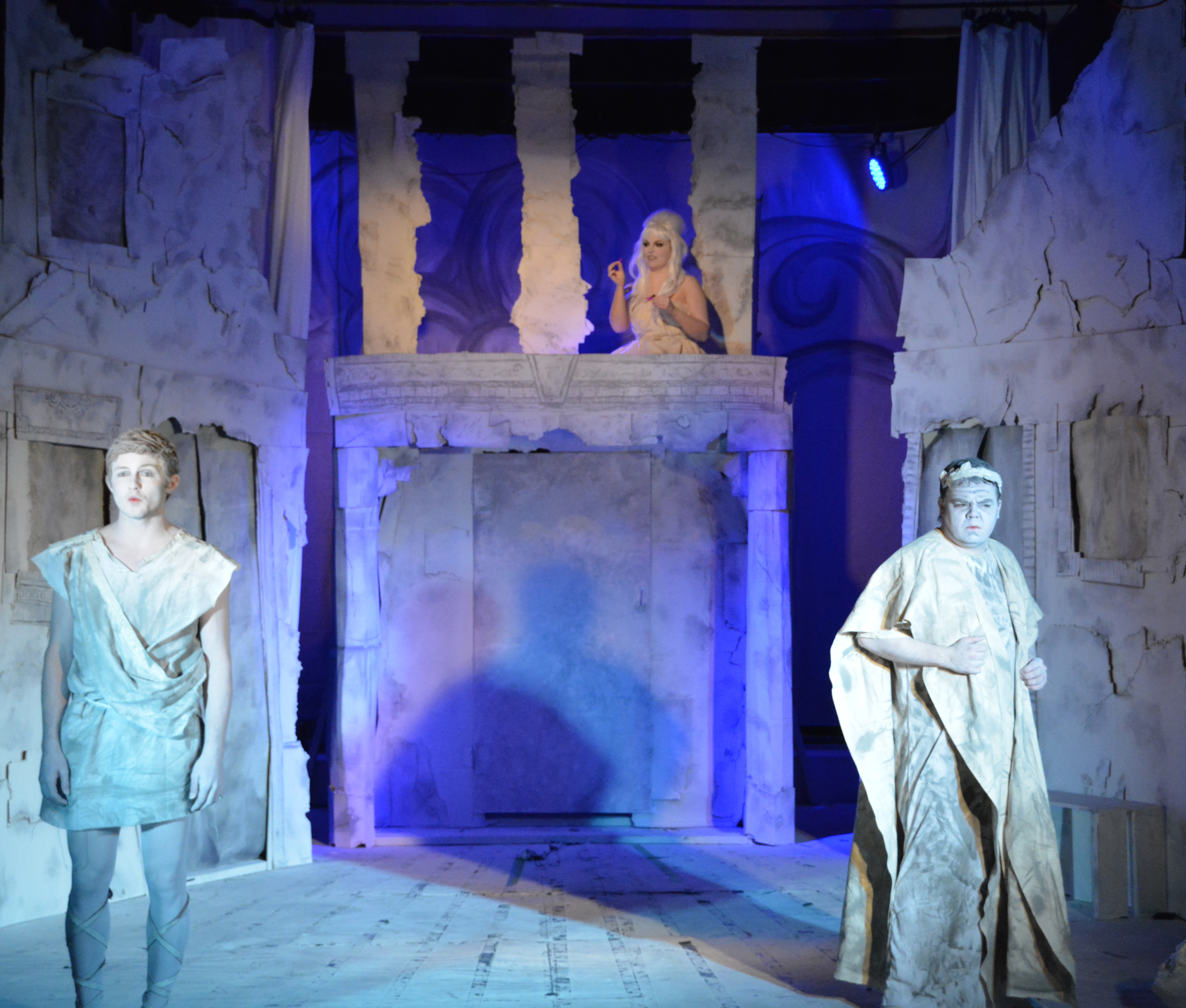
Berry also succeeds in making the cramped stage of the Kaleidoscope theatre more interestingly stylized than I’ve seen previously in this show. Choosing to dress the set in a kind of marbleized, dirty sheet look, Berry facades the three Roman houses in identical materials and colours, creating a crumbling look for this less than grand neighborhood setting. Carrying on this monochromatic effect, Berry’s costumes and makeup also take on the greyish hue with actors sooty powdered faces matching wonderfully with the set in a kind of clown cum ghost zombie look. Supported by Berry’s generous and stylish lighting, the whole effect is quite modern in a shabby chic architectural digest kind of fashion.

Luke Hamilton’s choreography makes decent use of the cramped space and has some bright moments such as the wonderfully silly and catchy ‘Everybody Ought to Have a Maid”’ number that has performers trolling through a dance scenario with added participants each go round. Less successful is his parade of courtesans who one by one show off their specialty. Here again, the lack of music and lag timing takes all the lascivious bite out of the endeavour.

As the madness of the show winds down to the happy ending we were promised in the opening act, there is no doubt that several ear worms were planted in my head despite the often less than boisterous deliveries in this production. It says much about the bouncy and biting score that even less than perfect productions can leave us with this happy aftermath. Berry has some splendid design ideas at work here and he himself provides one of the bright spots of the performance, but until he pulls the reins tighter and demand more from his cast at a faster clip, questions alluding to that nagging French saying will linger.

RATING

For Forum Lovers – It’s not a devastating departure, but neither is it the raucous, sexy, silly fun you love about this show. Berry’s vision for the look of the show is worth noting as is his performance. MAYBE SEE IT

For musical lovers – This is a fine but not special introduction to this chaotic and funny musical. You’ll be somewhat amused as you hum along. Pity that it isn’t going to blow you away. MAYBE SEE IT

For theatre junkies – Sure we love the music and lyrics and the character names delight (the name Gymnasia, the courtesan, alone makes me giggle every time) plus set and costume design like this deserves to be seen.  But whether you put the missing panache down to the intangible or figure out that the timing and energy just aren’t up to snuff, you’ll be better off fondly remembering this one on your own. SKIP IT

The Blackest Shore – Houston Press Review

The Blackest Shore

Gabriel Regojo in The Blackest Shore. Photo by Anthony Rathbun.


The Blackest Shore

Written by: Mark Schultz

Directed by: Jason Noodler

Company: The Catastrophic Theatre

Run Dates: February 13 – March 7, 2015


Read my review of The Blackest Shore for Houston Press at

http://blogs.houstonpress.com/artattack/2015/02/the_blackest_shore_review.php

Kinky Boots – Review

Kinky

Darius Harper as Lola. Photo by Matthew Murphy.


Kinky Boots

Book by: Harvey Fierstein

Music and Lyrics: Cyndi Lauper

Directed by: Jerry Mitchell

Company: Theatre Under the Stars

Run Dates: February 10 – 22, 2015


Daddy issues. We all got em. Whether you buy into the Freudian/Jungian theory of intrinsic competition in the parent child relationship or the more modern understanding of how fatherly archetypes shape our personality, it’s fair to say that our Dads have the potential to mess us up. It’s why playwrights from Shakespeare to Miller and too many more to mention have mined this complex relationship to dramatic effect in their works. But what about a musical treatment of the complex? Not one of those thinky-singing, intellectual examinations that are still in vogue in certain circles. A big, glitzy, show-stopping number kind of musical? Well if you slapped a dress on it and bedazzled the frock with oodles of glitter and sequins, you’d get the Tony-award winning Kinky Boots.

Based on a 2005 film, which in turn was inspired by a true story, Kinky Boots’ stage sashay was the creation of Tony-award winning playwright/actor Harvey Fierstein (book) and 80’s pop icon Cyndi Lauper (lyrics and music). While the circumstances that propel the show may be a little left of mainstream (that is if you consider drag queens unconventional after all this time), the arc is a bulls-eye utopian feel good musical from start to finish.

Charlie Price (Steven Booth) is the son of a men’s shoe factory owner in small town outside of London. Choosing not to go into her father’s business, Charlie and his sweetheart Nicola (Grace Stockdale) hightail it to London to take jobs as marketing flaks in a swanky firm. But Charlie’s Dad’s sudden death forces him back to the factory to literally and metaphorically fill his father’s shoes. In place as head fo the company, Charlie struggles with both sagging sales and his own issues about not living up to his father’s expectations. Enter the man in the dress, Lola (Darius Harper) a fab-u-lous drag queen with daddy issues of his own whose boxer-father never accepted him as he was. So much so that poor Lola can only feel comfortable in her wigs and dresses and stilettos that could easily strike oil. Problem is, his feet are killing him. The reason being, as Charlie the sudden shoe maker expert points out when the two meet, is that heels engineered for a woman (and cheaply made) are no way for a guy to walk through life. Quicker than you can say Manolo, the unlikely, but similar(as the musical desperately wants us to understand) pair strike up a deal where Charlie will turn his ailing business into a kinky boot factory for cross dressers and Lola will leave the night club scene and come design for him. Will it work, won’t it work? And what will happen when tensions arise between Charlie and Lola? It will all be decided at the international shoe show in Milan where the kinky boot new creations will be unveiled on the catwalk.

With no doubt how it’s all going to turn out in the end, we are left to marinate in the spectacle of the costumes and the set design and the music.  Mostly these  do a fine job of making this utopian-simple storyline bearable and downright fun in places.

Lauper’s lyrics won’t capture your heart or head, especially not with a song called ‘Everybody say Yeah’ that comprises seemingly endless shouts of “yeah” from the singers without much else to the number.  In other songs, such as ‘Step One’, Lauper’s lyrics choose rhyme over substance with lines like, “This is time for a shake-up, Look at me wake up, taking control. This is a new beginning, my gears are spinning, let’s rock’n’roll.” But what the lyrics lack, Lauper makes up for by giving us flashy if forgettable arrangements that provide showstopper moments for characters creating a celebratory atmosphere throughout most of the show.  All of this is wonderfully supported by David Rockwell’s sets design which conjure the kind of factory hipsters would kill to reclaim as a loft and Gregg Barnes’s costume design that delivers drag get ups and high-heeled boots to die for.

But if we’re here to bask in the sparkly confection fun of this show, the buzz is harshed unforgivably by lackluster choreography and middling performances. Throughout much of the show, Lola is flanked by a gaggle of drag queen backup singer/dancers called the Angels. They accompany him in his nightclub acts and they serve as models for the new boots, requiring their presence in the factory often. Decked out to the nines in full drag regalia and led by Harper’s strong voice, the Angels should have shaken their booty till the roof fell down, but instead under Director/Choreographer Jerry Mitchell’s staging; they barely get the walls shaking. Some of the problem seems to be the cramped space in which the Angles are confined, this is a busy set with not tons of room to really let loose. But had the choreography branched out beyond arm waves and the occasional splits and had the Angles been more talented dancers, these problems could have been overcome.

Overcoming most of the problems with the performances could have been dealt with in one word. Accent. Not a single one of the cast members manages a convincing working class accent. It’s not exaggeration to say that nowhere has the word ‘wanker’ been more butchered. British slang aside, Booth’s Charlie is as flat as the chests of the Angles out of costume. While his voice carries through strongly in his numbers, Booth flies through the fast paced show mechanically without any warmth or connection. Harper fares better thanks in part to a role that gives him the best lines and shines the spotlight on his terrific voice. But like any drag character at the center of a show (Hedwig, Frankenfurter, Albin) the charisma needs to come not from the costume and make up, but from the performer himself. In Harper’s case it’s hit and miss. In the infectious number, ‘Sex is in the Heels’ Harper’s energy has us in the palm of his hand and his performance in a cleverly staged boxing match against a close-minded factory worker helps make that scene one of the best. But Harper lacks spark in the slower numbers, most notably in the duet ‘Not my Father’s Son’where he and Charlie spell out their daddy issues for those that need reminding. Here Harper does little to make us feel Lola’s loss or pain. It’s a vocally strong but dialed in performance seemingly waiting to once again don the heels and get back to the fun stuff.

Truth is, in this production, Charlie and Lola may be the stars, but the spotlight belongs completely to Lauren (the risibly accented but stupendously comedic Lindsay Nicole Chambers), a factory worker with a crush on Charlie. With her lithe physicality that never shies away from gawkiness for a laugh, Chambers brings the house down in her solo number ‘The History of Wrong Guys’. Wrestling with her newly realized interest in Charlie, Lauren gets the very best of Lauper’s lyrics, “You used to be so “eh”, a limp lackluster bore. But now you’re changing into something I just can’t ignore.” But it’s Chambers’ goofy embodiment of her character that truly makes the lines come to life in song and throughout the show.  It may not be easy to steal the spotlight away from a 6 foot something drag queen, but Chambers is the one we watch and look forward to seeing again and again.

By the time the musical moves to Milan, we’ve been entertained highly and made to wish there was more talent in this soft ball sexual tolerance/learning to love yourself for who you are/letting go of your father complex show. Carl Jung once said, the question is not whether one has complexes. We all do. The proper question is whether we have them or they have us. In the case of Kinky Boots, the overly earnest and irony free show has us just enough to say we’ve had a good time but drops the ball too many times for us to want to commit fully to its therapy.


RATING

For the pearl clutchers – This is drag queen light. There are no alternative sexual relationships or even sexual situations in this story. Yes, there are men in women’s clothing discussing shoes, but that’s about as far out there as it gets. The accept yourself and others for who they are message goes down easy and may just entertain even your delicate sensibilities. MAYBE SEE IT

For musical fans – There are lots of big-ticket numbers here and while not all of them take off in full choreographed splendour, there is enough to keep your toe tapping. Don’t expect to fall in love with any of the music or lyrics and you’ll have a grand time. SEE IT

For theatre junkies – This is a fair production of a good but not great show. Yes it won the Tony for best musical and Lauper went home with the Tony for her work as well but as we all know, awards don’t necessarily mean great work. If you’re the type of theater goer that needs to rack up award winners in your canon then by all means, go. Otherwise, kicking off your shoes and sitting this one out wouldn’t be uncalled for. MAYBE SEE IT

The Speckled Band: An Adventure of Sherlock Holmes – Review

Sherlock

John Johnston as Holmes. Photo credit: Pin Lim.


The Speckled Band: An Adventure of Sherlock Holmes
Written by:  Arthur Conan Doyle
Adapted by:  Timothy N. Evers
Company: Classical Theatre Company
Run Dates: February 4 – 22, 2015


Ah Sherlock. Between being given new big screen life thanks to the highest paid actor in Hollywood (box office magic, Robert Downey Jr.)  and your present small screen triumphs (Jonny Lee Miller’s version on CBS and Benedict Cumberbatch’s fan favorite turn on BBC) you really are in vogue these days. So it’s no surprise that the Classical Theatre Company would want to bring a version of your tale to the stage. From the cross-section of folks cramming the theatre opening night, it seems like we’re still hungy for more of the famous detective’s deducing.  Bums in seats is never a bad thing for a company to wish for and accomplish.

But are we there to see a familiar character in a safely formulaic story so that we can all sit back, not work too hard and enjoy? Or are we there to see new life and insights breathed into a character we thought we knew? This version, adapted by Timothy N. Evers and directed by Troy Scheid gives us lots of the former and a respectable amount of the latter. And yet still, the thing feels off. Like something is missing. And it doesn’t take a Sherlockian brain to realize that some ill-conceived staging and a flawed storyline is the thing that ultimately murders this play.

The Speckled Band: An Adventure of Sherlock Holmes tells the tale of Helen Stoner (Amelia Fischer) and her controlling, violent-tempered stepfather, Dr. Roylott (a wonderfully bombastic and caustic James Belcher) . Helen and her sister Julia have been living with Roylott since their mother’s inexplicable death and as the play opens, we learn that now Julia too has died mysteriously. On the eve of her wedding, no less.  We also learn fairly quickly of some provision wherein Roylott loses his inherited fortune should either of his stepdaughters marry. As Helen’s own wedding quickly approaches with her betrothed out-of-town, she turns to her friend Dr. Watson (an easy to like Andrew Love) who suggests she employ the notorious Sherlock Homes (a superbly weird and wonderful John Johnston) to save her from certain death.

And therein lays the problem. Where’s the mystery? We know that Roylott is the killer right from the get go. We know that Helen is his next target and why. Yes, we don’t know exactly how Roylott did and will do it again. Had we been given suspenseful tension we might have cared to find out. Instead, Scheid gives us scenes of lukewarm violence where neither actor commits to the moment. Roylott grabs Helen, pushes her and at one point tries to strangle her, but there is such hesitancy in the staging that any feeling of alarm is snuffed out.  If Helen is truly frightened, Fischer does very little outside of delivering the dialogue to show it. In fairness to her, the script doesn’t help. On the eve of her possible death, Helen willingly lets Roylott into her room for a heated chat. Really? Risible plot points like this can’t help but put you in mind of bad 1980’s horror films….the house is haunted? Sure, we’ll go in! Helen might not die the moment she lets her murderer into her room, but our belief in any bloodcurdling feeling being elicited by this play perishes on the spot.

So it is a tremendous accomplishment that there can still be much to enjoy in this production. Well, if much were to mean the portrayal and staging of the great detective himself. It is Sherlock we’ve come to see and it’s a marvellous Sherlock we get. One that is subtly modernized for our ear (thanks to Evers adaptation which removes anachronistic language such as the famous elementary line), given full rein to be both laughed at and with (by Scheid’s fine sense of comedic direction) and in glorious oddball form thanks to Johnson’s refreshing portrayal.

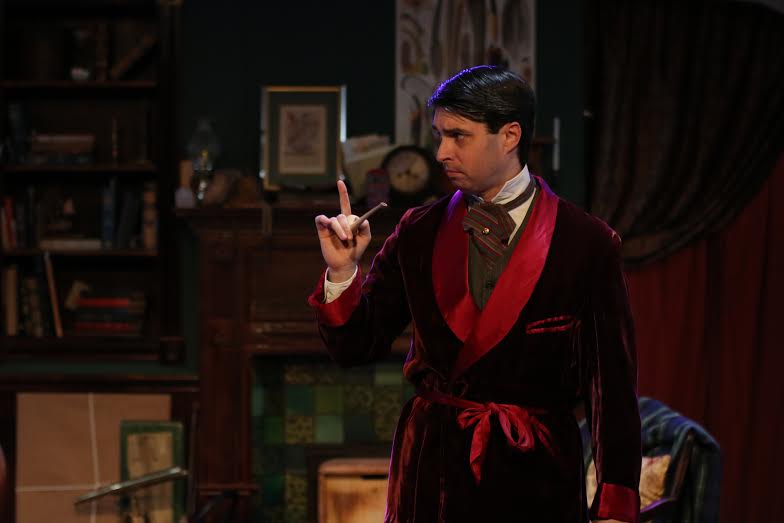
Slightly effete yet moving without any grace whatsoever, Johnson’s Sherlock flatfoots it around the stage with the bug-eyed,  hair smoothing, face touching tics and twitches of a slightly off kilter genius. Nothing is ever put down in its proper place. Papers are simply dropped where he stands and coats are flung to lie wherever they may. It’s a lovely touch for a character that has far more pressing mystery solving things to think about. But it’s really the voice that makes it all come together. Speaking at a clip far faster than the rest of the cast, Johnson rails off deductions like they were puffs of air all the while rolling his r’s in a somewhat derisive manner to wonderful effect. Nowhere here is a Sherlock that is in the least bit attractive or awe striking. Instead we are given a Sherlock who is the adult version of the creepy, socially awkward brilliant kid at the back of the class no one wanted to play with. It’s a distinct departure from recent portrayals (with Lee Miller’s being the closest) and it not only gives us a different view of the character, it opens up the possibilities of the humour tremendously.

Possibility is also the name of the game when it comes to set design in this show. Claire A. Jac Jones’ ambitious set that conjures no less than five different settings are nicely realized if cumbersome process. Each set change, accompanied by a blacked out stage and a mournful violin soundtrack, seems to go on forever as props are dragged in and backdrops are switched out. This is not a show that can afford to lose what tenous hold it has on the plot’s tension. Perhaps less ambitious design might have helped the woefully limp script and kept us more engaged with the actual so-called mystery of the play.

Instead we are left to be engaged by Sherlock, which may not mean a holistic theatre experience, but thankfully here does mean a light and fun way to spend a couple of hours.


RATING

For Sherlock fans – It’s a different take on the great detective. Sherlock is far more oddball than impressive genius in this show. But it’s done with such comedic finesse that it’s bound to delight. SEE IT

For mystery fans – Lack of tension or suspense or a mystery that anyone gives a hoot about will leave you cold. SKIP IT

For occasional theatre goers – This is easy, digestible, old-fashioned type of non-heady entertainment with some very strong performances in familiar roles. It may not be a fancy, edge of your seat production, but it might just suit what you are after. MAYBE SEE IT

For theatre junkies – With such polar opposite hits and misses in the production it comes down to what matters more, plausible plotline that creates drama onstage or delight in a terrific performance.  Only you can decide this one. MAYBE SEE IT

Fly – Houston Press Review

Fly (2)

(L-R) Kendrick “KayB” Brown, Joseph “JoeP” Palmore, Jason E. Carmichael, Nkem
Richard Nwankwo in Fly. Photo credit –  David Bray.


Fly

Written by: Trey Ellis and Ricardo Khan 

Directed by: Allie Woods

Company: The Ensemble Theatre 

Run Dates: January 29 – February 22, 2015


Read my review of Fly for Houston Press at http://blogs.houstonpress.com/artattack/2015/01/fly_review.php#more