Sequence – Review

sequencecast2

(l to r) Braden Griffiths, Karen Johnson-Diamond, Alana Hawley and Joel Cochrane. Photo Credit – Tim Nguyen

Sequence

February 20 – March 2nd, 2013

Big Secret Theatre

http://www.downstage.ca/sequence.shtml

You can hear my review on CBC’s Eyeopener at http://www.cbc.ca/eyeopener/columnists/theatre/2013/02/22/jessica-goldman-reviews-sequence/


A man sets up a ladder and proceeds to walk underneath it. He then opens an umbrella, smashes a hand mirror with a hammer and shouts “Macbeth”.  These are the opening moments of the world premiere drama Sequence that right from the start doesn’t underestimate the audience’s ability to intelligently engage with the notion of luck and coincidence. It’s the creation of Calgary playwright/ophthalmologist Arun Lakra, the left brain/right brain talent who recently won the 2011 Alberta Playwrights Network’s competition for his Sequence script.

Thoughtfully directed by Kevin McKendrick, the play takes the form of two linear storylines that run complimentary to each other, only overlapping in theme and subject matter. There is mercifully no ‘aha’ moment when then the two stories somehow miraculously come together tying everything up in a neat little bow.  Like I said, this is not mainstream showmanship for the masses.

One of the narratives deals with Theo (Joel Cochrane), who Time Magazine has called the luckiest man in the world because he is able to predict – with a perfect 20 year record– the coin toss at the Superbowl. His talents have made him not only famous, but very rich as Theo wagers double or nothing on each bet resulting in millions of dollars for his talents. At a lecture he is giving on how to gain some of his well-documented luck, he meets Cynthia (Alana Hawley), a young woman who has just discovered she’s pregnant and is concerned because she has a genetic disease in her family that can cause blindness. Cynthia has come with a closed envelope containing the test results of her baby and she wants Theo’s help, or actually his luck, to open the letter and read the results.

In the other thread we meet Dr. Guzman (Karen Johnson-Diamond), a flighty, wise-cracking science professor who is visited by Mr. Adamson (Braden Griffiths), a religiously faithful student that has the unbelievably bad luck to have completely failed a test by getting all 150 multiple choice answers wrong.

Dr. Guzman herself has some bad luck as well. She’s lost 92 percent of her vision due to her own genetic issue and by a fluke missed the opportunity to identify the disease gene when another scientist beat her to the punch and took all the glory.

The drama is well set up and the tensions that arise are perfectly plausible.  But what takes this play to a whole other level is that in addition to the regular dialogue you’d expect from these narratives, are the inclusion of some very high-minded discussions involving mathematical theories, probabilities of coin tosses, inherited behaviour, recursive numerical sequences and the very heated genetics vs. the hand of God discussion. There’s a lot going on in this play and in the wrong hands it could end up feeling more like a lecture than a piece of entertainment.

But McKendrick does a fairly impressive job of making this cerebral story both theatrically palatable and engaging. The entire cast is always present on Terry Gunvordahl’s cleverly designed stage that keeps the props to a minimum and instead hangs silver balls in strings from the ceiling, giving the set a peptide chain-ish cool scientific esthetic.  Each storyline populates their own side of the stage as the play flips, well-paced, back and forth between two narratives with the actors freezing in place when it’s not their turn. Occasionally McKendrick sends an actor into the frozen space of the other storyline making for both an interesting visual mashup and underlining the metaphorical connection between the two plotlines. Thankfully also mashed into the play amongst all the math/science talk  is quite a bit of humour and opportunity for the characters to show their humanness – their flaws and fears and ego.

For the most part McKendrick allows the lighter parts to work nicely alongside the heavier material without playing too hard for the laughs. However both script-wise and with the staging, Theo and Cynthia’s story worked far better than the professor/student narrative which felt a little forced both in dialogue delivery in the way the characters physically interacted with each other.  There is no question that Sequence is an incredibly challenging play to stage and despite the weaker thread, I give McKendrick full credit for his vision in this production.

Credit must also go to the decent cast for bringing this interesting story to life. My only quibble with the performances was Johnson-Diamond, who played Dr. Guzman’s quirkiness overly hard and as a result just wasn’t altogether believable as a professor. She seemed too caught up with nailing the timing of the jokes to really embody her character and bring the confidence and arrogance that a science professor ought to have. Conversely, Hawley’s Cynthia was the perfect embodiment of her character. She got the math geek-speak spot on while still being a sexy strong woman who challenges Theo and his whole rationale of what luck really is. You believed that she was frightened for her baby and was struggling with what to do next. It was a truly remarkable performance from a tremendously strong actress who continues to impress me.

Sequence will not appeal to everyone. It’s not a show you can watch passively and expect easy entertainment.  This play challenges the audience with smart dialogue about complex ideas and forces them to work for their reward. But do not fear, even if you are as utterly hopeless when it comes to math and high level science as I am, you will be able to keep up and find great enjoyment in the concepts presented. However, my greatest enjoyment came from not being given neatly packaged answers to the questions raised in the script. Instead Sequence gives you lots to chew on both in the eventual arc of the plot and in the bigger questions raised. Nothing makes me happier than to be excited by a new Calgary play.  Sequence may not be perfect on every level, but it was absolutely one of the most dynamic and intriguing shows I’ve seen this year

RATING

For the guys and the girls – They say the spoils of hard work are the most treasured. Sequence isn’t overly hard, but it does challenge. The entertaining results will give you much to think and talk about long after the play is done. SEE IT

For the occasional theatre goer – Perhaps this is asking too much of you when all you really want is to be entertained. SKIP IT

For the theater junkie – You’ll like it so much that you’ll want the weaker parts fixed immediately so that this play can shine even brighter. But even in its non-perfect state it will be one of the most interesting and well-conceived shows you’ve had the pleasure of seeing. SEE IT
Kung Fu Panties REDUX- Review

KungFuPanties

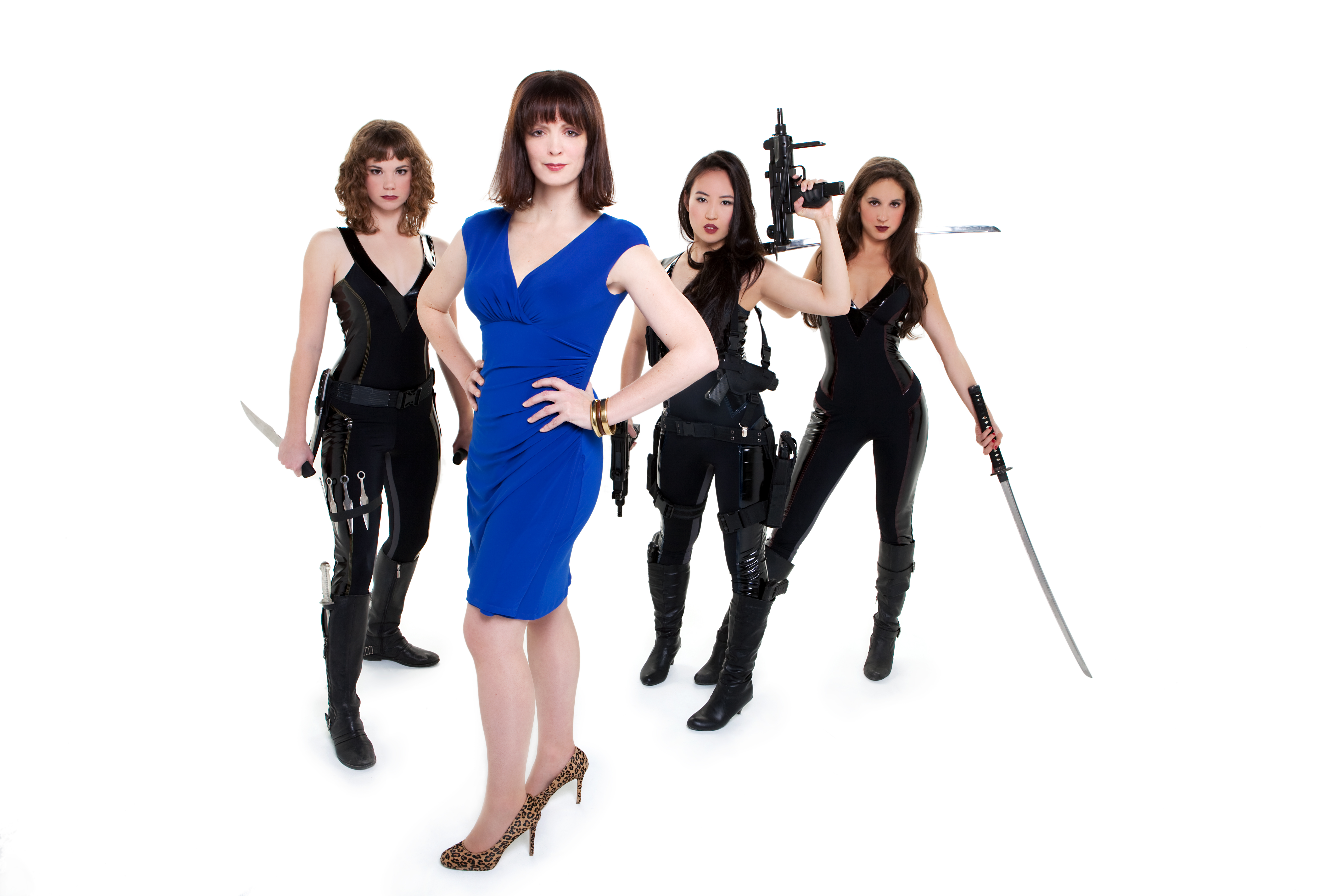
(l to R) Chantelle Han,  Rebecca Northan, Jade Benoit and Sarah Koury


Kung Fu Panties REDUX  

February 6 – March 9, 2013

Loose Moose Theatre

http://www.loosemoose.com/shows.htm


Derivative, repetitive, clichéd, sophomoric, predictable, bush-leagued and rambling. These are some of the words I would use to describe Rebecca Northan’s remount of her 2011 all-girl action movie genre hit, Kung Fu Panties, cast this time round with a group of emerging artists. However if you were to ask the audience around me their thoughts I’m sure they would have a different take. That is if they could stop their gut-busting, laugh-till-they-cried reaction long enough to tell you their opinion of the show.

It’s a difficult position for a theatre critic to be in. To find yourself with woefully little positive to say of a production when those around you are so obviously having a grand time. I could posit that this audience came into the show determined to have a good time and laugh out loud no matter what. I could use as evidence lines that had no intrinsic comedic value yet had people roaring hysterically. Lines like – “Get a haircut you hippie” or “A lot can happen in 11 minutes” or “You look like a Caucasian knock-off of Rico Suave”. Or I could cite the fact that all throughout the play, all an actor had to do was appear on stage to elicit uproarious laughter from the seats. But the truth is I can’t get inside other people’s head. I can only tell you what was in mine as I sat through a production that had me disturbingly wishing I was instead watching the 2000 film adaptation of Charlie’s Angels – a not very good movie but at least better than what I was seeing on the stage.

The gist of Kung Fu Panties is to introduce us to Darlington (Sarah Koury), Malta (Chantelle Han) and Goodbody (Jade Benoit), members of The Sisterhood, a knock off of the rough and sexy Charlie’s Angels characters introduced by the film franchise and ripped right out of hackney heaven. There’s the cold potty mouth one, the romantic moral one and the new kid who isn’t all that bright. Their job is to stalk and assassin evil doers, in particular a man by the name of Flores, a nefarious arms dealer and drug trafficker. The girls fight their way through Kung Fu battles, car chases, gun play, a staged orgy and a romance gone wrong to get their villain. And it’s all done with a tongue in check, spoofy and overly sexualized manner meant to be both funny in the doing and funny in the homage. The problem is that to my mind it accomplished neither. A lack of chemistry between the girls, a horrendous English accent a la Madonna once she moved to London, humour that consisted mostly of groin kneeing or men stripping down to teeny thongs and repetitive slow motion, ninja-aided fight scenes piled one tiresome moment upon another.

What the play lacked in writing and acting however was made up for somewhat by Northan’s direction which injected many well-conceived and smartly designed elements to the show. A laser beam security system is beautifully brought to life on the stage as the girls try to navigate their way through the maze, a final climatic car chase dramatized wholly on rolling office chairs is tightly delivered and expertly choreographed and the one pseudo sex scene with pumped in fog and a bed that rotates managed to stay just this side of silly enough to have amusing impact.

But those few expertly realized moments are by no means enough to save this production from feeling like one big schoolyard recess play. And I’m not sure I’ll ever get over my new-found contextual fondness for Cameron, Lucy and Drew.  Kung Fu Panties had all the potential of a fun, spoofy, action packed night in the theatre, but like most items of lingerie, it was much better in principle than in practice.


RATING

 For the girls – Despite the fact that each girl is a shallow stereotype, they do kick ass and triumph in the end. MAYBE SEE IT

For the guys – It seemed that the men were the ones laughing hardest at the ball-kneeing and male stripping. Not sure what that says about you guys. But hey, laughing is good I suppose. MAYBE SEE IT

For the occasional theatre goer – If you like this humour then it’s a laugh a minute even though it will feel a little long overall. MAYBE SEE IT

For the theater junkie – You’ve seen this all before, either on screen or in the theatre. Probably done far better. SKIP IT

Gaslight – Review

Gaslight-106

Patrick McManus and Anna Cummer in Vertigo Theatre’s GASLIGHT by Patrick Hamilton | Photo Credit:  Trudie Lee


Gaslight

January 26 – February 24, 2013

Vertigo Mystery Theatre

http://www.vertigotheatre.com/main/index.php?site=mystery&id=production&production=28

Listen to my review of Gaslight on CBC’s Eyeopener on Feb. 11 at 8:0 am at http://www.cbc.ca/eyeopener/


I have always thought that the traditional and oft used description of Patrick Hamilton’s 1938 play, Gaslight, as a mystery-thriller was a misnomer. Far from being a mystery, there are no twists and turns or searching for culprits or even a big surprise climax. Instead the malefactor is outed with almost iron-clad certainty in Act 1 with only few extra details uncovered later in the play leading to his expected arrest. Gaslight fares somewhat better in the thriller department with one great suspenseful scene to start off Act II, but then quickly devolves into the obvious happening at the expected moments.

So then, why is this story so successful? Gaslight was an immense hit when it premiered in London. It went on to become one of the longest-running non-musicals on Broadway and inspired two film adaptations, with the 1944 American version nominated for seven Oscars and landing Ingrid Bergman the Best Actress Award.

The reason for the story’s appeal is simple. What the plot lacks in classic edge-of-your-seat mystery genre tautness, it makes up for in the personal inner tension and terror of the plot’s main female character. Or at least that’s the idea if the production is going to be a success.

The play is set in the 1880s at the home of Jack Manningham (Robustly yet at times too theatrically played by Patrick McManus) and his young wife Bella (The antsy and emotive Anna Cummer). Right from the outset of the story it’s apparent that Bella is anxiously disturbed by her husband’s reproachful and insensitive quips at her, his overt flirting with the servants and his nightly unexplained disappearances from the house for several hours. Her submissive and almost self-flagellating response to her husband’s emotional abuse, we learn, is the result of months of scheming by Mr. Manningham to convince Bella that she, like her mother before her, is going insane. But it isn’t until a retired police detective named Rough (played with perfect pitch by Christopher Hunt) shows up to the house to speak with Bella in private that she herself learns of her husband’s deceit. Not just against her sanity, but in matters of murder as well. It turns out that the house the Manningham’s are living in was the site of a crime some years ago where an old woman was murdered for her precious jewels, which the killer never found. Still on the loose, Rough believes that he has identified her husband as the murderer and that Bella is being used in his plot to finally find the gem’s hiding place within the house. As I said, the plot in this “mystery” is laid bare quite early and all we are really left with is Jack’s evil abuse and Bella’s tormented mind to witness as a type of psychological thriller tale. In fact, this narrative arc was so successful in the original stage and film adaptations that it gave rise to the clinical term ‘gaslighting’, meaning psychological abuse whereby false information is systematically presented to a person with the intent of making them doubt their own sanity.

It’s a shame then that renowned Director, Christopher Newton (the original founder of Theatre Calgary and Artistic Director of the Shaw Festival for 23 years) didn’t quite manage to bring the squirm-inducing discomfort of watching a woman wrestle with her sanity or the empathetic terror that audiences really need to connect with this script. Newton’s direction was swift and confident and he did manage to draw out strong performances from his cast. However so much of Bella’s flitting-about spiral into insanity took place upstage and center stage resulting in literal and metaphorical distances between audience and character. In addition, her whirlwind behavior without pause leaves little room for true pathos.We watched her struggle instead of feeling it. And for me, that was the difference between losing myself in the play and merely witnessing it. Anna Cummer had all the talent to make Bella a true tragic figure that eventually gets her revenge, but she is blocked in her attempts in this case by some uninspired direction. This doesn’t stop the show from being good – the audience gives their attention happily – but it stops it from being great.


RATING

For the guys – I heard several men bemoaning the lack of real suspense in the story on the way out of the theatre. Yet even without this element they all seemed to enjoy the play well enough. MAYBE SEE IT

For the girls – Bella’s character is certainly no model for feminism. She’s weak and subservient beyond her potential madness. But such were the times and even if it’s not played to full effect, she does get the last laugh. MAYBE SEE IT

For the occasional theatre goer – The lack of a real whodunnit element may seem boring, but the unfolding of the known in this case is fun to watch. SEE IT

For the theatre junkie – Seeing Christopher Hunt do his thing is always worth the price of admission even if his sum is greater than the whole. MAYBE SEE IT


Falstaff – Review

Falstaff 344email

Laura Whalen and Gaétan Laperrière in Calgary Opera’s Falstaff.  Photo by Trudie Lee.


Falstaff

February 2, 6, & 8, @012

Jubilee Auditorium

http://www.calgaryopera.com/performancesandevents/falstaff/index.php


Well, I don’t believe I’ve ever seen that before in an opera! No, I’m not talking about the fact that this was my first experience watching Verdi’s comedic masterpiece, Falstaff. Nor am I referencing the silent scenery changes that had costumed characters schlepping set pieces on an off the stage, although that felt somewhat surprising to me as well. What I’m alluding to is not one, but three instances of bare buttock flashing on the stage in full moon fashion.  Hey, this is a comedy after all and while the stunt may have worn out its fun after the second attempt, I give the production credit for bringing a contemporary silliness to this delightfully performed and rhythmically interesting performance.

Falstaff, Verdi’s final opera written at the age of 79, is described as a mash-up of Shakespeare’s iconic comedic, gluttonous and bombastic character from the Henry plays and his comedy, The Merry Wives of Windsor. But apart from a few bits and details from Falstaff’s complex appearances in Henry IV Parts I and II, the opera is more a riff on the plot and characterization from Shakespeare’s comedic efforts. The tone is playful- Falstaff is a simple comedic character driving the action rather than commenting on it and there’s no gristle to be found in the libretto or orchestration. You come for fun, and fun you get.

The plot is a simple one. In an effort to improve his finances, Falstaff tries to seduce two married ladies, who in turn trick and humiliate him for his deceitful lechery. Make no mistake, Falstaff may have the starring role, but it’s the women who have the upper hand throughout this opera. As does Verdi’s music and Boito’s libretto.

In lieu of an overture, the audience is thrown right into the action with music that seems both simple and intricate at once. This is a busy composition that puts great demands on the performers as they banter quickly back and forth and layer call and response over one another. Conductor Robert Dean kept the pace lively and tight, enabling smooth pick-ups and good rapport with the action onstage.

All eyes were on the costumed-made rotund Gaétan Laperrière as Falstaff in this, his final performance before retirement. Laperrrière’s well controlled Baritone easily found the humour in the notes as did his deliciously arrogant and amusingly ridiculous stage delivery of the action. Standing out with her natural acting ability and energetic voice, Soprano Laura Whalen was immensely entertaining as Alice Ford, the would be married suitor who hatches the plot to teach Falstaff a lesson. However it was Soprano Eve-Lyn De La Haye as Nannetta, Alice’s daughter who is in love with a suitor undesirable to her father, who hit the spot for me.  Her liquid-clear fragrant and intensely sweet voice in both a duet and a solo piece left me with shivers and a desire to hear more from this talented young performer.

Set by John Conklin’s contemporary designs yet retaining the era’s proper dress, the opera felt fresh without the ‘trying too hard to be hip’ trap that many modern productions fall into. The exuberant sense of silliness was allowed to shine in Michael Cavanaugh’s staging which demanded and received ease of space and place from the performers. The audience is not told to laugh in this production; instead it flows naturally from the elegant action onstage.

Falstaff may not have the emotional intensity or memorable melodies of Verdi’s other works, but for pure silly fun, this production is a wonderful way to chase the winter blues away.


RATING

For the girls –So often the female roles in opera are subservient victims with no real control over the narrative. Not so in this one. Verdi may have been first to introduce the world to girl power with this one. SEE IT

For the guys –Girl power does not mean anti-male. Especially when the men are so funny. Think Judd Apatow meets classical music and singing. SEE IT

For the opera newbie – With its humor, simple plot and wonderful performances, this is a great opera to sink your teeth into. SEE IT

For the seasoned opera buff – Lapierrière deserves your respectful adieu with his wonderful performance and Verdi’s complex demands of both the orchestra and performers are very worthy of attention. SEE IT

The Kite Runner – Review

KiteRunner-ApplauseMeter

(l to r) Michael Peng, Conor Wylie, Anousha Alamian, Norman Yeung, Parnelli Parnes.  Photo by Trudie Lee.

The Kite Runner

January 29 to February 4, 2013

Max Bell Theatre

http://theatrecalgary.com/plays/kite_runner/more_info/

Listen to my review on CBC’s Eyeopener at 

http://www.cbc.ca/eyeopener/columnists/theatre/2013/02/04/theatre-review—the-kite-runner/


Never, ever see the movie version. This is my steadfast personal rule after reading a novel I deeply enjoy. Not because the film adaptation is necessarily not up to snuff (although let’s face it, many of them aren’t), but because I like to keep alive my own imaginative memories of the people, places and situations evoked between the pages, undisturbed by the biases and agendas of Hollywood or some other movie-maker. However, as a theater critic, the luxury of banning from your cannon all productions based on novels you enjoyed is not only impossible, it’s ill-advised. Especially when it’s done with as much thought, subtlety and confidence as Theatre Calgary’s Canadian Premiere of The Kite Runner in coproduction with Edmonton’s Citadel Theatre.

Economically and elegantly directed by Eric Rose, The Kite Runner is a stage adaptation that comes with the baggage of great expectation due to the sheer force of the story’s success. Khaled Hossein’s novel about two Afghan boys of different caste was published in 2003 and went on to become an international bestseller, claiming millions of copies published in approximately 70 countries. The movie version followed just a few years later with Marc Forster’s 2007 film adaptation which garnered Oscar and Golden Globe nominations and won several other critical awards. Seemingly undaunted by the story’s already wide exposure and possible critical saturation, playwright Matthew Spangler took his turn adapting the novel for the stage in his 2009 San Jose production. Spangler’s efforts paid off winning no less than five San Francisco Bay Area Theatre Critics’ Circle Awards, including awards for Original Script and Overall Production. In other words – Rose and his team had big shoes to fill. And despite some questionable narrative techniques in Act I, this production is yet another successful notch in The Kite Runner saga.

Staying remarkably true to the original novel right down to the first person narrative, Spangler’s adaptation tells the story of a Kabul boy named Amir, a wealthy Pashtun (the dominant ruling class in Afghanistan pre 1980’s Soviet invasion) who betrays his servant/friend Hassan, a Hazara (an ethnically oppressed Afghan minority) in order to win his father’s approval and love. Tormented by his deeds, Amir struggles the rest of his life with these demons until the opportunity for redemption, “to be good again “presents itself. Running concurrently with the boys’ narrative, is the very real historical backdrop of Afghanistan at that time. The play’s timeline addresses the fall of the monarchy, the Soviet invasion, the mass exodus of Afghan refugees to Pakistan and the United States and the Taliban regime. Ambitious in its scope, the story spans thirty years and two continents, presenting a great challenge for any director. Rose’s clever answer to the challenge is to not get carried away with the preciousness of place. Instead he allows the strength of many performances, evocative live drumming by the talented Salar Nader and Kerem Cetinel’s moody lighting and metaphorically minimal set design to stand in for literal translations of the many emotional and physical spaces the story inhabits.

The first half of the play unfolds through the adult narration of Amir (played by Anousha Alamian with expertly balanced intensity and energy) as he recounts the events of his younger self (a somewhat reserved Conor Wylie) and Hassan (played with disappointingly little emotional oomph by Norman Yeung). The audience learns of the dynamic between the master and servant-informed friendship between the boys, Amir’s jealousy of his father’s affection for Hassan, the community’s racism towards the Hazara people and the ultimate horrific events that lead Amir to inexcusably abandon and betray Hassan.  But if there is such thing as a feeling between being over and underwhelmed, then I would have to assert that I was simply whelmed by the treatment of these events. Having a narrator shadow himself as a younger boy, literally standing beside or behind every action, was both distracting and distancing. Especially when dealing with flashcard storytelling where no scene is more than a mere few minutes long. Just as I was trying to relate to the younger Amir and Hassan, there was the older Amir talking to us, pulling the audience out of the real connection with the characters and actors on stage. Thankfully this annoyance was overshadowed by both Alamian’s strong performance and the extremely compelling character of Amir’s father, Baba (the fantastic Michael Peng). Also distracting from this narrative tick was, ironically, the fact that set-wise, there was little to distract from the action. Cetinel’s bare-minimum design with just  few chairs or a desk when called for, clean-looking backdrops, moody lighting that often reduced to a black set with just one spotlight gave an impressively intimate feeling that beautifully matched Rose’s considered staging. The wonderful eponymous kite running scene, with its unfussy design and staging was a stunning example of how to do more with less.

But Act II is really when this play takes flight. Here the action shifts post exodus to San Francisco (again evoked with a gorgeous light hand by Cetinel) where finally the adult Amir is unleashed allowing Alamain to both narrate and act for himself resulting in a much-needed bond between character and audience. It is with this connection that we watch his new life in the USA unfold, including first love, marriage, his father’s illness and his lingering torment about his actions towards Hassan. By this point, the audience is so enthralled with Amir and his struggles that no one seems to mind the soap-opera-ish turn of events that send him back to Afghanistan in search of redemption for his sins. Frankly the somewhat hackneyed final plot twist that ultimately results in a fairly hermetically sealed conclusion bothered me as much in the book as it did in the theatre. I would have liked an ending less obvious. But after going on such a long journey with Amir, it is totally understandable why readers, and now audiences, eat this ending up with such relish.

The Kite Runner shows us a dark side to our souls, offers up the possibility of goodness and shows us a world that many Westerners know nothing about. Put quite expertly on stage in this worthy production the story will no doubt satisfy those who already loved the story and easily make fans out of newcomers to the tale.

RATING

For the guys and the girls – At the heart of his story are the universal themes of jealousy, weakness and striving for goodness that we can all relate to. Throw in an historically fascinating backdrop and a unique cultural glimpse and you will find enjoyment all around. SEE IT

For the occasional theatre goer – the minimal sets and bare design might throw you, but stay with it and you will quickly be won over by the emotional story. SEE IT

For the theatre junkie – Some great performances, beautifully balanced direction and design with a story you can’t help but fall for. SEE IT

Maria Rasputin Presents – Review

Maria Rasputin

Shari Wattling as Maria Rasputin.  Photo Credit: Kristian Jones.


Maria Rasputin Presents

January 29 – February 9, 2013

Joyce Doolittle Theatre

http://www.fortemusical.ca/upcoming/


Was Grigori Rasputin, spiritual leader to Russia’s Tsar Nicholas II and Tsarina Alexandra, a selfless healer and man of God trying to do right by the Romanov family and the people of Russia or was he a power-hungry opportunist who used the Royal Family’s trust to advance his own agenda? This is the central question in Maria Rasputin Presents, the uneven and ultimately unsatisfying new musical written and composed by Forte Musical Theatre Guild’s Joe Slabe and directed by Mark Bellamy.

Told through the narration of Rasputin’s daughter, Maria (well-acted but weakly sung in the upper range by Shari Wattling) the musical relives the events that led up to the monk’s ultimate murder. Played as a kind of circus act, a nod to Maria’s own time spent as a big top performer, Maria Rasputin Presents unfolds as a he says/she says light comedic narrative with Maria’s version of events compared every step of the way to that of Rasputin’s murderer Felix Yusupov (the strong-voiced Daniel Mallet gratingly assaulting us with a stereotypical capital-G gay character treatment). As the scenes play out, the two argue over what really happened with Maria interrupting Felix’s account mid-stream with a thrash of her ringleader’s whip to call him a liar and demand he present the truth. Or at least he truth as she wants to believe it. But the point really isn’t whose story is correct. At least not as Slabe has written it.

Rather than present complex or intriguing insights about the mythical Rasputin himself, the playwright is far more interested in the gay love affair between Felix and his murderous co-conspirator Dmitri Pavlovich (the energetic and talented Scott Shpeley) and this is where the musical spirals into boring, cliché-ridden camp. Beginning with a tired retread of every drag queen joke you’ve ever seen (Felix singing It’s Good to be a Queen) right through to the flamingly gay man attempting to lose his lilt number (Felix’s hackneyed I’m Gonna Make a Man Outta Me), the musical’s first act practically drowns in offensively obvious humour. It’s all just too much and adds nothing to the story but the playwright’s and/or director’s conceit.

Which is a shame as there are glimpses of something far more interesting and compelling along the way. Near the end of Act 1, we are finally shown some of the allure attributed to Rasputin (a mostly mechanical Kevin Aichele struggling to make meaning out of bland dialogue and a thinly written character) in a lovely song meant to heal the Tsarina’s Hemophiliac son. Forgetting for a moment that Sailing sounds an awful lot like Inch Worm of Danny Kaye and Hans Christian Anderson fame (and forgetting that this type of musical derivative populates much of the score), it’s a number that is not only beautifully sung but wonderfully enhanced by an extremely touching and effective use of puppetry. Oh yes, the show has puppets. But other than this one instance I can’t say that they were used to any great dramatic or comedic effect beyond the expected gags.

Things improve somewhat in the much shorter Act II as the comedic banality gets bumped for the more interesting elements of the story. The audience is quickly brought up to speed on political and historical events including the rumours swirling about Rasputin’s intentions. A wonderfully imagined and realized number, I Pull a Few Strings, makes use of human marionette staging to illustrate the hold Rasputin had over the Royal Family and Rasputin’s murder is cleverly portrayed via the show’s most musically and lyrically compelling number, The Dog Who Wouldn’t Die. Unfortunately what little ground the cast gained in these crowd-pleasing numbers is lost again in the finale when the comedy that has peppered the entire musical is ousted to make room for an out-of-place angsty and sentimental conclusion.

Slabe is right in thinking that the myth of Rasputin still intrigues us.  However by not allowing the audience inside the monk’s motives and feelings and instead leaving the story in the hands of the whip cracking Maria and more problematically the un-dynamic gay duo of Felix and Dmitri, Slabe has given us nothing more than a superficial glimpse set to music. But it’s Bellamy’s poor choices that ultimately cause most of the musical’s failings. From the volume of the live music which drowned out both female singers at every occasion to set pieces consisting of trunks that were at once unattractive and cumbersome/noisy to move around to the uber-gay vexatious presentation, it felt as though the director’s eyes and ears weren’t working on a full tank.

Original musicals don’t come around often in Calgary. Certainly not ones with the potential that this show has underneath all the clutter. I’m keeping my fingers crossed that Maria Rasputin Presents is a work in progress that eventually loses it’s done to death camp and morphs into a meatier and more cleverly funny and insightful production. To that end I wish them  Удачи! ( Good luck in Russian)


RATING

For the guys and the girls – Your enjoyment will depend on how funny you think fictional gay constructs are. Sure you’ll learn a bit about Rasputin himself, but not enough to feel satisfied. MAYBE SEE IT

For the occasional theater goer – The double-sided storytelling is easy enough to follow and the musical numbers roll along fine without boredom setting in. MAYBE SEE IT

For the theater junkie – Hopefully they’ll work out the narrative and production issues and remount. Wait to see what happens. SKIP IT