Unsex’d – Review

www.JaimeVedres.com

Jay Whitehead (seated). Photo Credit – Jaime Vedres.

Unsex’d

October 29 – November 2, 2013

MOTEL in the EPCOR CENTRE

http://www.epcorcentre.org/WhatsOn/ShowDetails.aspx?show_id=F1A07365-B139-41E4-B0B0-1526EB799F45

Listen to my live review from CBC Eyeopener at http://www.cbc.ca/eyeopener/columnists/theatre/2013/10/30/jessica-goldman-unsexd/

Well, I now know what a catamite is. The gist of the word was made fairly clear to me when Wilburn Hussey and Humphrey Hughes, two boy players in Shakespeare’s company, talk about a nobleman with specific sexual proclivities to whom they are to become catamite to. But I confess it wasn’t until I got home and looked the word up that I fully understood the meaning. To save you the trouble, should you be as unaware as I was, a catamite is a passive partner (usually a boy) engaged in anal intercourse with another man (usually an adult). As a language junkie, I was pleased as punch to add a new word to my lexicon thanks to Unsex’d, the new two-hander raunchy comedy by Daniel Judes and Jay Whitehead. However, when learning the word catamite is one of the very few intriguing things a play has to offer, perhaps a night home with Wikipedia would have been time better spent.

Unsex’d , this year’s winner of  Third Street Theatre’s New Queer Theatre Playwriting Competition and co-produced by Theatre Outré, takes place around the 16th century when women were not allowed on stage and boy-players took on the female parts in plays. As the show opens, we meet Wilburn Hussey, a not-so-young and not-so-pretty-anymore boy player in Shakespeare’s company. Wilburn has just made his debut as Juliete in Romeo and Juliette and the reviews are not kind. Not because of his acting necessarily, but because the critics viciously maintain that he’s too old and ugly for the role. The campy, overly emotional Wilburn is devastated and asks the spirits for someone to help him overcome his plight, et voilà, he meets Humphrey Hughes – a young beautiful gay bread seller who happens to love the theatre and is a fan of the older boy player’s work. Wilburn convinces Humphrey to come under his tutelage knowing that if he can teach him to act, Shakespeare will give Humphrey the pretty girl roles and save the really juicy female characters for Wilburn. All goes according to plan until Shakespeare writes Macbeth – finally giving Wilburn a strong female role to play in Lady Macbeth.  Of course Wilburn is thrilled until he loses the role to; you guessed it, Humphrey who inspires the now famous “Out, damned spot” quote after spilling wine on his dress. With the roles reversed the rest of the play deals with themes of young triumphing over old, beauty winning the day and how fame changes people.

At this point let me say that there is nothing so frustrating as a good premise put to waste, and unfortunately this is the case here. Unsex’d  takes what could have been a funny and insightful look into the boy player’s experience and pelts it to death with repetitive and obvious bawdy humour, tiresome camp, and a “dark” side that not only has been done to death, but done with far more panache.

Whitehead and Judes cleverly have their characters speak in pseudo Elizabethan English with many incorporated Shakespearean quotes, but the dialogue is peppered with cussing that is distinctly modern. It’s a nice touch and the cause of many laughs. The cussing turns to more R-rated language when we discover that Wilburn is Shakespeare’s gay lover. The gags at the expense of Will’s apparently small penis may be amusing the first time round, but Whitehead and Judes seem to want to beat the joke to death (no pun intended) by repeating it in some form or another throughout the play. The obvious in the bum, up the bum, let’s show the audience our bum humour that ensues at various graphic levels was supposed to be  comically shocking and or titillating, but was so relentless and transparent that it was rendered boring at best and simply annoying at worst. I’m all for raunchy humour and in this case, the queerer the better in keeping with the theme of the play, but cheap humour is cheap humour no matter what sexuality you put on it. In the case of Unsex’d, these types of easy laughs might appeal to audience members amused by the sight of a gay boy learning to performing cunnilingus by chomping on a tomato, but for me it was yawn-inducing.

But I’ll take this bromidic brand of sexual humour over Wilburn’s ear drum-bursting shrieking any day. Played by Whitehead, eighty percent of Wilburn’s performance sees him in full decibel, over the top camp which gets really tired, really fast. The rest of his performance however when brought down a notch, shows Whitehead to be a far funnier comic actor and wonderfully able to deliver the one serious and poignant moment in the play. Adam Beauchesne as Humphrey seems to have the opposite issue. He’s quite lovely as the shy, gay, boy-player, but when he takes on Lady Macbeth and his fame grows, Beauchesne doesn’t show the ego transformation strongly enough to make the point. My sense is that these are two talented actors who were given some questionable direction by Director Richie Wilcox on how much gas to give their characters and when to ease off the pedal a little.

Which bring us to the claim that Unsex’d has a “dark” side to all its humour. I suppose this refers to the whole youth and beauty and fame thing that happens when Humphrey trumps Wilburn in the play and in Shakespeare’s graces. While no one can claim that the reverence we hold towards youth and beauty isn’t disturbingly skewed or that the desire for fame can make monsters out of us, simply staging these problems without examination is not dark, it’s lazy. Unsex’d brings nothing new to the youth/beauty/fame conversation and in doing so, misses the unique opportunity to discuss the issues from a gay male perspective. For a play written by gay men, produced by two queer theatre companies, this seems like the play’s biggest transgression by far.

In a discussion with a friend after the play it was suggested that there are gay characters, gay themes and then there are gay plays. Unsex’d they contended was a gay play. I interpret this as meaning that perhaps very few audience members outside the gay community would like a play like this. I completely disagree with this notion. Plays, no matter what their subject matter or point of view can be enjoyed by lovers of theatre as long as the quality is there. I have seen and enjoyed many pieces of theatre whose writers I could not personally relate to or whose subject matter was something outside of my individual experience. Unsex’d is a play with a great idea, some clever writing and a few honest laughs along the way. But regardless if you are gay or straight or somewhere in between, Unsex’d is simply not a great play. In fact, to put my own twist on the quote from both Shakespeare’s Macbeth and the characters in Unsex’d, ‘Fair is foul and foul is foul’ when it comes to the end result in this play no matter what your sexual orientation may be.

RATING

For the open-minded – Nudity, strong language, simulated anal sex….. the only caution missing here is violence. There is certainly envelope-pushing going on in this comedy. If this alone makes you giggle, then the play might be your cup of tea. If you want a smarter bite with your raunch, you will be unimpressed. MAYBE SEE IT

For the sensitive. Don’t…just don’t. SKIP IT

For the occasional theater goer – Much of the play is rather sit-comish in its style. If the hefty dollop of queer humour is good with you then this might tickle your funny bone. But be warned, there are elements of a Shakespearean story in this play in both content and language which might put you off. MAYBE SEE IT

For the theatre junkie – A good idea brought down by overeager titillation and comedy that belongs to a La Cage aux Folles era will leave you frustrated and bored. SKIP IT
Crime in the Madhouse/Final Kiss/These Cornfields – Review

Alice Horror Show-4

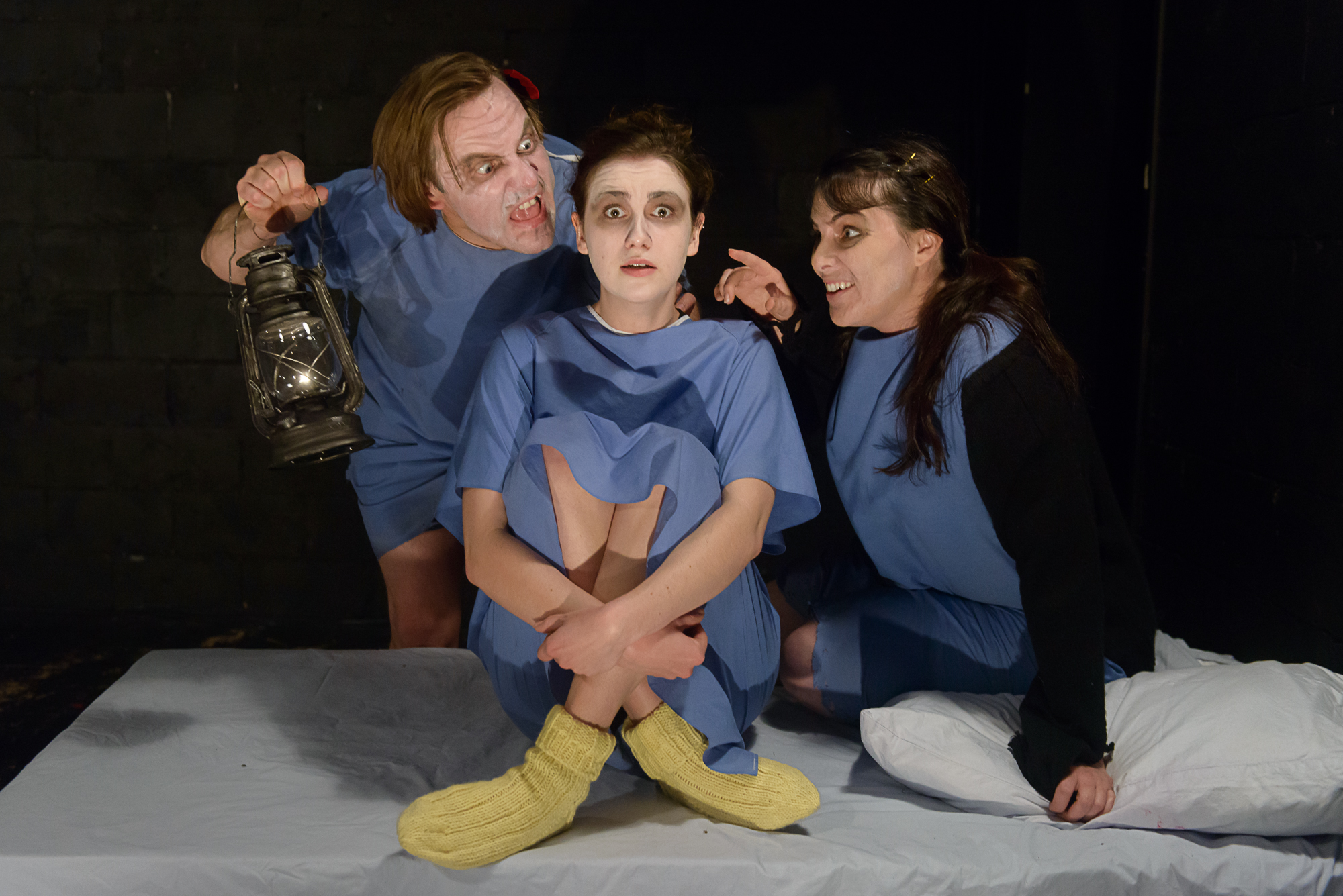
Lonni Olson, Anna Barker and Jennifer Lynn Bain in Crime in the Madhouse. Photo Credit – Teresa Rehmann Photography.

Final Kiss/These Cornfields/ Crime in the Madhouse

October 25 – November 2, 2013

Birds and Stone Theatre

Tickets at the Door – 8pm show

In a black-walled basement space echoing with the sounds of screams and creaky doors, an ashen-faced, humourless nun in full habit approached me in my seat. “Time for your medication”, she announced in a deadpan voice while holding out a tray of Dixie cups full of little white pellets.  I looked around at the other audience members who seemed as creepily amused by this as I was. I downed the tablets (Tic Tacs in case you were worried) and settled in for what I hoped would be a campy, scary, fun Halloween experience. This was Grand Guignol theatre after all.

Final Kiss/These Cornfields/ Crime in the Madhouse is a trio of performances brought to us by Organized Crime Productions in the style of the early 1900’s Theatre du Grand Guignol based in Paris. Purposefully written for maximum shock value, productions at the Grand Guignol theatre were meant to horrify, shock, sicken, amuse and titillate. An evening’s performance was usually a three play affair beginning with a fear-inducing grisly piece, followed by a sleazy sex farce as a kind of palate cleanser and concluded with a return to horror that was not considered a success unless several patrons literally fainted with fear or disgust.

Fast forward a century later and add in the pervasiveness of horror flicks, our bombardment by violent images at every turn and the thick skin we’ve grown as a result, and it takes more than scary theatre to make us collapse. But just because we remain very conscious throughout Final Kiss/These Cornfields/ Crime in the Madhouse (all based on original Guignol plays) doesn’t mean there isn’t disturbing fun to be had along the way in this somewhat uneven but wonderfully designed and directed seventy-minute production.

Whether it’s the tense story of man whose face was burned off in an acid attack by his former fiancée (Final Kiss), the tiresome, unfunny farce about a feuding couple (These Cornfields) or the truly gruesome story of a young woman trapped in a madhouse with those that wish her harm (Crime in the Madhouse), Director Alice Nelson shows her confidence. Guignol theatre is by nature melodrama and Nelson keeps it palatable with simple staging, letting the story itself be the action even in the most ghastly of scenes. Or perhaps its Serena Snively’s wonderful makeup that ranges from grey pallor with sunken eyes to …well… no eyes at all that’s the real accomplishment here.  Either way, visually this is a production that easily rivals what passes for gory effects on larger stages.

The cast (six in all) who all play double or triple duty in the performances had some disappointments but was more notable for the actors that stood out.  Jennifer Lynn Bain as Mrs. Cornfield and a madhouse patient both in the final play and as stage dressing prior to the performance was fascinating in all her ticks, disturbances and vengefulness. Anna Barker as the acid throwing fiancée, a sexy maid and the young woman in the madhouse stunned with her ability to cry and plead with guilt or fear seem both natural and upsetting. There is nothing more exciting than finding new talent on stage and if this performance is any indication, Barker is one to watch.

But the most entertaining flashes came not during one of the three mini-plays, but in the moments in between. Twice the audience was treated to a short puppet show performed by Alice Nelson and written by Kelleen Conway Blanchard. Foul-mouthed, darkly inappropriate and hysterical, these puppet skits stole the show and were a nice counter balance to the varying degrees of success the more formal plays enjoyed.

This is most certainly not a show for everyone and even those attracted to the experience will find fault. But Final Kiss/These Cornfields/ Crime in the Madhouse is silly/creepy fun done well and a great way to celebrate the Halloween season.

RATING

For those that like to be disturbed – There are some good psychologically disquieting moments in this production and the gore factor is impressively present.  SEE IT

For the squeamish – The moments sans gore are not so compelling that this is an experience you need to push yourself through. SKIP IT

For the occasional theater goer – Think of this like a short story version of theatre. If that appeals and you’re up for the off-kilter content, this  may work for you. MAYBE SEE IT

For theatre junkies – Guignol is not exactly excellent theater, there are weaknesses in the cast and the farce is a misstep. But the production is impressive as are some of the performances. MAYBE SEE IT

The Great Gatsby – Review

TC-GatsbyJessica

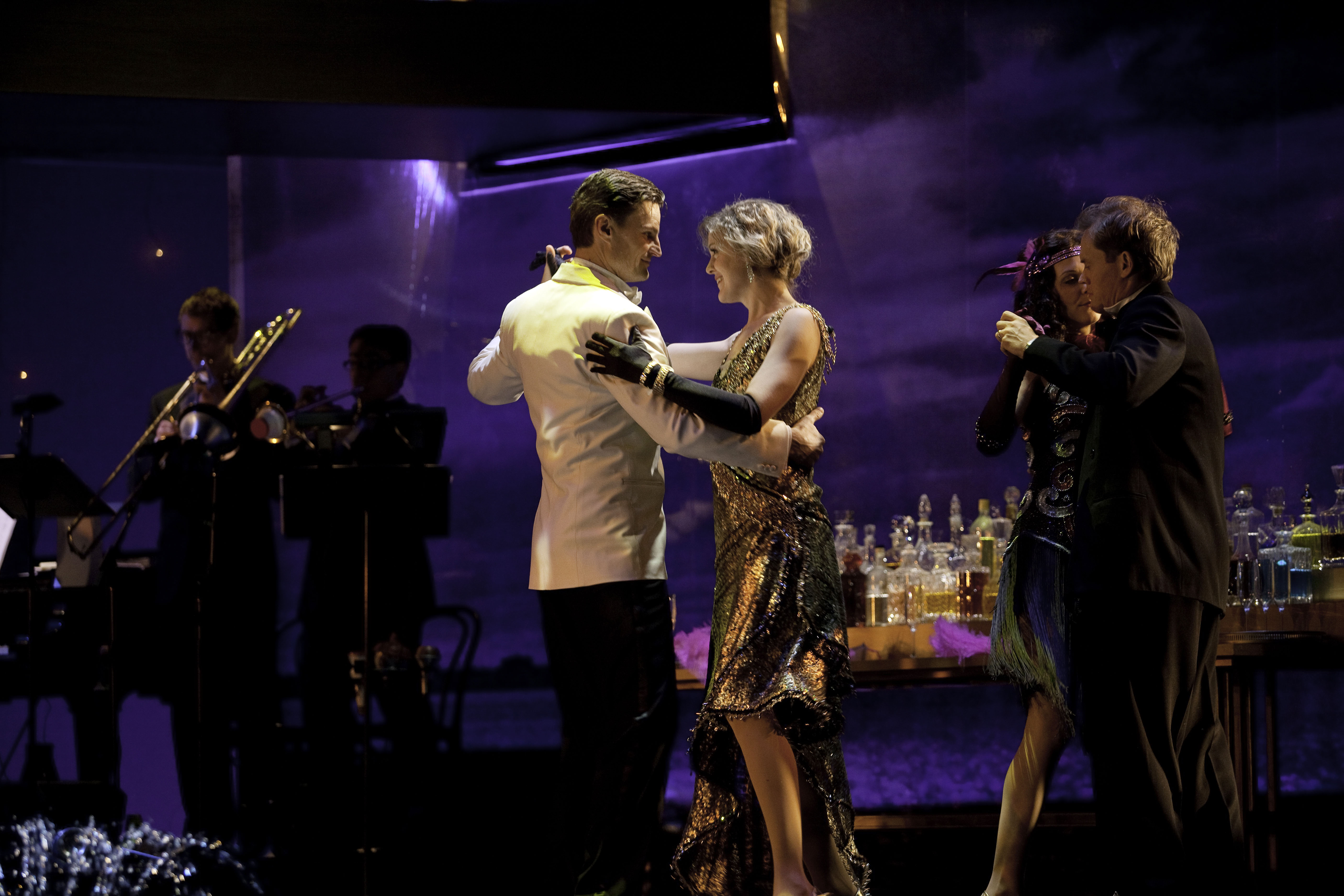
(l to r) BOB FRAZER (Jay Gatsby), AMY RUTHERFORD (Daisy Buchanan), CELINE STUBEL (Myrtle Wilson), CRAIG ERICKSON (Tom Buchanan).  Photo by Trudie Lee.

The Great Gatsby

October 15 – November 10, 2013

Max Bell Theatre

http://www.theatrecalgary.com/plays/the_great_gatsby/more_info/


In one of the last scenes of Theatre Calgary’s production of Simon Levy’s adaptation of The Great Gatsby, the privileged and shallow Daisy Buchanan tells Jay Gatsby that she cannot be with him because the fantasy perfection of their love has been marred by reality. “I wanted it to be beautiful,” Daisy tells Gatsby as an excuse for going back to her cheating husband and unhappy marriage. In far too many ways, Daisy’s words are a metaphor for Director Kim Collier’s treatment of F. Scott Fitzgerald’s famous tale. Like Daisy’s wish, this show is overflowing with beauty onstage but like the blemishes that ruin Daisy’s ability to actually be with Gatsby, the production is beset by problems that ultimately ruin the audience’s relationship to the story.

If you are not one of the twenty-five million people worldwide who has purchased and presumably read Fitzgerald’s 1925 novel, or seen one or both of the screen versions, a quick refresher. Nick Carraway, a decent young man from the Midwest, moves to New York in 1922 to try to make his fortune trading bonds. He rents a house on Long Island next to a huge mansion owned by a mysterious man named Jay Gatsby who is known throughout NY for hosting lavish, extravagant parties that everyone who is anyone attends. We eventually learn that these parties, his amazing house and in fact all of Gatsby’s wealth and success has all been designed to impress  Daisy Buchanan , his first love and by coincidence Nick’s cousin. Daisy used to love Gatsby when they were younger, but Gatsby went off to war and Daisy ended up marrying Tom, a fabulously wealthy, old moneyed, brute of a man who has affairs on her left right and centre. Tom’s most recent fling is a working-class married woman named Myrtle. Nick helps Gatsby reunite with Daisy and it looks at first as if they will get back together, but Daisy backs out at the last-minute and ends up killing Myrtle by accident in a hit and run as she’s driving back to the home she shares with Tom. Myrtle’s husband comes to believe that it was Gatsby who was Myrtle’s lover all along as well as the one who killed her, so he tracks Gatsby to his house and shoots and kills him.

The production’s fatal flaw, aside from Director Kim Collier’s safe presentation that offers nothing unique or exciting in the telling of this story, is the dynamic between Nick and Gatsby. To put it simply, Gatsby (a milquetoast Bob Frazier) has no charisma or emotional authority and Nick (Jonathan Young) has too much. Gone is the awe that Nick feels for Gatsby and absent is Gatsby’s flawed but magnetic persona that keeps the audience so enthralled with his longing for Daisy’s love and admiration. The result is castration of the play’s emotional motivation, leaving it as soulless as the characters that inhabit the narrative.

However soulless can be interesting when done with intelligence. Despite the despicable nature of all of Fitzgerald’s characters in The Great Gatsby, there were some intriguing performances in this production. Jamie Konchak as Daisy’s friend Jordan does an admirable job playing a successful golfer who’s real game seems to be playing a more honest person than she really is. Craig Erikson as Tom turns in a strong but somewhat confusing performance that is more unrefined brute in manner and speech than well-bred, old-moneyed cad.  But it’s Amy Rutherford as Daisy who really catches our eye.  It’s easy to pass off Daisy as nothing more than a vain, shallow and spoilt character, but Rutherford brings a layer of despondency and fear to the role that makes her a far more interesting character than any other portrayal I’ve seen. The more Rutherford ramps up Daisy’s hollowness, the more she allows us to see her behaviour as a pathetic cry for help.

But back to the beauty of the show. Casting and character aside, there is no question this Gatsby wins us over with the way it looks. Judith Bowden’s basic set design is just steel beams with scrims and a catwalk but this allows her the use of some gorgeous projections and props/ larger design pieces inserted into each scene.  Tom and Daisy’s house soars with grand stately art deco columns, Gatsby’s home gains majesty from a huge staircase and a triple water fountain built right into the stage, the Plaza Hotel in NYC is perfectly deco chic and the apartment where Myrtle and Tom meet is shabby cool with a great view of a 20’s billboard outside the window. The costumes are equally stunning with dandy suits for the men and daytime and evening flapper dresses for the ladies, many of which I’d happily pinch for my own wardrobe. All of this was complemented by Collier’s fluid and often beautiful staging which provided great visual interest even when the emotional and intellectual substance of her production waned.

On a personal note, I have never been a big fan of The Great Gatsby in any of its forms. I find the story lacking in satisfying emotional motivation and all the characters neither likeable nor interesting enough to relish as despicable personas. Nevertheless, I do understand why Gatsby has evolved into the iconic story it is today and why the notion of a powerful man motivated by flawed longing for his fantasy version of a particular woman lives on in popular culture. Or at least it will as long as this production isn’t the benchmark.  I would venture to guess that anyone seeing the show for the first time would have no clue as to why the image of Gatsby has become such a standard reference or why this story is considered a classic piece of American literature. What audiences will get are some decent performances and beauty that would make even Daisy Buchanan happy.

RATING

For Gatsby Fans – While this show never strays from the original story, it totally misses the mark in its depiction of Gatsby and Nick. But perhaps you’ll forgive this to marvel in such a beautiful visual depiction of the story you love. MAYBE SEE IT

For Newbies – Entertaining enough and visually sumptuous as it is, you will most likely be baffled at all the fuss. If you want the real heartbeat of the story, I’m afraid you’ll have to sit down with the book. MAYBE SEE IT

For occasional theatre goers – This is a big expensive production that will hit all the familiar notes you need to feel you are getting your money’s worth. SEE IT

For theater junkies – No matter how lovely to look at, an un-Gatsby-esque Gatsby is unacceptable. SKIP IT

The Motherfucker With The Hat – Review

MOFO

Beau Dixon (l) as Ralph D. and  Haysam Kadri (r) as  Jackie. Photo credit, Brian Harder.

The Motherfucker With the Hat

October 15 – November 2, 2013

Martha Cohen Theatre

http://www.atplive.com/2013-2014-Season/Motherf–ker/index.html

Listen to my review on CBC Eyeopener on Monday Oct. 21st at 7:40 am at http://www.cbc.ca/eyeopener/


Just because a man is sober, has worked the AA system and finally kicks whatever substance had their claws in him, doesn’t mean he’s a good person. It just means he’s clean. This is the message the less than angelic AA sponsor Ralph D. conveys to the newly sober yet still troubled Jackie near the end of Stephen Adly Guirgis’ The Motherfucker With the Hat. It’s a good message and an interesting jumping off point that is unfortunately quashed by thin narrative and silo acting in this slight but amusing play.

Set in modern-day New York, the play is a funny fast-paced foul-mouthed story about feuding Puerto Rican-American childhood sweethearts Jackie (Haysam Kadri) and Veronica (Carmen Aguirre). Jackie, newly sober, hot-headed but whiny more than dangerous despite his stint in jail, accuses Veronica of infidelity when a mysterious man’s hat appears in their apartment. Veronica, a coke-addicted hell-cat of a gal, stands her ground with Jackie, denying any wrongdoing while dosing out her own brand of spitfire anger. Jackie’s sponsor, the mellow-talking, stay positive Ralph D. (Beau Dixon) tries to keep Jackie from blowing up, but ultimately proves himself to be a very poor advisor indeed. Meanwhile, Ralph is having his own challenges with his ‘in-recovery’, ball-busting wife Victoria (Melanee Murray) who sees Ralph for the dog he really is. Outside this maze of addiction and recovery stands Jackie’s effete but straight oddball cousin, Julio (Francisco Trujillo), who agrees to help Jackie in his quest for revenge despite a history of Jackie’s ill and often hurtful treatment of him.

In what could be described as an all you can eat profanity buffet, Guirgis’ script is littered comically with gutter language at every turn. In one of her softer moments, Veronica prefaces her admission of love for Jackie by saying, “You know I’d rather kick a fucking three-legged kitten down a flight of stairs than admit something like that”.  Jackie doesn’t abandon his litany of f-bombs either when Ralph suggests they pray. “God?”, Jackie says. “Hello again. You may remember me. I’ve prayed like fifty-seven fucking times to you already.” To Guirgis’ credit, these moments get great laughs from the audience, long after the shock value of the words wear off. We laugh because the language shrugs off any consideration. It’s real and appropriate and often renders these characters funny without their meaning to be. But laugh as we do, the script fails to deliver anything more than an entertaining moment-by-moment experience that wears thin as a satisfying story. Of course not every show needs a grand epiphany at its close, but that doesn’t excuse the ‘so what’ feeling we are left with here, ultimately rendering the humour pointless.

The shallow narrative construction however doesn’t stop the cast from giving it their all with the minor characters decidedly stealing the show. Aguirre’s Veronica is full-out Latina-tigress without once devolving into stereotype. She manages to internalize her character deep in her belly and  gives us a high-octane performance that is both hilarious and thoughtful. Murray has the difficult task of playing the only non-funny role as Victoria, an angry and betrayed woman grasping for relief. Her failed sexual scene with Jackie is one of the play’s few truly interesting moments and Murray gets the credit for making it work. But really, it’s Trujillo that shines the brightest as Cousin Julio with his hysterically swishy yet macho character that is as quick to talk about hair products as he is to reference Jean -Claude Van Damme. Going full camp without devolving into tired typecast is no small feat and Trujillo commands this fine line brilliantly. However, it’s his ability to show his dramatic side in two stunning scenes where he drops the comedy and explains to Jackie his hurt then his allegiance that finally brings real substance and heart to the play.

The thread in these supporting performances is that their best moments come not in dialogue, but effectively in monologue. Guirgis’ patter is meant to be automatic-weapon-fast, but in this production the interaction between characters feels more than slightly off.  To my ear it felt as though everyone was so focused on getting the language down pat that they forgot to actually listen to each other. Dixon’s serviceable performance as Ralph suffers somewhat from this but it can really be felt with Kadri’s Jackie who hits all the right dialogue notes but never really evolves into a fully present character.  As a classically trained Shakespearean actor, playing a substance abusing, potty mouthed Puerto Rican loser may be too much of a stretch for Kadri who seems uncomfortable in the role despite working hard in the production.

Director Ron Jenkins does his best to keep pace with Guirgis’ megawatt script but strangely resorts to gimmick with nonsensical bicycle riding during scene changes and nudity that is either unnecessary or more egregiously, in bad taste. A naked man emerging post shower from the bathroom is understandable if not needed, but a naked man riding a bicycle around the stage for no reason  is a cheap ploy that belies a confidence problem. No fault can be found with Narda McCarroll’s wonderful set design featuring the interior of a shoddy New York apartment easily changed-up to represent three different homes. Her lit windows hanging in elevation above the set representing the cramped and populated reality of life in the Big Apple are the perfect icing on her design.

The Motherfucker With the Hat was a good enough show when it premiered on Broadway in 2011 that it was nominated for 6 Tony Awards. But it wasn’t a good enough play to have walked away with single one. The Calgary production is a good enough play to entertain you in the moment, but as the usually quick to rise to their feet audience showed on opening night by overwhelmingly remaining seated, it’s not necessarily completely winning us over either.

RATING

For the profanity sensitive – This is by no means a family show or a production for those offended by language. Never mind the full male nudity. You are best to stay at home and watch re runs of 80’s sitcoms. SKIP IT

For potty-mouth lovers – Sure you’ll love the language and how expletives are thrown about like they are candy on Halloween. But please do take a moment to realize that unlike less sophisticated scripts, the language here is not simply to shock or titillate, it’s actually in deft service of the characters who use it. SEE IT

For occasional theatre goers – Sensitivities aside, this is a fun, entertaining play that moves quickly and asks nothing more of you than to watch and laugh at some pretty pathetic characters who stay that way. SEE IT

For theater junkies – It’s a toss-up between some impressive performances and occasionally interesting writing and a script that is ultimately weightless and a cast that often operates on a ‘my line, your line’ dynamic. MAYBE SEE IT

Subway Stations of the Cross – Review

IMG_2311

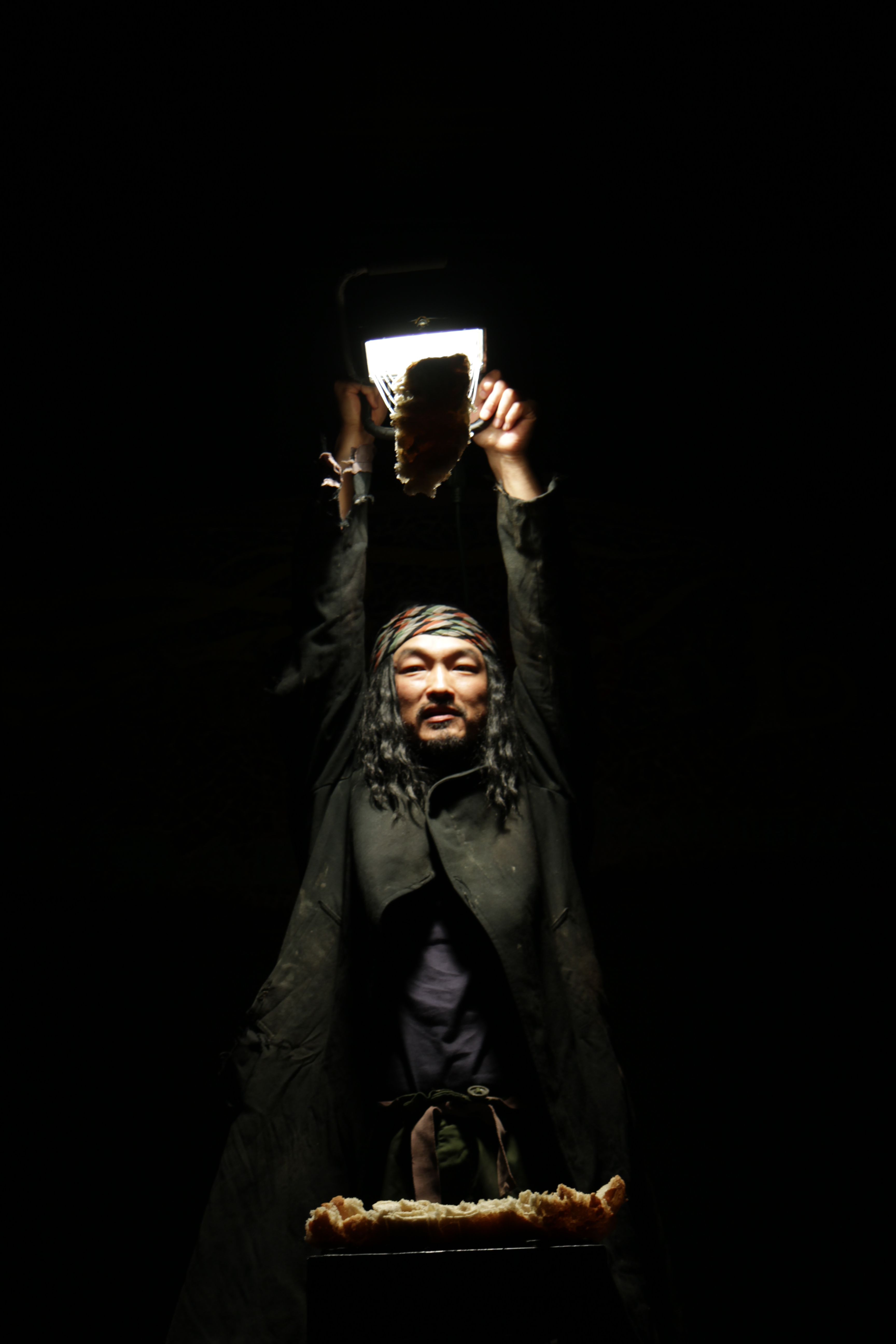
Ins Choi, Subway Stations of the Cross. Photo Credit Alex Feilpe.

Subway Stations of the Cross

October 2 – 6, 2013

Engineered Air Theatre – EPCOR Centre

http://www.fireexit.ca/


At the risk of sounding parochial, I have a difficult time enjoying spoken word poetry as a theatrical experience. I either find that my pleasure in the words would increase dramatically if I could just read them privately and ignore the person on stage acting them out for me, or I find that while the performer is engaging, the words fall flat. Maybe I’ve just been going to the wrong kind of spoken word shows. Or maybe it just took Ins Choi and his intriguing if somewhat widely woven solo show, Subway Stations of the Cross, to show me that watching a man reading and singing poetry on stage could hit many of my theatrical and intellectual sweet spots.

Choi’s sixty minute show which he wrote and stars in, introduces us to a nameless homeless man with nothing but a cardboard platform to stand on, a small guitar to play and a microphone and amp to ensure his message is heard. He may look like a cross between Captain Jack Sparrow and Godot’s Vladamir and Estragon, and he probably smells worse than all of them put together, but this is a man with profound ideas to share. Ideas that while referencing everything from icons of 80’s pop culture to Japanese Anime love metaphors, all come back to the notion of faith through the character of Jesus Christ.

Choi says his poetry was inspired by the homeless and mentally ill men he met out in parks and public spaces in Toronto. These men would wax haphazardly poetic about all things mystic and religious while at the same time launching into non-sequitur tangents on whatever direction their uncaged minds took them. It’s these souls that Choi is channelling in his charismatic performance with a gravelly voice and stunned, sometimes stuttered but forceful delivery. And it’s with them in mind that Choi offers up some beautiful and challenging notions on faith in his poems and songs.

“God is calling you to dance”, we are told along with lines alluding to our disco pants. We are given a list of all those creatures that fall from heaven to earth – ET, Superman, and Lucifer. We hear that, “forgiveness is for them, but forgiving is for you”. We are told to repent via a stunning poem that could serve equally as a trial judgement on white-collar crime as it could on old-fashioned sin. And we are asked to consider if Jesus would recycle and want to bring Elvis back if he were with us today.

Interspersed among the heavier Christian themes in this piece are some fun and purely entertaining ditties. Chief among them is an ode to 80’s sitcoms that will have anyone old enough to remember when the gals on Facts of Life all got a little hefty laughing out loud.

If it sounds to you like Subway Stations of the Cross is all over the place narratively without a definitive structure, then you’d be correct. This is not traditional storytelling in any sense of the word. Choi is starting from nowhere in particular and trying to achieve nothing conclusive. No doubt this will pose problems for many audience members who go to the performance expecting to have their faith tickled or to see an inspiring story. Choi is there to do neither. His musings are just that – musings on the faith he grew up with and still has connection to set to a modern, multifaceted and fragmented consciousness.  It’s all done with a smartly light and fascinating touch right up till the end where Choi jumps the shark by bringing physical representation of the body and blood of Christ into the mix. It’s an effective crucifixion sight gag, but ultimately cheapens the experience by shoving a metaphor down our throats that had previously been beautifully only alluded to.

RATING

For the faithful – Choi’s inclusion of modern references only enhances the splendour of his belief and the message in his poetry and song will no doubt resonate on many levels. SEE IT

For the faithless – This is not a lecture or a sermon. Choi is not preaching here. Yes he talks about forgiveness and repentance, and Jesus is a character in his prose. But the cleverness in this piece is that from a purely intellectual and historic point of view, the poetry and performance stands up as intriguing entertainment. SEE IT

For the occasional theater goer – No doubt some fans of Choi’s hit show Kim’s Convenience will want to see this piece thinking it’s more of the same. I can imagine the shock on their faces when they do. This work is niche to the extreme. With no story, arc or even narrative structure, this one is best left to those seeking very alternative modes of theatre. SKIP IT

For theatre junkies – How nice to see range like this from an artist. From Kim’s Convenience to this performance, Choi is proving himself to be a man of many types of talents. This show has risk written all over it and while it might not resonate perfectly as a fully formed theatrical experience, Choi’s performance and writing deserve your attention. SEE IT