Almost a Love Story – Review

AlmostALoveStory0031 NB2_0865

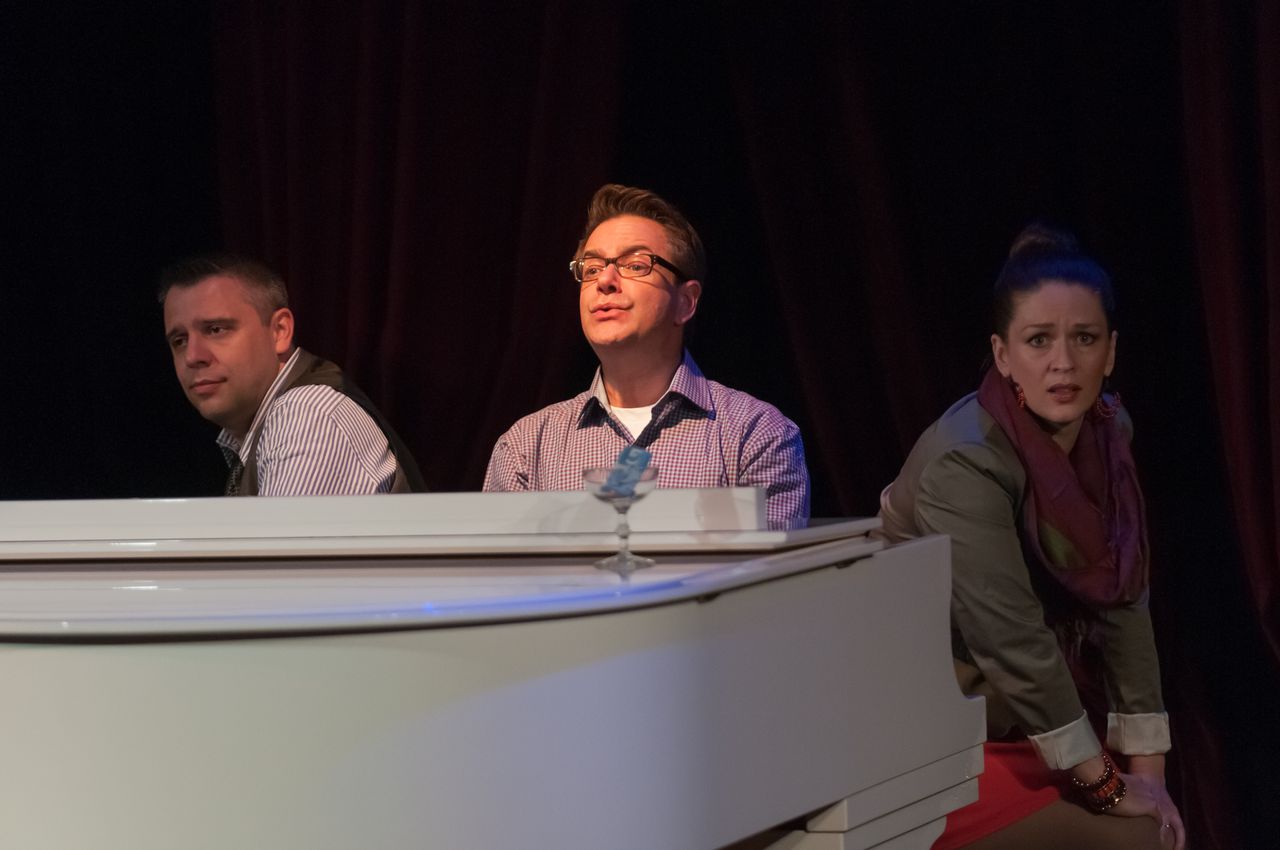
Hal Kerbes as Henry, Frank Zotter as Callum, Christopher Hunt as David and Joe Perry as Daniel in Almost a Love Story by Louis B. Hobson. Photo by Benjamin Laird.

Almost a Love Story

April 29 – May 18, 2013

Lunchbox Theatre

http://www.lunchboxtheatre.com/almost-a-love-story.html


When I get asked if I know a particular Calgary actor or director or playwright, my answer is usually yes, but not in person. People are always surprised by this. “You’ve never met them? But you’re a theatre critic?” Exactly, I say. As a critic, I don’t want to know the actor or the director or the writer. I want to be able to watch them work with no prejudices or attachments or personal feelings whatsoever. And I manage to pull this off pretty well most of the time. But the Calgary theatre scene is a tight community and every once in a while it’ll happen than I will meet someone I have to review. And that’s fine. I keep it casual and write it off to just being part of the gig I need to deal with. But now, a colleague of mine has gone and completely mucked up this whole arm’s length arrangement for me.

Without any consideration for my professional ethics whatsoever, Louis B Hobson, theatre critic for the Calgary Sun and one of my favorite people, has written a play and darned if the folks at Lunchbox Theatre aren’t producing it as their final show of the year. At first I considered not reviewing Almost a Love Story, a play about a son who discovers his dead father had a secret male lover. Not because I couldn’t be honest about the show, but for fear that if I was, and if I disliked the play, I might be hurting a pal and jeopardizing a friendship. To his credit, Louis told me that this was unacceptable. I absolutely was to see the play, review it, and if I hated it we’d still be a right as rain. Well, with permission like that (and curiosity to see what he’d come up with) I took the plunge. And now I’m hoping Louis meant what he said, because I found Almost a Love Story to be lacking in almost every way possible.

Directed by Pamela Halstead, the play tells the story of Daniel (Joe Perry), a young adult aspiring actor who seeks out his dead father’s drama teacher colleague Callum (Frank Zotter) to help him prepare for an audition. Callum agrees to help but privately airs his anxieties about the situation to his ridiculously and pejoratively flamboyant friend Henry (Hal Kerbes). Turns out that Callum and Daniel’s father David (Christopher Hunt) were engaged in a secret four-year affair that ended when David realized he had terminal cancer and needed to call things off and concentrate on his wife (Lindsay Burns) and son. Far from finding comfort in the brief love they had, Callum struggles to let go of David both emotionally and in a more physical remembrance manner.  In an expected and obvious narrative arc, Callum and David’s secret is found out and the ramifications of David’s other life affects all who loved him.

But just because the general plot is an oft written and popular model (Brad Fraser’s True Love Lies and Mike Mills’ Beginners come to mind) doesn’t mean it can’t be written with adroitness and invigorated with new feeling.  Unfortunately what Hobson have given us instead is, to paraphrase David Mamet, melodrama without invention or believability.

In their first audition rehearsal, Daniel segues from a discussion about natural acting to accusing Callum of being his father’s lover without so much as an emotional change in tone or pace. Much worse however is that Daniel goes from being angry to being fine with the whole situation in a matter of seconds, so much so that he asks Callum to continue helping him with his monologue prep. I know that Lunchbox shows are only 50 minutes long, but surely more time could have been given to what should have been a complex and sensitive scene.

The writing continues in this emotionally wallop-less and unrealistic manner throughout the show taking us from a flaccid flashback of David and Callum’s first pangs of lust to an ill-conceived scene of Daniel’s sexual confusion to David’s lacklustre admissions of illness to his lover and wife.  Layered onto these script issues is a heavy helping of Shakespeare mixed into the dialogue. A portrayal of a scene in Hamlet is what brings the male lovers together; it is Iago’s monologue that Daniel initially wants to perform for his audition; the superstition of Macbeth is bantered about the one time David, Daniel and Callum actually meet and I believe it’s a quote from Two Gentleman of Verona that Callum uses to eventually send Daniel on his way.  Mixing metaphors in this dialogue manner is fine and dandy, but for it to work the actors have to be able to do the words justice and that just isn’t the case. In fact even without the famous lines, this cast can’t seem to rise above the problematic script.

Perry as Daniel makes the best of the character he is given and at times delivers the most natural acting of the cast despite scenes that render him implausible. Zotter as Callum tries his hardest to tug at our heart-strings, but more often than not ends up whining and whinging his discomfort in an effort to bring some emotion to the words. Burns manages to conjure some anger in her final scenes, but her milquetoast performance up until that point makes her an afterthought at best. Kerbes goes full throttle as a screaming Kimono-clad queen who prefers to dole out clichéd barbs as show tunes rather than plain English.  He does illicit a few giggles from the audience, but to my mind this type of hackneyed acting is cheap laughs at best. Most disappointing is the feloniously wasted talents of Hunt as David. Monotone, hands in pockets and without one ounce of the passion or excitement we are told the character exudes, Hunt numbly wanders on and off the stage in flashback scenes that are so bereft of impact they manage to neuter the play as a whole.

They say in the theater that the writer creates the blueprints and the actors are the bricks, but it is the director that is the architect of the whole structure. It is for this reason that much of the responsibility for the failings of Almost a Love Story fall with Halstead.  The dubious scenes, the poorly performed Shakespeare, the groan-worthy camp and the waste of talent all happened under her watch. With direction that either could not or would not challenge the problems this play needed to overcome, Halstead was yet another disappointing element in show that desperately needed a strong hand to whip it into shape.

Hobson claims that his goal for Almost a Love Story was not to shock, but rather to “encourage dialogue and to look at love in all its glorious diversity.” I have no doubt that this was his sincere intention.  But in a line that Henry would no doubt approve of, the road to hell is paved with a playwright’s good intention.

RATING

For the guys and the girls – You know this story. You know these characters. They will surprise you at times, but you won’t buy it. Or if you do, it happens and is forgotten so fast you won’t care. SKIP IT

For the occasional theater goer – Maybe you haven’t seen this story before and maybe its simplicity and non-introspective nature will appeal to you. MAYBE SEE IT

For the theatre junkie – If like me you are a Christopher Hunt fan, then save a broken heart and miss him in this one. In fact, just miss it altogether. SKIP IT

Chicago – Review

????????????????????????????????????

Photographer: John Watson. Stage West Theatre Restaurant Calgary


Chicago

April 18 – June 23, 2013

Stage West Theatre Restaurant

http://www.stagewestcalgary.com/shows.html


How many 37-year old musicals can you name that still resonate today? West Side Story still speaks to our harmful ‘them and us’ attitude, My Fair Lady can touch present day nerves about class, appearance and acceptance and Tommy still shines the light on our current religious cult of personality. No doubt there are others. Now ask yourself, how many decades-old musicals are not only resonant but thoroughly modern in their relevance, and I’ll bet that Chicago is the top of a very short list. Dealing with themes of media manipulation, the obsession with fame and the fleeting nature of instant stardom, Chicago could just as easily have been written about a 2013 reality TV, paparazzi, spin doctor world as it was about the windy city in the 1920’s. Add in a slew of jazzy, sexy musical numbers and choreography by the inimitable Bob Fosse, and it’s no wonder that Chicago is one of the longest running shows Broadway has ever seen as well as an Academy Award winning movie.

The latest incarnation in Calgary is brought to us by Stage West Theater Restaurant in an energetic and mostly successful production that stays true to the original and will satisfy fans of the both the stage and film versions. As the show begins, Roxie Hart (fantastically sung, danced and acted by firecracker Marisa McIntyre) shoots the man she’s having an affair with. Thrown in jail, Roxie meets Velma (an underwhelming and somewhat gawky Andrea Wingelaar) a notorious murderess who is the sensational toast of the headline-hungry media. Both women have hired the cutthroat PR savvy lawyer Billy Flynn (the terrific Matt Cassidy) to sell their innocence to jury and make them media stars in the process. But instant fame is fickle as is Flynn’s attentions, and both women have to fight each other as well as other inmates for the media spotlight they crave and the innocent verdict they desire.

The decision to locate a live four-piece band in the centre back of the stage means Director Max Reimer is given a very shallow space to work with and he does so with taut yet spirited direction that never feels crowded or compromised. Which is a good thing because the cast needs room to show off some wonderful dancing. Fans of Fosse will be happy to know that Choreographer Phil Nero doesn’t mess with the master’s signature style and the cast rises to the occasion giving us the sultry, sexy jazz-handy moves we want to see. Standout numbers We Both Reached For The Gun, Me and My Baby and Courtroom Scene explode with outstanding showmanship and receives hearty cheers from the audience.

For those cast members whose role is more about song than dance, this Chicago delivers unevenness.  Playing Roxie’s cuckold pushover husband, Amos, Ed Sahely wonderfully milks audience sympathy with his number Mister Cellophane and gets one of the biggest audience reactions when he is finally tossed aside. Conversely, Elizabeth Stepkowski Tarhan is woefully miscast as the tough talking prison matron Mama Morton. Unable to physically pull off the character’s swagger or vocally settle into the street-talking potty mouth lines, Stepkowski Tarhan is a disappointment despite her strong singing voice.

Having the characters of both Velma and Mama not up to snuff was a distinct let down in the show, but not enough to extinguish the fun of watching Roxie, Flynn and the rest of the cast do their stuff. This production of Chicago might have been missing the full gamut of the ‘old razzle dazzle’, but like the fleeting fame Roxie seeks, disappointments in the show disappear fast to make way for brighter, shinier star moments.


RATING

For the guys – No sappy love songs or delicate dance numbers here. Chicago is a sexy scrabble of a musical with great moves, music and lyrics. This cast keeps the pace and will make sure you have fun. SEE IT

For the girls – Sure women are portrayed as fame-whore, adulteress, vapid characters with no heart of gold lurking beneath. But still you can’t help rooting for Roxie and loving McIntyre’s portrayal. Drop any indignation and sing along. SEE IT

For the occasional theatre goer – Yes, just yes. SEE IT

For the theater junkie – While not a must see (especially if you’ve already seen one version or another) McIntyre’s Roxie is astoundingly good and just might make you forget the others before. MAYBE SEE IT

I Am My Own Wife – Review

I am my own wife

Paul Welch as Charlotte von Mahlsdorf. Photo credit Aaron Bernakevitch.


I Am My Own Wife

April 24 – May 4, 2013

EPCOR Centre Motel

http://thirdstreet.ca/12-13-season/wife/


How do you curate a life? It’s the question asked by playwright Doug Wright, as himself, in his compelling 2003 Pulitzer Prize and Tony Award winning play, I Am My Own Wife. Wright’s challenge is made all the more complex by the very real and controversial life he is attempting to dramatize for us. Born in 1928 under the name Lothar Berfelde, Charlotte von Mahlsdorf was a German transvestite who managed to survive and thrive under both the Nazi regime and communist-controlled East Germany.

Upon hearing Charlotte’s story from a reporter friend, Wright travels to Germany hoping his interviews with her will allow him to pen a tale of gay heroism in the face of terrible adversity. This was the play we wanted to write. But the more Wright learns about Charlotte, the more imperfect she becomes. Did she kill an abusive father or a father she simply didn’t like? Was she a passionate antiques collector and museum owner or a thief who stole Jew’s furniture when they were carted off to the camps? Was she a protector of the gay community or a secret Stassi spy? With no way to discern what truly happened all those years ago, Wright gives us a play that embraces the full ambiguity that was Charlotte’s life and lets the contradictions stand as both intriguing drama and intellectually juicy questions.

However, more than the story itself which at times is overly matter of fact and lacking emotional punch, it’s how Wright configures his drama and how Third Street Theatre’s production brings it to life that makes I Am My Own Wife truly enthralling theatre.  The play is written as a one-man show with no fewer than thirty-six characters of different gender, language, accent and age. Played here by the incredibly talented Paul Welch, with astute direction from Kevin McKendrick, we are treated to vivid characters in a performance that is wonderfully self-aware and perceptive. Welch’s chameleon-like ability to morph from a sixty-five year old distinctly unglamorous but sweet transvestite with a heavy German accent to a southern-drawl American reporter to an oily German TV talk show host is remarkable. Equally impressive is Welch’s ability to switch back and forth between English and German without sacrificing one iota of acting prowess. Frankly my tongue got tied just listening to him chew through the plentiful dialogue that would have left a lesser performer gasping for air.

Complementing the richness of the subject and dialogue is the relative simplistic elegance of Deitra Kalyn’s set design. Respecting the smallness of the theatre, Kalyn does not try to replicate the grandness of the show’s Broadway set which was strewn with the antiques that comprised Charlotte’s Gründerzeit Museum of furniture, gramophones, clocks and records. Instead, dozens of pencil illustrations of the objects are hung reverently, creating a collage that echoes the clutter. Pieces are talked about, moved, played with and even dusted. But all this is done through exquisitely directed mime with not a real object in sight. It’s a shame that this elegance is disrupted by a small video screen showing signifier projections like Are you a boy or a girl? and Listening or Curating, to identify the quick chapter-like scenes in the play. For the most part these title projections were redundant and at worst meaningless.

But by the time the play winds down to its 75 minute mark, whatever deficits of emotional connection or quibbles with design choices, there is no doubt that we have witnessed a little piece of greatness. I have long ago given up believing that a play will be terrific simply because it has an award attached to it. But Wright’s beautiful dialogue and structure in combination with McKendrick’s sensitive direction and a thoroughly outstanding effort by Welch, makes I Am My Own Wife, one award-winning play I can happily cheer for.


RATING

For the guys and the girls – Drop your image of Rocky Horror’s Frankenfurter, Charlotte is the farthest thing from a campy transvestite you’ll ever see. In fact, to my read, the show is not so much about Charlotte’s difference but instead her commonality. Good and bad. And while you’ll wish you had more of an emotional tug from the character, her story will fascinate you. SEE IT

For the occasional theater goer – Charlotte is a tough character to get to know in a narrative structure that will be too disjointed and possibly frenetic for you to enjoy. Plus loose ends are generally not your cup of tea. SKIP IT

For the theatre junkie – When direction this good meets an actor up to the challenge, magic happens. SEE IT


War – Review

War

From l to r: Beau Barker, Josh Symonds, Brendan Andrews and Andrew McKenzie. Photo by Amy Dettling.


War

March 27 to April 6, 2013

EPCOR Motel

www.theatrebsmt.ca


The issue at play in Theatre BSMT’s production of Dennis Foon’s clunky and ridiculously contrived War is the genesis and outcome of violence in male teenagers. Told through the intersecting stories of four boys, the play attempts to take the shine off the fierce aggression sold to young men as glamorous, successful modes of being.  Hockey obsessed Brad (Andrew McKenzie) has been groomed to be a goon on the ice since he was young and that mindset has more than spilled over into his attitude off the ice. His best friend Tommy (Brendan Andrews) dreams of flying a fighter jet and his time as a cadet has added on a lust for killing thanks to the rhetoric about “the enemy” he has been fed over the years. Shane (Josh Symonds) is a feared gang member with a newly acquired heart of gold who is tired of being the thug for rent. Finally Andy (Beau Barker) is the nerdy actor who desperately wants to learn the ways of the tough guys both for a part he’s after and to better protect himself from other boys. While Foon’s motivation for writing the play is interesting and the characters he chooses to tell his tale fine enough, the death and destruction War reaps on what passes for dialogue in this play is an unforgivable casualty.

Told with sparse language eliminating anything resembling an adverb or adjective in a combative Haiku kind of flow, the boys spend most of the play spitting declaratives at each other. In a scene where Andy, attempting to exact revenge from Brad for making him strip, demands the same from Brad, the dialogue becomes monosyllabic. “Problem?….Trust…..Test….Now?…Now…The Belt…Some Space…..Additional….Right here?….Affirmed”. Is this manner of speaking  supposed to be a metaphor for the fact that these boys are operating in a type of war zone without time for drawn out exchange? Possibly. Does the resulting dialogue sound false, laughable and forced? Absolutely. Even when the script allows things to become  more conversational in tone, the flow is littered with made up “gang” terms like Skrunk for slutty girls and Scube for loser boys. Rather than sound modern and menacing, the whole effect is risible, utterly undermining the lessons we are supposed to be learning as each boy’s violence turns on them in various destructive ways.

Not helping matters is a cast that seems as uncomfortable with the language as we are. McKenzie delivers his lines with cottonmouth-like diction, making it almost impossible to understand what he is shouting about and Andrews’ unmodulated aggression takes the impact out of his one truly violent scene. Symonds ’dialogue is spared much of the irritating cadence and as a result his character is somewhat compelling to watch even if he can’t provide the fearsome gangster charisma that is called for in this role. But Symonds does give us one of the only emotionally grabbing scenes in the play with a monologue about his brother’s violent death. The fact that Symonds could carry off the scene despite the distracting bleed-through sound of the show going on next door speaks to his professionalism if nothing else.

The one bright spot in this production is Barker, who is the only actor to rise above the monumental limits of the script to deliver a thoughtful and at times subtle performance. Whether speaking of his father’s death to the other boys or in his fourth-wall breaking monologue, Barker’s take on nerdy intelligence seems plausible and decidedly non-cliché.

But neither Barker’s decent performance nor Amy Dettling’s fairly smooth direction which has the boys moving around the chain-link fence set  can save this play from itself. I would love to be able to write off War as a failed experiment and be fine with its dismissal. But what makes this failure so hard to forget is that Foon actually had the seeds of a good play here. The issues are fresh and in need of examination. Unfortunately with this treatment, the battle to win over the audience is lost before the play can even get going.


RATING

For everyone – SKIP IT

If I Weren’t With You – Review

o0MFVEVFbZFDjH8GFKYlD_HoETuDU2b2inMfoLfWeKk,WqE_FawcpJoObm85uQWz5Uuqljd-F8vXJx3kBONRhl4

Katherine Fadum as Pam, Joe Slabe as Steve and JP Thibodeau as Allan in If I Weren’t With You by Joe Slabe, photo by Benjamin Laird.


If I Weren’t With You

April 1 – 20, 2013

Lunchbox Theatre

http://www.lunchboxtheatre.com/if-i-werent-with-you.html

Listen to my review from CBC Eyeopener at http://www.cbc.ca/eyeopener/columnists/theatre/2013/04/02/jessica-goldman—if-i-werent-with-you/


Below you’ll find the song list for the Joe Slabe’s world premiere musical, If I Weren’t With You, about what happens when a once happy marriage starts falling apart:

I Do

Everything is Fine

In the Beginning

Someone’s Always There

In Your Shoes

Tell Yourself You’re Happy

The Man in the Middle/If I Weren’t With You

If I Weren’t With You (Reprise)

Someone’s Always There (Reprise)


I give you this list not simply because it wasn’t printed in the program. (Which is wasn’t, and anyway what’s up with that? Please, please, please theatre companies…put the songs on the program!!)  I’m giving you the songs because I’m betting you’ll want to go back and read the titles to remember just how much you enjoyed listening to them in this predominantly lighthearted yet grounded in reality musical look at relationship issues.

Directed with finesse by David Leyshon, If I Weren’t With You adds up to a show with 80% comedy, 10% tragedy and another 10% reality in the narrative/lyrical mix. The musical starts with the marriage of Pam (fantastically played by Katherine Fadum) and Allan (JP Thibodeau sweetly playing a man who’s lost himself) who are young and in love with their whole lives ahead of them. The show then quickly fast forwards to several years later when the couple are not so young, not so happy and possibly turning away from the love part. Pam is working all the time not really communicating and Allan is trying to communicate but he’s not really listening. They’re at that awful stage when a marriage is in trouble where they say everything is ‘fine’ to each other, but we all know better. Behind their spouse’s back the couple is secretly dreaming of what life would have been like without each other and all the things they’ve given up to be together. As their frustration grows they begin to fight, say some pretty hurtful things and end up not talking at all. Or at least not to each other. But they do end up talking, separately to Steven (a somewhat stiff yet charming Joe Slabe); a single gay friend of Pam’s who plays the middle-man trying to get the couple to work things out. There is a bit of an emotional twist that gets revealed later in the play that I won’t give away, but it helps explain the genesis of the couple’s problems and it’s the roadblock they need to get past.

But back to the music.  All the songs in the show are written and composed by Slabe who provides a live accompaniment courtesy of a baby grand piano on the stage. It’s an interesting double duty Slabe is taking on here with both playing all the music and also acting a supporting role in the show and Leyshon handles this tricky directional challenge well. At times Slabe works in the background, dimly lit; simply providing the music.  When called upon, Slabe easily transitions into actor/singer and piano player role without any pesky directorial contrivance.

Of the ten songs in this one-act, fifty-minute show, I’m happy to say that I liked every single one. Thematically they all had a kind of jazzy, somewhat funky show tune standard kind of feel to them. So yes, nothing terribly risky or original, but does that matter when each song is eminently hummable and enjoyable on its own merits? With Slabe’s great piano playing and arrangements that guaranteed to tickle your earworms, I don’t think so. But really, it was the lyrics that won me over. If I Weren’t With You is a fairly generic storyline, but what saves this light musical from being nothing but a cliché, are Slabe’s quite funny, smart, insightful, and occasionally melancholy songs that don’t rely too heavily on hackneyed phrasing to make a point.  The ideas they convey maybe old and at times even overly retread, but the words sound fresh and entertaining and even poignant in places. Everything is Fine is a wonderful duet by the couple which has them claiming status quo to each other while wondering why they are secretly upset yet afraid to stir the pot. Someone’s Always There allows Fadum’s voice to shine as she laments that she is never lonely, but painfully aware that she never gets a minute to herself. In one of the best numbers of the show, Allan and Steve drunkenly sing In Your Shoes, a duet about how they wish they could trade relationship statuses with each other. And of course, If I Weren’t With You has the couple hilariously listing off all the things they wouldn’t have (acne, a fat ass, a boring home in the suburbs) and would have (better sex, regular sex, a career they loved) if only they were single and or married to someone else.

Sure the audience pretty much knows how it’s going to all work out, this is a light musical after all. But thanks to peppy direction, fun songs/lyrics and engaging performances, If I Weren’t With You is a delightfully lovely romp through someone else’s marriage struggles.


RATING

For the guys – Tired of the guy always being played as a buffoon in comedies about marriage issues? Not the case here. Allan is a relatable character and there is thankfully no attempt to make you take sides. SEE IT

For the girls – This is not adults behaving badly or genders tossed around as stereotypes. While the show is a funny light musical, it does touch on real issues that everyone can appreciate. SEE IT

For the occasional theater goer – A perfect one-act light musical. You’ll like the story, the music, the lyrics and the performers. SEE IT

For the theatre junkie – Sometimes even serious theatre goers just want to be entertained by a fun light, short show. This would be a good one for that. SEE IT