Pink Sugar – Review

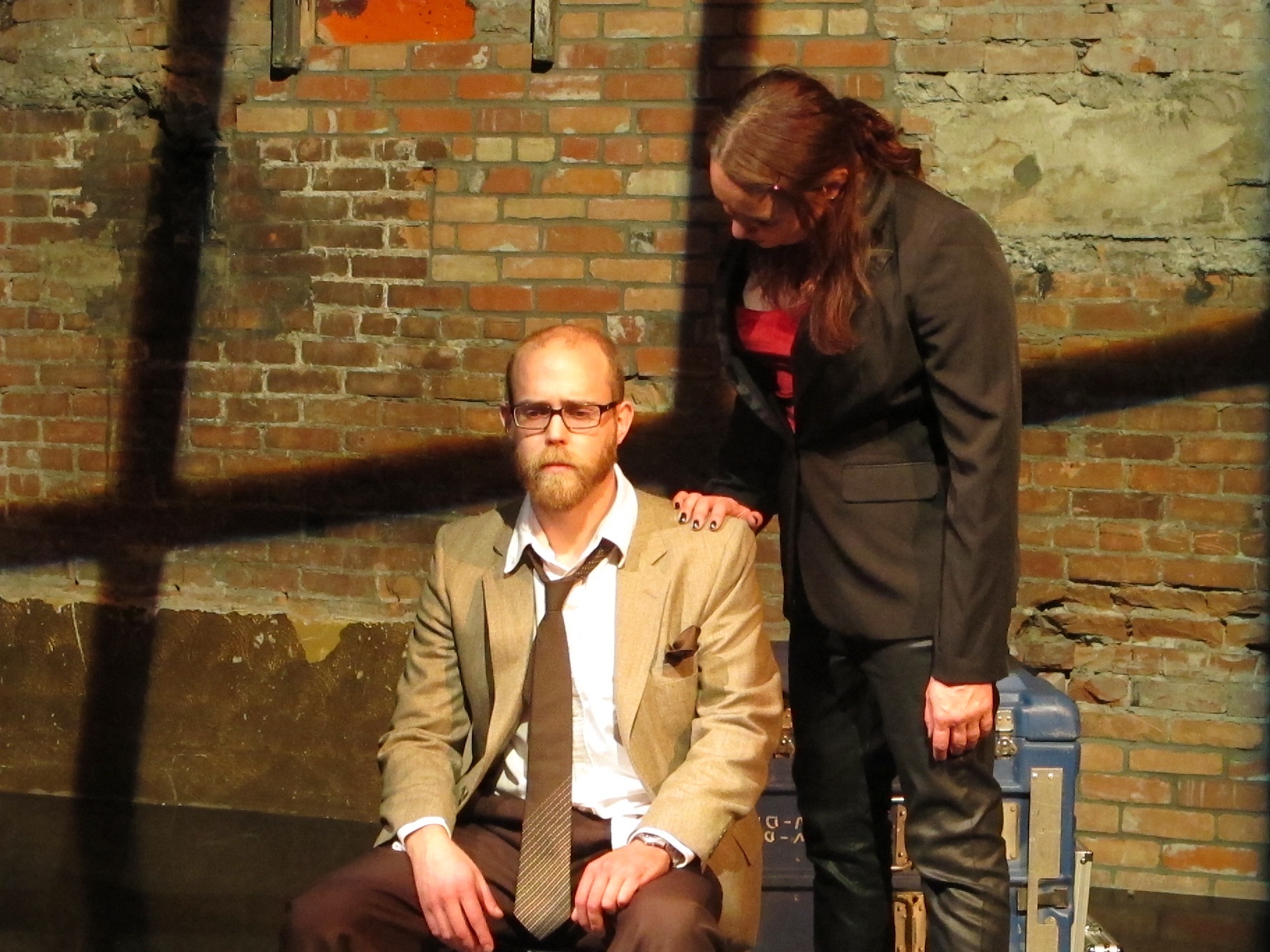
Paul Sutherland as Max and Laryssa Yanchak as Sylvie


Pink Sugar

September 25 – 29, 2012

Theatre Junction Studio

https://tickets.theatrejunction.com/TheatreManager/1/login&event=0


I had initially decided against seeing and reviewing Pink Sugar. Not because the play didn’t interest me, but because my schedule only allowed for one play this week and a highly recommended production of The Shakespeare Company’s Hamlet won that slot. Decision made, end of story. Or so I thought.

But yesterday I got an email message from Pink Sugar’s playwright urging me to reconsider my choice:

“Come See Pink Sugar! I remember reading a review from you here where you were wishing that a show that dealt with human trafficking would have dug in a bit deeper…. Pink Sugar is really an attempt to do this. Shakespeare is dead and unlikely to benefit from the critical exchange. Seriously, if you can squeeze it in would love to hear your thoughts.

Natalie Meisner (the writer)”

Apart from making me laugh, Ms. Meisner’s comments cleverly threw my own theatre criticism back at me. She was right; I had been disappointed by a recent human trafficking play and was looking for a better treatment of the subject.  So the claim that her story was superior and the invitation to see and provide feedback was just too tempting. Squeeze it in I did.

Meisner was certainly right, Pink Sugar does dig deeper and provide the more complex and nuanced examination of human trafficking that I was hoping for. It does this however through a deeply uneven narrative that unnecessarily mixes genres, relies at times on gimmick and doesn’t know when to end.

The story is told through a series of four interwoven monologues that occasionally cross paths to form two-character dialogue. Spencer is a Canadian 20-something who takes a post-graduation trip to a World Cup match in a foreign country that either I failed to catch or wasn’t mentioned. At the match he spots Elan, an enticing Moldavian girl who quickly seduces him and whisks him away to countless countries under the haze of the drugs she feeds him in order to eventually steal his kidney.  Providing the counterbalance to this story is Max, a 40-something looser in life dialysis patient driven by desperation and lack of other options to illegally purchase a new kidney. Sylvie, a high stakes dealer in all things illegal from weapons to drugs to people to people’s parts provides the means for Max’s purchase.

All four characters populate the stage throughout the play as they each take turns telling their part in the organ trafficking and the backstory of how they came to be involved. It could have been a smart and powerful way to get at this intricate, nefarious and emotional issue. And in the case of three of the characters it was.

Sylvia Niederberger as Elan not only nailed her accent with precision and authenticity, her haunting delivery of a woman so broken by psychological and physical trauma and terror was flawless.  Meisner’s writing of this character as a villain/victim beautifully highlighted shades of gray, the grit of the issue and provided some hard truths to absorb.

Laryssa Yanchak as Sylvie, the hard as nails contraband dealer, also delivered a strong performance and pulled as much believability out of this over the top role as she could. In another actor’s hands Sylvie could have been dominatrix-like or even campy, but Yanchak found the subtleties in Meisner’s not too subtle writing of this character and rounded just enough edges to make her darkly and disturbingly compelling.

But for me, the standout was Paul Sutherland as Max. His ability to simultaneously play his character’s backstory and present day reality in a quiet elegant whirlwind of tension and emotion was magic to behold. Whether playing his character drunk or scared or bitter, Sutherland moved effortlessly inside Max and presented us with a performance that penetrated far beyond the role he was playing.

Unfortunately when it came to Spencer, things fell apart on all levels. Far from the interesting yet troubled realities of his co-characters, Spencer is one-dimensional, weirdly sarcastic and without authentic motivation. I didn’t believe his instant love for Elan or his somewhat comedic suffering post-surgery and I had to hold back gags when despite everything he still says he wants Elan back. Making matters worse was Kyall Rakoz’s performance. William Shaterner-esque in his cadence, Rakoz came across as smarmy and cardboard as though he himself didn’t believe the lines he was delivering.

If Meisner was trying to infuse some levity and dark humour with Spencer’s character, she blew the flippancy top off with Spencer’s kidney. Projected on a screen as a crudely drawn cartoon character, the animated kidney shows up three times throughout the show to sling dark jokes about the organ trade and the value we place on life. I’m the first person to applaud black humour, but in this case, the kidney wasn’t all that funny or interesting and it felt like I was watching Meisner’s conceit rather than an integral part of the performance.  More importantly, the jarring juxtaposition of the serious and disturbing narrative of Elan, Sylvie and Max against the barely amusing kidney cartoon felt extremely disjointed. Meisner would have been far wiser to make the kidney a more sinister and dark character and leave the gimmicky yuks for another time.

Directed with economy that was simple yet visually interesting, Jason Mehmel does a nice job allowing each character room to tell their stories.  But even his sure-footed staging can’t stop the play from rambling at the end, way overshooting the high note it could have gone out on. Instead we get silly resolutions to some characters and just too much dialogue from others. This is too bad as there was a moment about ten minutes from the close of the play where Max calls for one last drink that I think would have been a superb and dramatic final line.

I think given time I will mostly remember the good of this production due to the fantastic performances of three talented actors and some intelligent writing by Meisner. But for now I can’t help feeling the frustration of seeing another yet play about human trafficking that didn’t hit the mark.


RATING

For the guys and girls – Some very good insights into the issue of human and organ trafficking delivered by some excellent performers. But the play itself is lacking the weight of its subject. MAYBE SEE IT

For the occasional theater goer – Way too alternative and nonlinear for your liking. Neither successfully serious nor laughably funny, this play will lose you right from the start. SKIP IT

For the theatre junkie – What works well, works really well and the parts that don’t are bearable. Especially when you consider Sutherland’s outstanding performance. MAYBE SEE IT

Back at it

Forgive my absence over the past two weeks, but even declared theatre junkies need a vacation once in a while. Mine came in the form of lions and leopards and elephants all courtesy of the remarkable and beautiful country of Kenya. Sadly the safari is over, I survived the 22 hour flight home yesterday and once I shake the jet lag I’ll be back to reviewing as usual.

There were four plays that I missed being out-of-town and all four are coming to a close this weekend or shortly after. Between taking a day or two to recalibrate and getting ready for the next round of productions, I decided that I only had the bandwidth to see one of them. My choices were, Double Indemnity at Vertigo Theatre, Pink Sugar at Theatre Junction GRAND, A Steady Rain at EPCOR Centre’s Motel or Hamlet also at Vertigo Theatre.

I saw A Steady Rain in New York with Daniel Craig and Hugh Jackman a couple of years ago and while both actors did a fine job, I wasn’t a big fan of the play. I found it to be wordy without necessarily being interesting and infused with shock value more for the sake of  sensationalism than a compelling story arc. Ok , so that was out.

Double indemnity, to be frank, just didn’t interest me all that much no matter how gorgeous I hear the set design is. With Terry Gunvordahl as the designer I have no doubt that the stage looks spectacular. But I need more than that – so pass on that one.

So it came down to a play I know very well to one I haven’t seen before – the famous story of a troubled Prince or a play about stolen body parts. And while I wish I could see both Pink Sugar and Hamlet, I’ve decided that Hamlet it is. Mostly because of the onslaught of emails I received from sources I trust telling me it is a must see on several fronts and also because I’m a fan of The Shakespeare Company’s work and am eager to see their first production with Haysam Kadri as Artistic Producer and director.

Yes, I am having guilt pangs at missing Pink Sugar. And given the right circumstances MIGHT be talked into squeezing it in. But I’ll need your help with that. Please, if you see it and feel it is something I should catch, drop me a line and let me know. Unfortunately I won’t be able to offer up full reviews for either production because of timing issues, but every show I see does become eligible for our annual Calgary Critics’ Awards.

Look forward to your thoughts and see you in the theatre!


Next to Normal – Review

(l to r) Robert Markus as Gabe, Kathryn Akin as Diana, John Ullyatt as Dr. Madden in NEXT TO NORMAL.  Photo by Trudie Lee.

 Next to Normal

Sept 11 to 30, 2012

Max Bell Theatre

http://theatrecalgary.com/plays/next_to_normal/more_info/

Listen to my live review on CBC Eyeopener on Monday September 16th http://www.cbc.ca/eyeopener/


I might as well just come out and say it. I am so proud of Theater Calgary for starting their season off with Next to Normal. It’s a thoroughly modern, unique and risky production and I heartily applaud their gutsy decision to bring this little known (in Calgary), but critically acclaimed huge Broadway hit to their stage. I believe Calgary audiences are sophisticated and curious enough to embrace this kind of intelligent and entertaining programming and not just settle for the same old rehashes of “safe” plays. Yes CATS and Shirley Valentine and To Kill A Mockingbird…. I mean you!

OK, soapbox put away. Let’s get to the business of reviewing.

Next to Normal opened on Broadway in 2009, was nominated for 11 Tony Awards and won three including Best Original Score. Perhaps even more importantly, it won the 2010 Pulitzer Prize for Drama, becoming just the 8th musical in history to receive that honour.  (Two other such honorees you may know of being Rent and A Chorus Line.)

The story centers on the Goodmans, a seemingly normal family that is being slowly torn apart by the fact that Diana, the mother, has been suffering from bipolar disorder for the past sixteen years. Also called manic depression, bipolar condition is a mood disorder that results in serious, even drastic changes in personality alternating between highs (mania) and lows (depression). The family has pretty much learned to take it day by day with Diana as they never really know which side of her they’re going to get. Even more upsetting is that despite all the pills and the therapy Diana is getting no better and is perhaps even worse. As the musical opens, we witness Diana’s latest mental crises and the story chronicles her attempts to get better, this time through some pretty extreme types of treatment. In addition to Diana’s struggle, the musical presents a refreshingly realistic look at the effects of bipolar disorder on the family and how each of them is affected and compromised as a result of the illness.

With a subject like this, Next to Normal could have easily been a heavy dramatic play. But what makes this such an interesting production is that Tom Kitt who wrote the music and Brian Yorkey who did the book and lyrics decided to tell this story in short, flashcard type scenes using rock music and singing that pretty much populates the entire performance.

The music comprises mainly of electric guitar and bass with a lot of heavy drum beats and occasional softer rock ballad type numbers that use acoustic instruments for effect. None of the tunes are particularly memorable or hummable but in this musical that’s okay, it’s the lyrics that count. Concise and clear, clever and intellectual, emotional and raw, the lyrics to the songbook of Next to Normal carry the story and bring it to life for us. When Diana, dulled by the medication she’s taking, longs for an end to the fog, she sings a number called I Miss the Mountains about wanting to be able to feel the highs and lows of life again.  It’s a beautifully articulated number that elicits the kind of sympathy and understanding mere dialogue wouldn’t  be able to create.

Another song, this time sung by Diana’s daughter Natalie, called Superboy and the Invisible Girl, powerfully illustrates her feelings of neglect and abandonment because of her mom’s situation. Again it’s raw and real and the lyrics tug at you without an ounce of drippy sentiment.

Sound, however was a big issue in the performance I saw.  With a sound mix that saw the music thoroughly overpowering the singing on almost all counts, I found myself either straining furiously trying to hear the lyrics or simply not being able to hear the words at all. It was a frustrating and headache-inducing experience that I’m sincerely hoping they quickly resolve as this is a show where you don’t want to miss a word.

Especially since they are sung by some impressively strong performers. Kathryn Akin as Diana delivered a performance with flawless tonal and emotional accuracy. She gracefully imbued her character with intelligence, humour and a believably fragile mental state.  Akin’s duality of a strong yet subtle at times singing voice brought lovely nuances to this complex character. Sara Farb as Natalie, the daughter was stunning in her frustration and pain communicated through strong and emotional singing. Robert Markus as Gabe, the son, plays a pivotal and surprising role in the musical (no spoilers in this review) and was without a doubt the strongest and most compelling voice on stage. A surprise standout for me was Michael Cox in his supporting role as Henry, Natalie’s boyfriend.  Natural in his acting and captivatingly sweet in his singing, Cox was a small gem of a performance to watch.

I wish I could praise the cast as a whole, but there was one disappointing weak link for me. Rejean Cournoyer as Dan, the father, lacked any real chemistry with the other cast members and his somewhat stiff and forced performance made it seem as though he was uncomfortable in the role. To add insult to injury, his voice while passable, just didn’t seem up to the demands of this production. It wasn’t a tragic turn by any stretch, but with such a good cast around him, Cournoyer seemed lacking.

Rounding out the production were Cory Sincennes’  simple and stripped down set designs composed of steel girder-like structures supporting two catwalks, turning the stage into a  three-storey structure for the actors to populate.  Chairs and tables were wheeled in and out when needed, but the effect was distinctly bare with dark lighting and ethereal rain effects in the background. Minimal sets don’t always succeed or enhance a production, but in this case I think the choice worked. Perhaps a kind of a metaphor for the dark and stark emotions the entire family is feeling or at the very least providing no distraction from the powerful emotions being communicated in the show, the unadorned set was something I was actually grateful for.

If there is one final thing to be appreciative of in this production, it’s Ron Jenkin’s sure handed direction.  An immense talent, Jenkins once again populates his stage with visually interesting movement and some tremendously courageous performances. Whether the scene was dark and upsetting or lighter and even humorous, Jenkins never over-wrings the emotion out of the script and instead trusts in his audiences’ acumen to connect strongly with the action.

Next to Normal is a roller coaster of a story where nothing is neatly solved or even solved at all. Dubbed an anti-musical by some, there is most definitely no light and breezy ‘Surrey with a fringe on top’ kinda number. And while I certainly don’t think that every musical should aspire to this type of production, I really respect the story Next to Normal tells and how they tell it. It is utterly unique to see a musical tackle real, messy, disturbing situations and present it an entertaining but also thought-provoking kind of show. A show that doesn’t talk down to its audience or try to heavy handedly teach us something about mental illness. Next to Normal present the reality and then lets its audience sit and think about it. This is definitely the kind of theatre I embrace and if Calgarians are willing to try something new, I think they’ll feel as excited by this production as I am.

RATING

For the guys – Don’t let a bipolar female character scare you away. Mental illness knows no gender and neither does this story. The issues and emotions will affect you deeply as you find ways to relate to each of the characters in this show. SEE IT

For the girls – No ‘crazy lady’ stereotypes here. The women in Next to Normal are treated with respect and offer up remarkably realistic portraits of emotion and frustration and even moments of joy. SEE IT

For the occasional theatre goer – Probably not the feel good musical that you gravitate towards and this may be too modern and alternative for you. But if you want to stretch yourself and see what a musical about real life problems is like, this is the one to go to. MAYBE SEE IT

For the theatre junkie – It’s an important and compelling show to add to your cannon and happily, Theatre Calgary presents a performance worthy of all the accolades. SEE IT

The Bob Shivery Show – Review

Esther Purves-Smith as Germaine, David LeReaney as Frank, Trevor Rueger as Bob Shivery and Karen Johnson-Diamond as Corporal Blunt in The Bob Shivery Show by David Sealy, directed by Michael Kennard. Photo by Benjamin Laird.

The Bob Shivery Show

September 10 – 29, 2012

Lunchbox Theatre

http://www.lunchboxtheatre.com/the-bob-shivery-show.html

Listen to my review on CBC’s Eyeopener at http://www.cbc.ca/eyeopener/columnists/theatre/2012/09/11/jessica-goldman-reviews-the-bob-shivery-show/

Lunchbox Theatre kicked off their 2012/13 offerings with the world premiere of David Sealy’s The Bob Shivery Show, a comedy about one man’s journey to win back the girl he loves.  It’s only the second play I’ve seen this season and I’m already willing to bet that it’ll be the worst show I will see all year. Or at least I’m hoping it will be, because frankly I won’t be able to take many more like it.

Not witty enough to be interesting, not slapsticky enough to be funny, the play’s dialogue and characters are terribly one-dimensional (sometimes even half dimensional if there is such a thing), the set design is pathetically ugly, the performances weak and the gimmicks so poorly conceived that I truly have nothing positive to say.

Unfortunately being a critic, I can’t abide by the old adage of saying nothing when the saying will be unkind. Instead I will do my best to explain.

The story is essentially a poor man’s comedic riff on the famous German Faust legend in which a man signs a contract with the Devil to get what he otherwise can’t have. In this case Bob Shivery is a nerdy Saskatchewan postal worker in love with Germaine, a mousey public school principal. We have no idea how they met, why they are friends or even what Bob sees in Germaine, yet we expected to believe that he is desperately in love, but too afraid to tell her. Cue obvious fawning and awkward body language.

Two minutes into the play Germaine tells Bob that she’s met someone in Calgary – a big shot lawyer working for an oil company (and by the way we’re all supposed to find this hilarious in a ‘poke fun at Calgary’ kinda way). Germaine announces that she is moving to Calgary to live with the lawyer for a bit before she decides whether or not to accept his marriage proposal. Bob is devastated, but still inert – until he meets Frank, a flashy insurance salesman who offers him a contract where he can get whatever he wants, even Germaine, for an undisclosed price to be named at a later date. Bob resists the agent, who he outs as the Devil right away, or at the very least an agent of hell, and decides to chase after Germaine all on his own. With Frank following him and tempting him every step of the way, Bob encounters several ridiculous and tiresome scenarios until he finally finds Germaine.

As if this wasn’t bad enough, throughout the show are two recurring gimmicks that were at once out-of-place and unnecessary. The less egregious of the two was the game show voice-over treatment that popped up every time a scene change was going on. Modelled after the “This is your Life” type of bio snippets, the voice would espouse updates on Bob’s progress with catch phrases to no great effect. In fact, other than the title of the play which is obviously game-showish in its wording, I have no idea what the point of this effect was. It didn’t add or enhance anything in the script and as far as I can tell is just an excuse to use the disco ball and distract the audience from the sloppy scene changes.

The other ploy was to give voice to Germaine’s cat Snowy via a hand puppet with a French accent. Several times in the play, Snowy speaks to Bob encouraging him to go after Germaine and tell her how he feels. I’m sure it was meant to be hilarious, but my feeling is that if you need to rely on an anthropomorphic kitty to get laughs, maybe you should rethink your script.

Here’s what really boggles my mind about this play, it’s been workshopped twice already in Calgary at Lunchbox’s Stage One Festival in 2010 and 2012. What that means is that The Bob Shivery Show was seen and worked on by professional directors, actors, writers and even had public feedback sessions and yet it’s STILL this bad. I cringe to think what Sealy’s script was like before it was helped along. Not to mention the fact that thousands of dollars have been spent developing this show – money that in my opinion could have been put toward a much more worthy production.

I have great pity for actors who find themselves in less than stellar plays. I often feel embarrassed for them as they try to make some good out of a bad script. But in this case, I felt that for the most part, the performances were as weak as the play itself. Trevor Rueger plays Bob, or should I say shouts Bob. Lunchbox is not that big a theatre and I have no idea why Rueger felt the need to bellow his lines like he was performing at Lincoln Centre. Perhaps it was to make up for his inability to bring any warmth or humanness to his mechanical character. Karen Johnson Diamond, playing a painfully unfunny police officer, took on most of the physical humour but played it heavy-handed and just too overly broad to be considered humorous or decent acting. Part of the blame for this must go to Director Michael Kennard of Mump & Smoot fame, who let his actors flail around gracelessly and stiffly from one scene to the next sucking any possible humour out of the experience. Fairing a bit better was David LeReaney as Frank the insurance salesman/Devil character and Esther Purves-Smith as Germaine. Both actors had some success at not falling into the clichéd trap of the dialogue and at least delivered performances that didn’t make me wince.

When it came to the set, the issue was the opposite from the script. Whereas the dialogue was over the top and laden with loud and obvious jokes, Scott Reid’s set was stark and cold and just plain ugly.  I have no issue with a propless set. For some shows it adds tremendous drama and tension to the performance. But with bare walls, and one or two unremarkable props in each scene, it felt cheap and unfinished and not befitting a professional theatre company at all.

Do I have ideas on how to make this play better? Sure, I guess. But rather than rework the tired old contract with the Devil, love the girl but afraid to tell her tropes, I would much rather spend my time seeing new and interesting stories that take a risk and offer up a unique theatre experience. The Bob Shivery Show, no matter how many time you workshop it, will never be that show.

RATING

For everyone – I disliked this play so much that I simply can’t bring myself to spend time thinking about why each of you shouldn’t go. SKIP IT

Sexy Laundry – Review

Sexy Laundry

September 5th – November 4th, 2012

Stage West

http://www.stagewestcalgary.com/shows.html

Listen to my review from this morning on CBC Eyeopener http://www.cbc.ca/eyeopener/columnists/theatre/2012/09/06/jessica-goldman—sexy-laundry/


You know those obvious but mildly amusing PG-rated risqué jokes that you can tell your grandparents without feeling embarrassed? Well expand that joke into a one-act, two-hander comedy about a married couple trying to put the spice back into their relationship and you have the play Sexy Laundry.

The show, written by Canadian playwright Michelle Riml, was first performed at the Vancouver Fringe Festival in 2002 and has  gone on to become something of a world-wide phenomenon in the light comedy circuit. To date, Sexy Laundry has been performed not just across Canada, but also in the US, Britain, South Africa and Germany with several translations pushing  the wide appeal of the play.

The show opens with Alice and Henry, a married couple of 25 years, in a room at the L Hotel, the latest, hottest, trendy, expensive hotel in town. Alice has rented the hotel room for the weekend so that she and Henry can spend some time trying to spice up their relationship and bring romance and passion back into their marriage. You see, Alice is pretty dissatisfied with the way things are going and Henry is pretty dissatisfied with Alice’s nagging him to change all the time. Cue standard comic fodder.

The added amusing catalyst to the story is that Alice has brought along a Sex for Dummies manual in the hopes that the book’s exercises will help the couple become more connected sexually. Alice and Henry make half-hearted attempts at activities such as  ‘share your fantasy’ or ‘give nicknames to your partner’s sexual body parts’,  but instead of getting closer and more intimate, the couple spend most of the time fighting about their relationship and what is missing from the marriage. Possibly to the point of a breakup.

So we watch as the obvious lines, arguments and punch lines get thrown around and occasionally they are amusing, as when after hearing Alice’s threesome fantasy Henry says he wishes she fantasized about some more normal like meadows and white knights. Alice responds with “I think you are confusing my fantasies with a Maxi-pad commercial!” Cute enough.  Sometimes the writing is even surprisingly insightful on the gender divide and the problems that arise when a marriage goes stale, as when Henry complains that he signed up for a weekend of passion and all he’s got is Alice complaining about everything he does. “I am who I am, Alice”, he says. “No you are not Henry”, says Alice. “You are a shadow of who you used to be”.  Nice line I thought.

But other than these few little lovely moments, the script lurches from one clichéd joke to another with comedic writing that personifies a ‘been there done that’ experience. Sure they get the easy giggles from audience members who like to see the same old dynamics played out on the stage, but frankly I was bored and ached for a more inventive and surprising way of telling this story.

So I suppose I can’t completely fault ex Falcon Crest star, William Remington Moses for his fine but not great performance.  Moses plays Henry, a straight-laced, mildly successful, frugal engineer who just wants to come home, watch the news and not be bothered with talking about feelings or worrying about intimacy issues. Not a bad guy, just a middle-aged man who loves his wife and doesn’t want to think too much about it. On top of the mostly banal writing, Henry is not a particularly interesting role to play –  a fairly obvious kind of character who is dramatized for his quirks rather than as a full character. Without much to work with, Moses does a fine job, however I found him a little too unmodulated in his emotional range at times. In his hands, Henry seems the same whether he’s mad or surprised or upset and it further dilutes his already dull character. But the sameness wasn’t intolerably glaring and Moses did manage to bring a nice ease to the role that at least made Henry somewhat believable and made the clichéd lines bearable to watch.

Ease however is not how I would describe Jane Spidell’s acting. Alice’s character is the one that gets all the personality and all the funny lines and it should be a role an actor has fun with. Spidell was caught up in trying so hard to “Capital A” act this part that she felt forced and stiff and pretty much undercut any chemistry the couple had on stage.  However, just as I was going to write Spidell off completely, she delivered a monologue about three-quarters into the play about going back to the gym for the first time in years – and she did a great job. She was funny, and relaxed and well-timed and brought a much-needed spark to the production. That’s when I realized, Spidell was fun to watch when she was delivering solo lines but the minute she had to interact with Moses, she lost it again. I’m not sure what that says about her as an actress or maybe the casting choice of putting these two together, but regardless of the reason, Spidell’s Alice was mostly lacking.

Also lacking was Sean D. Ellis’ swanky hotel room set which was anything but swanky. More Ramada Inn than Ritz Carlton, the room was decorated in hues of brown and orange (hello 1970’s!) and not in a retro cool kinda way either. In what I suppose was an attempt at minimalist chic came off as cheap and dingy which would have been fine, but for the big fuss the script makes about how chic the L Hotel is.

Director J. Sean Elliot does an acceptable job moving his two-hander show around the stage with enough diversity to keep the action interesting. However I wish he’d been more succinct with some of the more physical gags instead of letting them drag on to the point of way past funny. In particular, the scene near the end of the play where Alice brings out all the stops to seduce her husband milked the joke so hard I was literally cringing and looking at my watch.

So no, Sexy Laundry is not the type of theatre that turns me on. That said, I can’t say I completely hated it. Even with all the many faults, the show does have its charms and some of the insights into male/female relationships are well presented. To be fair, there was plenty of giggling going on around me, so I believe most of the Stage West audience were amused by it even if I wasn’t. For me, the most ringing endorsement I can muster is to say it was a passably fine light night in the theatre.


RATING 

For the guys – Lots of jokes about nagging wives and the impossible pressures they put on men. But nothing you haven’t heard before, told better. MAYBE SEE IT

For the gals – Lots of jokes about unromantic husbands and how hard it is to be a middle-aged woman. But nothing that you haven’t heard before, told better. MAYBE SEE IT

For the occasional theatre goer – Familiar comic territory that delivers exactly what you expect it done well enough. SEE IT

For the theatre junkies – Nothing for you here. Move along. SKIP IT